Product Design, Manufacturing & Innovation Resources
Home » MTT Assay for Measuring Cell Viability

MTT Assay for Measuring Cell Viability

1983
  • Tim Mosmann
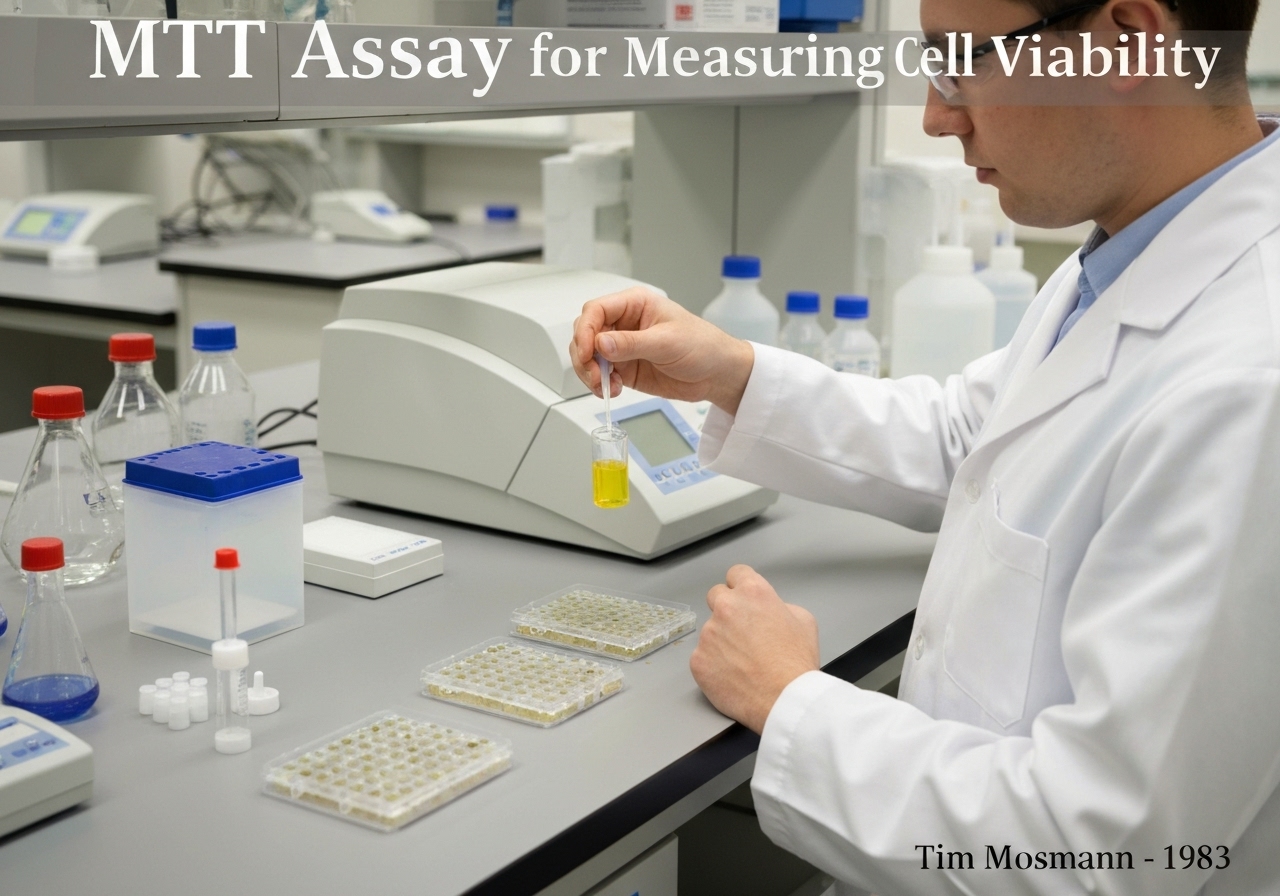
Scientist performing MTT assay in a cell biology laboratory for assessing cell viability.

(generated image for illustration only)

The MTT assay is a colorimetric method for assessing cell metabolic activity, which serves as a proxy for cell viability, proliferation, and cytotoxicity. Viable cells with active mitochondria contain reductase enzymes that convert the yellow tetrazolium salt MTT (3-(4,5-dimethylthiazol-2-yl)-2,5-diphenyltetrazolium bromide) into an insoluble purple formazan. The amount of formazan produced is proportional to the number of living cells.
The MTT assay, first described by Tim Mosmann in 1983, revolutionized the way researchers quantify cellular responses in vitro. It provided a faster, more quantitative, and less radioactive alternative to previous methods like the chromium-release assay. The principle is based on the activity of mitochondrial dehydrogenases in living cells. These enzymes are part of the electron transport chain and are only active in metabolically functioning cells.


In the procedure, the water-soluble yellow MTT reagent is added to cells in a culture plate. It is taken up by the cells and reduced by mitochondrial enzymes into formazan, which is an insoluble, purple, crystalline product. The formazan crystals accumulate within the cells. After an incubation period, a solubilizing agent, such as dimethyl sulfoxide (DMSO) or an acidified alcohol solution, is added to dissolve these crystals, resulting in a colored solution. The absorbance of this purple solution is then measured using a spectrophotometer at a specific wavelength (typically between 500 and 600 nm). The intensity of the color is directly proportional to the number of metabolically active, and therefore viable, cells. By comparing the absorbance of treated cells to untreated control cells, one can calculate the percentage of cytotoxicity or inhibition of proliferation caused by the test compound.

UNESCO Nomenclature: 2406
– Biology of the cell

Type

Medical Procedure

Disruption

Substantial

Usage

Widespread Use

Precursors

  • development of cell culture techniques
  • understanding of mitochondrial respiration and the electron transport chain
  • invention of the spectrophotometer
  • use of tetrazolium salts as redox indicators in histology
  • need for a quantitative, non-radioactive cell viability assay

Applications

  • drug screening for cytotoxic effects in cancer research
  • toxicology testing of chemicals
  • assessing cell proliferation in response to growth factors
  • high-throughput screening in drug discovery
  • biocompatibility testing of materials

Patents:

NA

Potential Innovations Ideas

  • automated robotic systems for ultra-high-throughput mtt screening
  • development of similar, but water-soluble formazan assays (mts, xxt, wst-1) to simplify the protocol
  • multiplexing mtt assays with other assays (e.g., for apoptosis) in the same well
  • adaptation of the mtt assay for 3d cell cultures and organoids
  • microfluidic devices incorporating mtt-based viability checks
  • using mtt assays to screen for compounds that enhance mitochondrial function
  • developing mtt-based kits for home water toxicity testing
  • integrating mtt readouts into ai-driven drug discovery platforms
  • using modified mtt reagents that emit fluorescence instead of color for higher sensitivity
  • adapting the assay to measure bacterial viability and antibiotic susceptibility
Related to: MTT assay, cytotoxicity assay, cell viability, colorimetric assay, formazan, mitochondrial activity, toxicology, drug screening, high-throughput screening, spectrophotometry.

Historical Context

MTT Assay for Measuring Cell Viability

1970
1975
1977
1983
1987
1990
1990
1970
1973
1975
1979
1983
1988
1990
1990

(if date is unknown or not relevant, e.g. "fluid mechanics", a rounded estimation of its notable emergence is provided)

10th year anniversary

Full size images and downloads are only available, 100% free, for registered members.

> Login <