Product Design, Manufacturing & Innovation Resources
घर » कोशिका व्यवहार्यता मापने के लिए एमटीटी परख

कोशिका व्यवहार्यता मापने के लिए एमटीटी परख

1983
  • Tim Mosmann
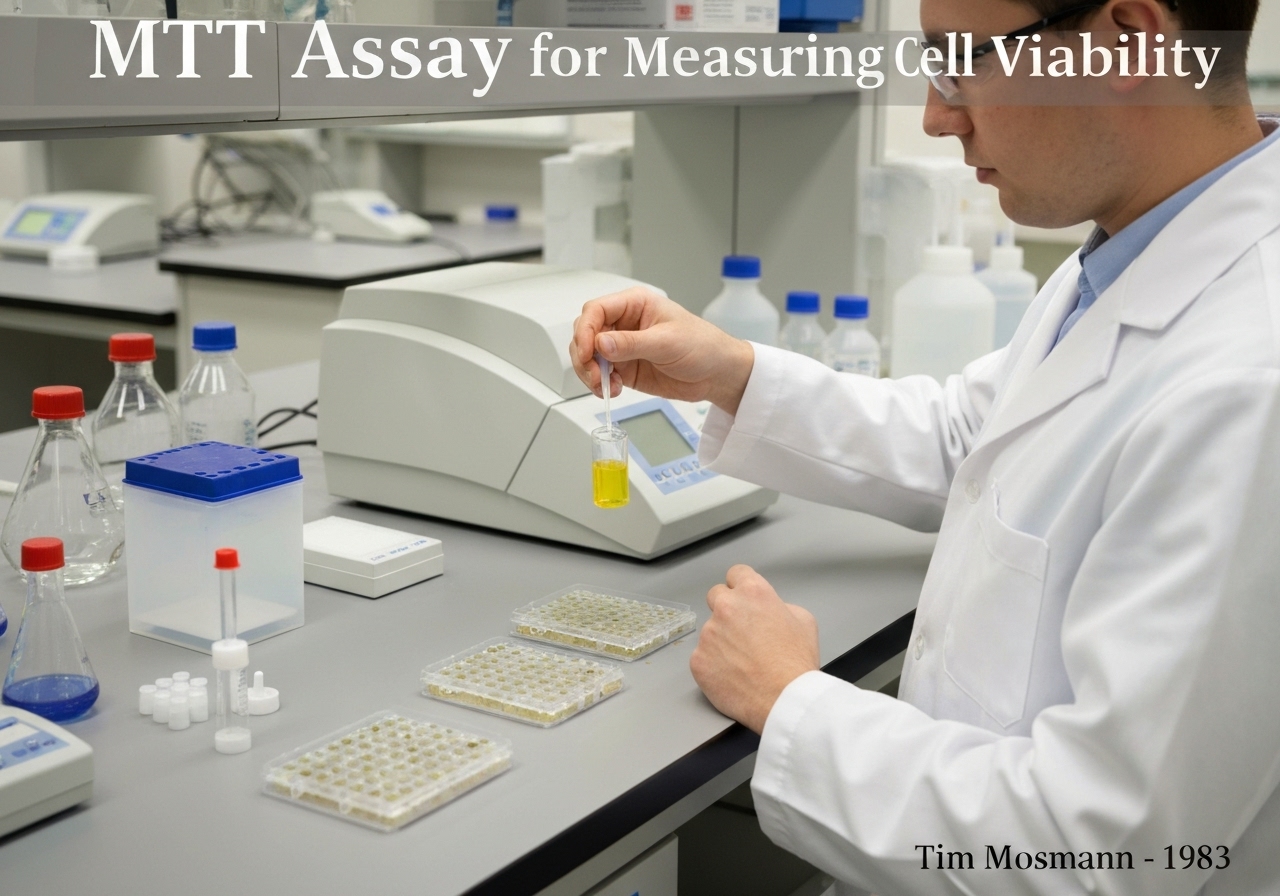
Scientist performing MTT assay in a cell biology laboratory for assessing cell viability.

(यह छवि केवल उदाहरण के लिए बनाई गई है)

The MTT assay is a colorimetric method for assessing cell metabolic activity, which serves as a प्रॉक्सी for cell viability, proliferation, and cytotoxicity. Viable cells with active mitochondria contain reductase enzymes that convert the yellow tetrazolium salt MTT (3-(4,5-dimethylthiazol-2-yl)-2,5-diphenyltetrazolium bromide) into an insoluble purple formazan. The amount of formazan produced is proportional to the number of living cells.
एमटीटी परख, जिसका वर्णन सबसे पहले टिम मोसमैन ने 1983 में किया था, ने शोधकर्ताओं द्वारा इन विट्रो में कोशिकीय प्रतिक्रियाओं को मापने के तरीके में क्रांतिकारी बदलाव लाया। इसने क्रोमियम-रिलीज़ परख जैसी पिछली विधियों की तुलना में एक तेज़, अधिक मात्रात्मक और कम रेडियोधर्मी विकल्प प्रदान किया। इसका सिद्धांत जीवित कोशिकाओं में माइटोकॉन्ड्रियल डीहाइड्रोजिनेस की गतिविधि पर आधारित है। ये एंजाइम इलेक्ट्रॉन परिवहन श्रृंखला का हिस्सा हैं और केवल चयापचय रूप से कार्यशील कोशिकाओं में ही सक्रिय होते हैं।

In the procedure, the water-soluble yellow MTT reagent is added to cells in a culture plate. It is taken up by the cells and reduced by mitochondrial enzymes into formazan, which is an insoluble, purple, crystalline product. The formazan crystals accumulate within the cells. After an incubation period, a solubilizing agent, such as dimethyl sulfoxide (DMSO) or an acidified alcohol solution, is added to dissolve these crystals, resulting in a colored solution. The absorbance of this purple solution is then measured using a spectrophotometer at a specific wavelength (typically between 500 and 600 nm). The intensity of the color is directly proportional to the number of metabolically active, and therefore viable, cells. By comparing the absorbance of treated cells to untreated control cells, one can calculate the percentage of cytotoxicity or inhibition of proliferation caused by the test compound.

UNESCO Nomenclature: 2406
कोशिका जीवविज्ञान

Type

चिकित्सा प्रक्रिया

व्यवधान

संतोषजनक

उपयोग

व्यापक उपयोग

शगुन

  • कोशिका संवर्धन तकनीकों का विकास
  • माइटोकॉन्ड्रियल श्वसन और इलेक्ट्रॉन परिवहन श्रृंखला की समझ
  • स्पेक्ट्रोफोटोमीटर का आविष्कार
  • ऊतकविज्ञान में रेडॉक्स संकेतक के रूप में टेट्राज़ोलियम लवणों का उपयोग
  • एक मात्रात्मक, गैर-रेडियोधर्मी कोशिका व्यवहार्यता परीक्षण की आवश्यकता

आवेदन

  • कैंसर अनुसंधान में साइटोटॉक्सिक प्रभावों के लिए दवा स्क्रीनिंग
  • रसायनों का विष विज्ञान परीक्षण
  • वृद्धि कारकों के प्रति प्रतिक्रिया में कोशिका प्रसार का आकलन करना
  • दवा खोज में उच्च-थ्रूपुट स्क्रीनिंग
  • biocompatibility testing of materials

पेटेंट:

NA

संभावित नवाचार विचार

  • automated robotic systems for ultra-high-throughput mtt screening
  • development of similar, but water-soluble formazan assays (mts, xxt, wst-1) to simplify the protocol
  • multiplexing mtt assays with other assays (e.g., for apoptosis) in the same well
  • adaptation of the mtt assay for 3d cell cultures and organoids
  • microfluidic devices incorporating mtt-based viability checks
  • using mtt assays to screen for compounds that enhance mitochondrial function
  • developing mtt-based kits for home water toxicity testing
  • integrating mtt readouts into ai-driven drug discovery platforms
  • using modified mtt reagents that emit fluorescence instead of color for higher sensitivity
  • adapting the assay to measure bacterial viability and antibiotic susceptibility
संबंधित विषय: एमटीटी परख, साइटोटॉक्सिसिटी परख, कोशिका व्यवहार्यता, कैलोरीमेट्रिक परख, फोरमाज़ान, माइटोकॉन्ड्रियल गतिविधि, विष विज्ञान, दवा स्क्रीनिंग, उच्च-थ्रूपुट स्क्रीनिंग, स्पेक्ट्रोफोटोमेट्री।

ऐतिहासिक संदर्भ

Natural Killer cells in a laboratory setting, examining cytotoxicity mechanisms.

प्राकृतिक हत्यारा (एनके) कोशिका साइटोटॉक्सिसिटी

नेचुरल किलर (एनके) कोशिकाएं जन्मजात प्रतिरक्षा प्रणाली की साइटोटॉक्सिक लिम्फोसाइट्स हैं, जो वायरल संक्रमण और कैंसर के खिलाफ प्रारंभिक रक्षा के लिए महत्वपूर्ण हैं। टी कोशिकाओं के विपरीत, इन्हें पूर्व संवेदीकरण की आवश्यकता नहीं होती है। एनके कोशिकाएं "मिसिंग-सेल्फ" पहचान तंत्र के माध्यम से उन लक्ष्य कोशिकाओं की पहचान करती हैं और उन्हें नष्ट करती हैं जिनमें एमएचसी क्लास I अणु कम हो गए हैं - जो ट्यूमर और वायरस द्वारा अपनाई जाने वाली एक सामान्य प्रतिरक्षा बचाव रणनीति है - और परफोरिन और ग्रैनजाइम के माध्यम से एपोप्टोसिस को प्रेरित करती हैं।

कोशिका व्यवहार्यता मापने के लिए एमटीटी परख

1970
1975
1977
1983
1987
1990
1990
1970
1973
1975
1979
1983
1988
1990
1990

(यदि तिथि अज्ञात है या प्रासंगिक नहीं है, उदाहरण के लिए "द्रव यांत्रिकी", तो इसके उल्लेखनीय उद्भव का एक अनुमानित आंकड़ा प्रदान किया गया है)

नवीनतम परिवर्धन

शीर्ष पोस्ट और लेख

शीर्ष मूल उपकरण

10वां वर्ष सालगिरह

पंजीकृत सदस्यों के लिए पूर्ण आकार की छवियाँ और डाउनलोड 100% निःशुल्क उपलब्ध हैं।