MTT 분석법은 세포 대사 활동을 평가하는 비색법으로, 세포 생존력, 증식 및 세포 독성을 간접적으로 나타내는 지표로 사용됩니다. 활성 미토콘드리아를 가진 생존 세포에는 노란색 테트라졸륨 염인 MTT(3-(4,5-디메틸티아졸-2-일)-2,5-디페닐테트라졸륨 브로마이드)를 불용성 보라색 포르마잔으로 전환하는 환원효소가 존재합니다. 생성된 포르마잔의 양은 생존 세포 수에 비례합니다.
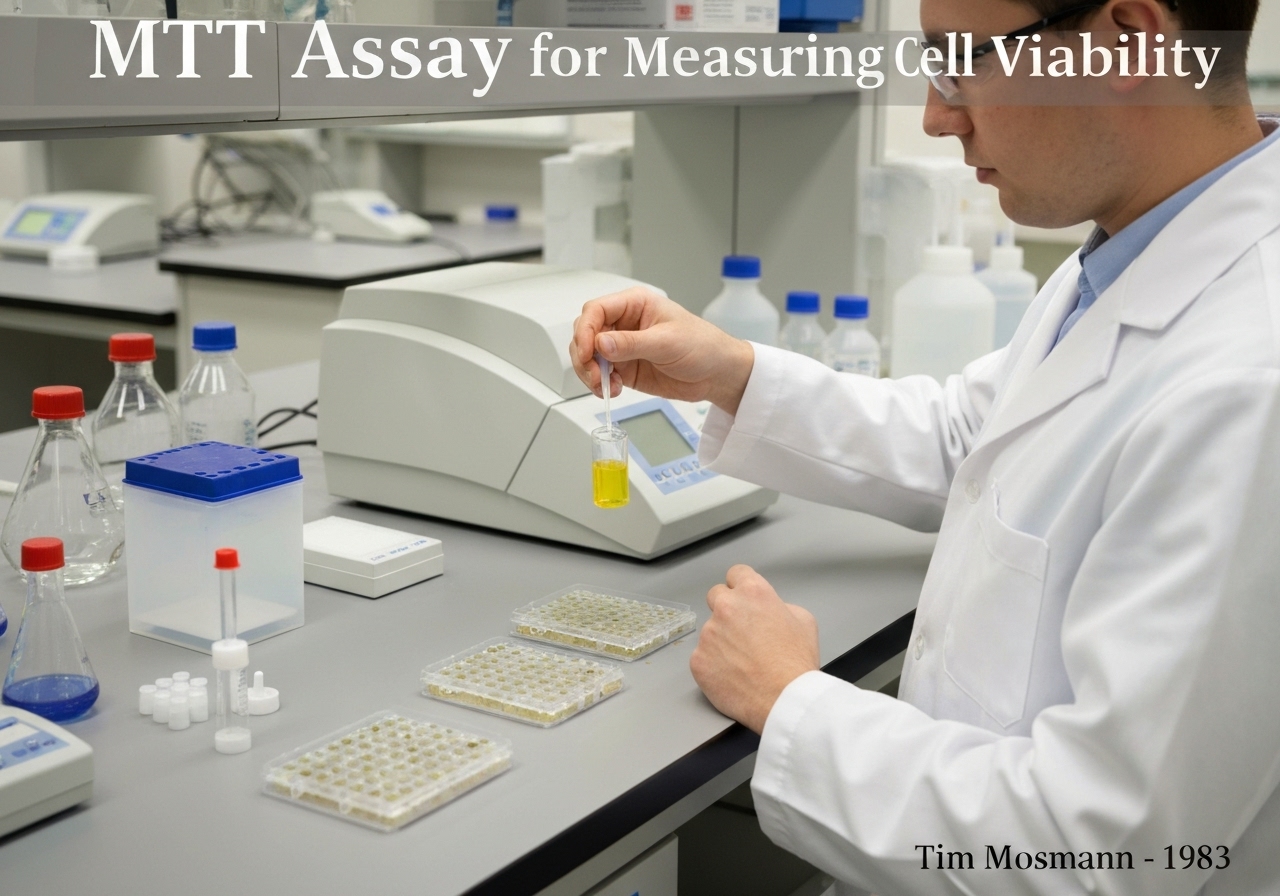
(설명을 위한 생성된 이미지입니다)
MTT 분석법은 세포 대사 활동을 평가하는 비색법으로, 세포 생존력, 증식 및 세포 독성을 간접적으로 나타내는 지표로 사용됩니다. 활성 미토콘드리아를 가진 생존 세포에는 노란색 테트라졸륨 염인 MTT(3-(4,5-디메틸티아졸-2-일)-2,5-디페닐테트라졸륨 브로마이드)를 불용성 보라색 포르마잔으로 전환하는 환원효소가 존재합니다. 생성된 포르마잔의 양은 생존 세포 수에 비례합니다.

1983년 팀 모스만(Tim Mosmann)이 처음 발표한 MTT 분석법은 연구자들이 시험관 내에서 세포 반응을 정량화하는 방식을 혁신적으로 변화시켰습니다. 이 분석법은 크롬 방출 분석법과 같은 기존 방법에 비해 더 빠르고, 더 정량적이며, 방사능 노출도 적은 대안을 제공했습니다. MTT 분석법의 원리는 살아있는 세포 내 미토콘드리아 탈수소효소의 활성에 기반합니다. 이 효소는 전자 전달 사슬의 일부이며, 대사 활동이 활발한 세포에서만 활성화됩니다.
In the procedure, the water-soluble yellow MTT reagent is added to cells in a culture plate. It is taken up by the cells and reduced by mitochondrial enzymes into formazan, which is an insoluble, purple, crystalline product. The formazan crystals accumulate within the cells. After an incubation period, a solubilizing agent, such as dimethyl sulfoxide (DMSO) or an acidified alcohol solution, is added to dissolve these crystals, resulting in a colored solution. The absorbance of this purple solution is then measured using a spectrophotometer at a specific wavelength (typically between 500 and 600 nm). The intensity of the color is directly proportional to the number of metabolically active, and therefore viable, cells. By comparing the absorbance of treated cells to untreated control cells, one can calculate the percentage of 세포독성 or inhibition of proliferation caused by the test compound.
세포 생존율 측정을 위한 MTT 분석법
(날짜를 알 수 없거나 관련이 없는 경우, 예를 들어 "유체역학"의 경우, 주목할 만한 등장 시기를 대략적으로 추정하여 제공합니다.)

고화질 이미지 및 다운로드는 등록된 회원에게만 100% 무료로 제공됩니다.
> 로그인 <