
Home / Product Design / Innovation Frameworks
Innovation Frameworks and Methods for Engineers
Innovation frameworks and methods give structure to creative work. This page covers idea generation techniques, creative problem solving, an innovation frameworks comparison and engineering innovation methods, from design thinking vs TRIZ to stage gate vs Scrum, sorted by the goal you have.

Search guides, methods, tools and standards
Type a topic, a material, a standard or a tool name. Results appear below the search box.
Try search: TRIZ, design thinking, stage gate, technology push, brainstorming, scrum
Language
Loading…
Categories
Loading…
What do you need to do?
Pick a task. Each card jumps to the matching section of this page.
Generate ideas
Brainstorming, SCAMPER, Six Thinking Hats, mind maps and AI prompts.
Resolve a technical contradiction
TRIZ, the 40 inventive principles and the ideal final result.
Choose between ideas
Impact-effort and Pugh matrices, MoSCoW, Delphi and concept tests.
Run the project
Phase-gate, Scrum, kanban, design sprints and prototyping.
Assess maturity and timing
TRL, technology roadmaps, S-curves and disruption.
Build an innovation culture
Hackathons, co-creation, jugaad and the habits that block ideas.
Pick a framework
Nine frameworks in one table, with the question each answers.
Get a quick answer
TRIZ versus brainstorming, SCAMPER, TRL, phase-gate and Scrum.
Where to begin
New to innovation
Stuck on a design problem
From idea to market
New to innovation
- Design Thinking: a human-centered process from user insight to prototype and test.
- Brainstorming: generate many ideas quickly in a group, without early judgment.
- SCAMPER: prompt changes to an existing product: substitute, combine, adapt, modify, put to other use, eliminate, reverse.
- TRIZ (Theory of Inventive Problem Solving): a systematic method for inventive problems, built from patterns in patents.
- Easy 3 Gold Nuggets for Innovation: treat customer feedback, product failure reports and complaints as sources of innovation in product design.
Stuck on a design problem
- Best 40 TRIZ Principles to Boost Your Design Challenges: the 40 TRIZ principles to resolve design contradictions and feed brainstorming sessions, with a short recap of the TRIZ methodology.
- Ideal Final Result (IFR): the TRIZ concept of the perfect solution independent of current constraints, as in self-healing materials.
- Morphological Analysis: combine the options for each design parameter systematically.
- Biomimicry: solving human problems by copying nature's proven strategies, with examples such as Velcro from burrs and Sharklet surface textures.
- Lateral Thinking: break habitual patterns to reach unexpected solutions.
From idea to market
- Innovation.world’s Concept Explorer™: concept Explorer, the site's visual tool to browse concepts and linguistic connections.
- Weighted MVP Features Prioritizer™: free tool to list, categorize and prioritize the features of a minimum viable product, with a visual matrix: quick wins.
- Technological Readiness Levels (TRL): definition, scoring in project management and company planning, limitations and considerations.
- The Phase-Gate project model: phases 0 to 4, from market study and feasibility to industrialization and launch.
- Market Pull & Technology Push: How to Combine for Innovative Designs: definitions, examples of market pull innovations and how to combine both.
Idea generation techniques
Quantity first, judgment later. Use creative problem solving techniques such as SCAMPER and the Six Thinking Hats to leave habits behind, borrow from other fields through analogies and biomimicry, and keep ideas visible with mind maps. Separate generating from evaluating, or the loudest voice wins.
- Brainstorming: generate many ideas quickly in a group, without early judgment.
- Reverse Brainstorming: ask how to cause the problem, then invert the answers.
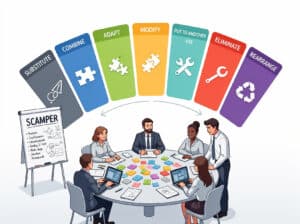
- SCAMPER: prompt changes to an existing product: substitute, combine, adapt, modify, put to other use, eliminate, reverse.
- Six Thinking Hats: look at a problem from six distinct viewpoints in turn.
- Mind Mapping: organize ideas around a central topic as a branching diagram.
- Analogical Thinking: solve a problem by borrowing a solution from another domain.
- Lateral Thinking: break habitual patterns to reach unexpected solutions.
- Biomimicry: draw design solutions from how nature solves similar problems.
- Creative Problem Solving (CPS): a structured process to explore a problem, generate ideas and act.
- Best 2 LEGO Lean Creative Advertisings & Free Ideation Game: two LEGO advertising campaigns, Imagine and The Shadow Knows, analyzed for lean creativity.
- Best 25+ AI Prompts for Mechanical Engineering: conceptual design, material and component selection, DFM and DFA, simulation, CAD and GD&T, safety.
- AI Mindmap: create mind maps with AI.
Resolve a technical contradiction
When improving one parameter worsens another, a trade-off is not the only answer. TRIZ treats a contradiction as the start of an inventive step: state it, look up the matching principles and aim at the ideal final result. Use it when brainstorming stalls.
- TRIZ (Theory of Inventive Problem Solving): a systematic method for inventive problems, built from patterns in patents.
- Best 40 TRIZ Principles to Boost Your Design Challenges: the 40 TRIZ principles to resolve design contradictions and feed brainstorming sessions, with a short recap of the TRIZ methodology.
- TRIZ 40 Inventive Principles and Contradiction Matrix: resolving technical contradictions where improving one parameter worsens another.
- Ideal Final Result (IFR): the TRIZ concept of the perfect solution independent of current constraints, as in self-healing materials.
- Morphological Analysis: combine the options for each design parameter systematically.
- Innovation.world’s Concept Explorer™: concept Explorer, the site's visual tool to browse concepts and linguistic connections.
Choose between ideas
Ideas are cheap, resources are not. Score the options against explicit criteria, compare them with a reference concept, and test the survivors with users. Weighted tools make the trade-offs visible and the decision easier to defend.
- Impact Effort Matrix: rank ideas by expected impact and required effort.
- Pugh Matrix: compare concepts against a reference on weighted criteria.
- MoSCoW Method: sort requirements into must, should, could and will not have.
- How-Now-Wow Matrix: classify ideas by novelty and feasibility.
- Nominal Group Technique: combine individual idea generation with structured group ranking.
- Delphi Method: reach expert consensus through anonymous rounds of questions.
- Affinity Diagramming (KJ Method): group many ideas or data points by natural similarity.
- Concept Testing: check how users react to a concept before developing it.
- Weighted MVP Features Prioritizer™: free tool to list, categorize and prioritize the features of a minimum viable product, with a visual matrix: quick wins.
- Innovation Ambition Matrix: balance core, adjacent and transformational initiatives.
- Risk Matrix: rank risks by likelihood and severity.
Run the project
A framework for the work itself keeps a project moving. Phase-gate suits hardware where late changes are costly, Scrum and kanban suit work that splits into short iterations, and design sprints compress learning into a week. Many teams combine them.
- The Phase-Gate project model: phases 0 to 4, from market study and feasibility to industrialization and launch.
- The Scrum Methodology: 5 Step Guide To Understand The Process: initiation, planning, execution, review and release, with its benefits for flexibility and team collaboration.
- Agile Methodology: deliver work in short iterations with frequent feedback.
- Kanban: a visual pull system that limits work in progress.
- Sprint Method (Design Sprint): answer a key question in five days through a prototype and a user test.
- Double Diamond: diverge and converge twice: first on the problem, then on the solution.
- Hackathons: a time-boxed event where teams build prototypes on a challenge.
- Design Thinking: a human-centered process from user insight to prototype and test.
- Agile Project Management: delivering a project iteratively in small manageable tasks, used in software, product development and marketing.
- Project Management Triangle (Triple Constraint): how scope, time and cost constrain each other, used in project planning and change requests.
- Rapid Prototyping: quickly fabricating a scale model from 3D CAD data, used with 3D printing in automotive and aerospace design.
Assess maturity and timing
Timing decides many innovations. TRL tells how mature a technology is, a roadmap links technology to product and market over time, and the S-curve shows when a technology nears its limits. Use them to decide when to invest, wait or switch.
- Technological Readiness Levels (TRL): definition, scoring in project management and company planning, limitations and considerations.
- The Most Effective Ways to Create a Technology Roadmap in Product Development: purpose, types, plant capability assessment, technology audit, and user interviews and surveys.
- Layered Structure of Technology Roadmap: a multi-layer chart with time on the horizontal axis, used in strategic business planning.
- T-Plan Fast-Start Roadmapping Process: a workshop method from the University of Cambridge for quickly building a first-pass technology roadmap.
- S-Curve Model of Product Sales: the logistic curve of sales volume over time, used in sales forecasting and technology adoption modeling.
- Disruptive Innovation: a simpler or cheaper offer that grows from the low end or a new market and displaces leaders.
- Schumpeter’s Theory of Creative Destruction: how innovation constantly destroys old industrial structures and creates new ones, a base for disruption theory.
- Ansoff Matrix: map growth options by product and market novelty.
- Market Pull & Technology Push: How to Combine for Innovative Designs: definitions, examples of market pull innovations and how to combine both.
- The Tipping Point Model for Idea Diffusion: Gladwell's Mavens, Connectors and Salesmen and how they drive idea diffusion in viral and influencer marketing.
Build an innovation culture
Frameworks fail in teams that punish new ideas. Make it safe to try, give small budgets and deadlines, and open challenges to outsiders through hackathons, crowdsourcing and co-creation. Watch for the habits that block ideas, from crab mentality to the belief that a problem has no solution.
- Easy 3 Gold Nuggets for Innovation: treat customer feedback, product failure reports and complaints as sources of innovation in product design.
- The 6 Kickass Jugaad Principles for Your Designs: find opportunity in adversity, do more with less, act agilely, aim for simplicity, include marginal segments, follow your heart.
- The “Dantzig Effect” For Innovation: how George Dantzig solved two statistics problems presented as unsolvable, and why a beginner's mind helps innovation.
- The “Crab Mentality” in Marketing, Product Design and Innovation: origin of the metaphor, psychological drivers, common examples and how to overcome it.
- Co-Creation Workshops: involve users and stakeholders in designing the solution.
- Crowdsourcing: open a problem to a large group of outside contributors.
- Hackathons: a time-boxed event where teams build prototypes on a challenge.
- Innovation Games: use game formats to explore needs and ideas.
- Ideation Campaigns: run a time-limited call for ideas across an organization.
Innovation frameworks comparison
Nine frameworks cover most innovation work. Each name links to its page.
| Framework | Question it answers | Use it when |
|---|---|---|
| Design Thinking | What does the user really need? | At the start, when the problem is not yet clear |
| Double Diamond | Are we solving the right problem, and is this the right solution? | To structure exploration and delivery in two phases |
| SCAMPER | How can we change an existing product or process? | To improve something that already exists |
| TRIZ | How do we resolve a contradiction between two requirements? | When improving one parameter worsens another |
| Pugh Matrix | Which concept beats the reference on our criteria? | To choose between concepts |
| Phase-Gate | Should this project continue, change or stop? | For projects where late changes are costly |
| Scrum | What can we deliver in the next short iteration? | For work that can be split into increments |
| Technology Readiness Levels | How mature is this technology? | Before depending on it in a product |
| Technology roadmap | When will technologies and products be ready? | To align R&D with market timing |
Innovation rules that hold in practice
- Define the problem before you generate ideas. A well-stated problem is half of the solution.
- Generate alone first, then share. Group sessions work best for combining and selecting ideas.
- Separate idea generation from evaluation. Judgment that comes too early kills the unusual ideas.
- Treat a contradiction as a signal. When two requirements clash, look for a principle that resolves it, as in the 40 TRIZ principles, rather than settling for a compromise.
- Write the scoring criteria before you see the ideas, then score each idea against them.
- Test the riskiest assumption first, with the cheapest prototype that can answer it.
- Check technology readiness. A concept that needs a technology at TRL 3 cannot be a product next year. See Technological Readiness Levels.
- Combine market pull and technology push. See Market Pull and Technology Push.
- Protect time and budget for exploration, in small bets with clear stop rules.
- Search patents and the literature before you invent. Someone may have solved part of it. Start with Free Latest Patents Search.
- Document what you learned, including failures, so that the next team starts higher.
Find prototyping, IP and research partners
Suppliers and consultants
- Prototyping strategy
- Systems engineering: complex architecture and multi-disciplinary integration.
- Mechatronics and robotics design: integration of sensors, actuators and code.
- Embedded systems and firmware: low-level programming for hardware control.
- Industrial additive manufacturing: SLS, DMLS metal and SLA production.
- Industrial design: aesthetics, ergonomics and form-factor development.
- Intellectual property and patents: patent searches, filings and IP strategy.
- Technology transfer: moving research from universities to the market.
- The full suppliers directory: search by map, keyword and category.
Universities, research and jobs
- Universities active in project management
- Universities active in industrial design
- Free Latest Patents Search: the latest English-language patents from the European Patent Office.
- Free Latest Scientific Publications Search: free search tool for the latest articles of leading peer-reviewed journals, updated in real time, with filters by topic, journal.
- Engineering jobs worldwide: engineering vacancies in product design, innovation and manufacturing.
Learn the methods
The Design Thinking and Innovation courses teach the frameworks on this page in sequence. Level 1 builds the early-stage toolkit, starting with TRIZ. Level 2 takes a validated concept to market. Each course is free and has must-know checklists and a final exam.
Editor's top picks
Pages selected by the editor for this topic.





Innovation framework questions, answered
Which innovation framework should I use?
Match it to your goal. Use design thinking or the double diamond to understand the problem, brainstorming or SCAMPER to generate ideas, TRIZ for technical contradictions, a Pugh or impact-effort matrix to choose, and phase-gate or Scrum to run the project. The table above compares nine of them.
What is the difference between TRIZ and brainstorming?
Brainstorming draws many ideas from the knowledge and imagination of a group. TRIZ is a structured method built from patterns found in patents: it restates a problem as a contradiction and points to principles that resolved similar ones. See TRIZ and Best 40 TRIZ Principles.
What are the 40 TRIZ principles?
They are 40 generic inventive principles, such as segmentation, nesting and inversion, derived by Genrich Altshuller from the study of patents. A contradiction matrix suggests which principles to try for a given pair of conflicting parameters. See Best 40 TRIZ Principles.
What does SCAMPER stand for?
Substitute, Combine, Adapt, Modify, Put to another use, Eliminate and Reverse (or Rearrange). Each word is a prompt to change an existing product or process. See SCAMPER.
What are Technology Readiness Levels?
TRLs form a nine-level scale from basic principles observed (TRL 1) to a system proven in operation (TRL 9). They show how mature a technology is before you rely on it. See Technological Readiness Levels.
What is the difference between phase-gate and Scrum?
Phase-gate splits a project into stages with go or no-go decisions between them. Scrum works in short iterations, called sprints, that each deliver a usable increment. Hardware projects often use phase-gate at the top and agile methods inside the stages. See The Phase-Gate project model and The Scrum Methodology.
How do I choose between many ideas?
Write the criteria first, then score each idea against them, for example with an impact-effort matrix or a Pugh matrix. Test the best candidates with users before investing. See Impact Effort Matrix, Pugh Matrix and Weighted MVP Features Prioritizer.
What is design thinking?
Design thinking is a human-centered process that moves from understanding users to defining the problem, generating ideas, prototyping and testing. It is iterative rather than linear. See Design Thinking and Double Diamond.
What are the best idea generation techniques?
Brainstorming, SCAMPER, mind mapping and the Six Thinking Hats are common starting points. Analogies and biomimicry bring ideas from other fields, and TRIZ helps when a contradiction blocks progress. See Brainstorming, SCAMPER and Six Thinking Hats.
Related topics
Innovation methods connect with value-driven design, go-to-market work, emerging technologies and collaboration.