Product Design, Manufacturing & Innovation Resources
Home » Ideal Final Result (IFR)

Ideal Final Result (IFR)

1960
  • Genrich Altshuller
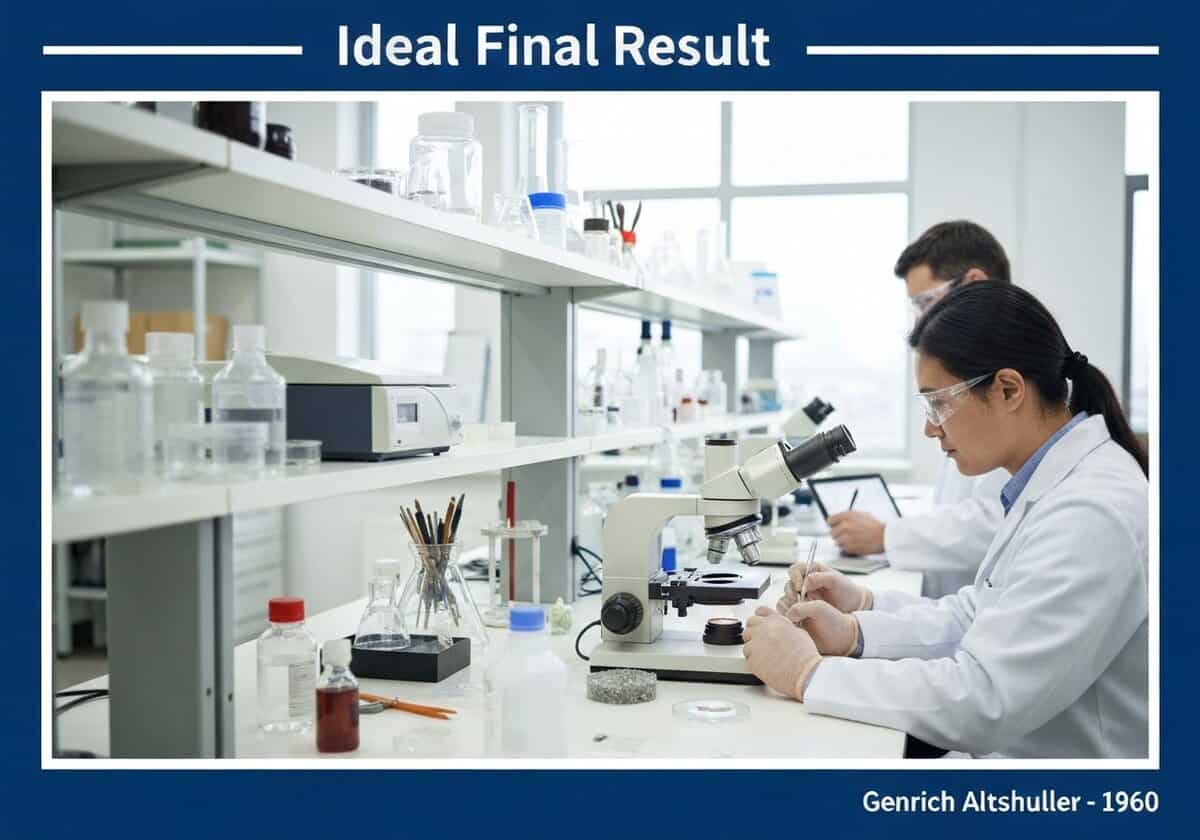
Self-healing materials in a laboratory setting, demonstrating innovative repair mechanisms.

(generated image for illustration only)

The Ideal Final Result (IFR) is a core concept in TRIZ that defines the ultimate, perfect solution to a problem, independent of current constraints or resources. It is typically formulated as “the system (or element) itself performs the required function without its own existence.” This mental tool helps problem-solvers overcome psychological inertia and focus on function rather than form.

The Ideal Final Result (IFR) is a powerful psychological and analytical tool within the TRIZ methodology. It serves as a beacon, guiding the problem-solving process towards a breakthrough solution by defining the endpoint of the Law of Increasing Ideality. The formulation of the IFR is a deliberate act to break free from the mental constraints imposed by the current system and its problems. Instead of asking “How can we improve this device?”, the IFR prompts the question “How can the required function be achieved without the device at all, or with zero cost and zero harm?”.

The classic formulation is: “The X itself performs the function Y”. For example, if the problem is to inspect a pipe for cracks, the IFR would be “The pipe itself indicates its cracks”. This leads to solutions like adding a substance to the pipe material that changes color when exposed to air through a crack. The IFR forces the problem-solver to look for existing resources in the system or its environment that can perform the desired function. This concept is closely linked to the TRIZ principle of ‘Trimming’, where unnecessary or harmful components of a system are removed, and their useful functions are reassigned to other existing components. By defining the ideal outcome, engineers and innovators can work backward to find a practical solution that is simpler, cheaper, and more elegant than a conventional, incremental improvement.

UNESCO Nomenclature: 5312
– Social psychology

Type

Abstract System

Disruption

Substantial

Usage

Niche/Specialized

Precursors

  • concepts of ‘perfect’ or ‘ideal’ systems in philosophy and engineering
  • value engineering principles focusing on function
  • cybernetic concepts of self-regulating systems

Applications

  • self-healing materials that perform the function of repair without a separate repair mechanism
  • dissolvable medical stitches that hold tissue and then disappear
  • software that automatically updates itself without user intervention
  • smart dust sensors that gather data without the presence of a bulky sensing device
  • on-demand services like uber or airbnb, where the function (transport, lodging) is provided without owning the assets

Patents:

NA

Potential Innovations Ideas

Due to scrapping bot traffic, currently more than 40k per day, this content is reserved to community members.
> Login < or > Register < (100% free) to access this, so as all other restricted content and tools.

Related to: ideal final result, IFR, TRIZ, problem solving, innovation, psychological inertia, ideality, function analysis, system thinking, creativity.

Historical Context

Ideal Final Result (IFR)

1950
1957
1960
1960
1970
1980
1980
1942
1957
1957
1960
1965
1970
1980
1983

(if date is unknown or not relevant, e.g. "fluid mechanics", a rounded estimation of its notable emergence is provided)

Full size images and downloads are only available, 100% free, for registered members.

> Login <