The Crab mentality (“crabs in a bucket”) is a psychological and social phenomenon where members of a group attempt to reduce the confidence of any member who achieves success beyond the others, or to pull them back down to the group’s level.
It is best summarized by the phrase: “If I can’t have it, neither can you.”
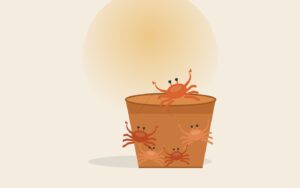
In a product organization, this dynamic rarely announces itself as envy. It shows up disguised as prudence: the “realistic” feedback that kills a bold concept, the endless review cycle that sands an innovative design down to a safe average, the marketing team that positions a breakthrough feature timidly so it won’t outshine the flagship.
Understanding crab mentality is therefore not just a self-help exercise — for project managers, team managers, HR and innovators, it is a diagnostic tool for why promising products get diluted, why internal innovation teams get starved, and why markets full of capable companies converge on sameness.
Key Takeaways
- Accountability gates influence: only people who bear the cost of a bland outcome should hold veto power over a design.
- Intent before opinion: feedback that can’t reference the design’s stated brief is a preference, not a critique.
- Prototypes disarm committees: reviewers can argue with a slide, but not with a user they just watched succeed. Note that in contrary, a badly executed prototype demo will kill a project. “It was just a quick prototype” will not recover from a bad impression.
- Comparison sets your ceiling: a roadmap built from competitor screenshots climbs toward where the rival was, never where the market is going.
- Sign the cannibalization number early: pre-approved self-disruption can’t be weaponized against the new product in its first bad quarter.
- The do-nothing scenario has a price: every zero-sum objection collapses once you cost out what a competitor takes if you don’t ship.
- Loud is not large: judge a redesign by week-four retention and switch-back rates, not day-one complaint volume.
- Support must be contractual: innovation labs die from vague promises, so get distribution, data access, and quotas in writing before the first prototype.
- Sabotage hides in anecdotes, not dashboards: tracking internal ticket wait times for new ventures makes quiet suffocation measurable and escalatable.
- Envy converts to research: when a competitor impresses you, write up the customer job their product does — imitation copies features, differentiation answers jobs.
Origin of the Metaphor
The term comes from the behavior of live crabs in a bucket. A single crab can easily climb out and escape. But put a group of crabs in the same bucket, and the moment one starts to reach the rim, the others pull it back down. In the end, no one escapes, and they all share the same fate.
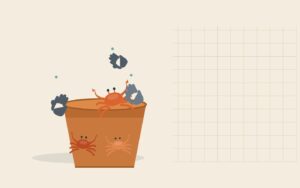
The product translation: the bucket is the organization, the process, or the market category — and the lone crab is the startup, the skunkworks team, or the designer with an unconventional idea. A solo founder can ship a radical product because nobody is holding their leg. Inside a large company, that same idea must survive stakeholder reviews, brand guidelines, legal caution, and the quiet resistance of teams whose roadmaps it threatens. Each “pull” is individually reasonable; collectively, they keep everyone at the bottom of the bucket.
Design by committee is the purest expression of this.
When every reviewer gets to remove what makes them uncomfortable, the distinctive edges of a design — the very things that would make it memorable and marketable — are the first to go.
The result is a product that offends no one internally and excites no one externally.
Innovation research calls this “regression to the corporate mean”: the bucket doesn’t kill the crab, it just guarantees the crab never leaves.
Expert tips:
- Cap veto power at the number of people accountable for the outcome. Everyone else comments; nobody else blocks. Most “pulls” come from reviewers who carry zero risk if the product turns out bland.
- Open every design review by reading the brief aloud, then require feedback to reference it. Anything that contradicts the brief is a strategy dispute, not a design note — move it to a different meeting with different attendees.
- Show prototypes, not slides. A deck invites opinion; a working prototype invites observation. It is much harder to pull down something a reviewer just watched a real user succeed with.
The Psychological Drivers
Psychologists suggest this behavior isn’t usually about malicious intent, but deep-seated insecurities. Each driver has a direct organizational and market analogue
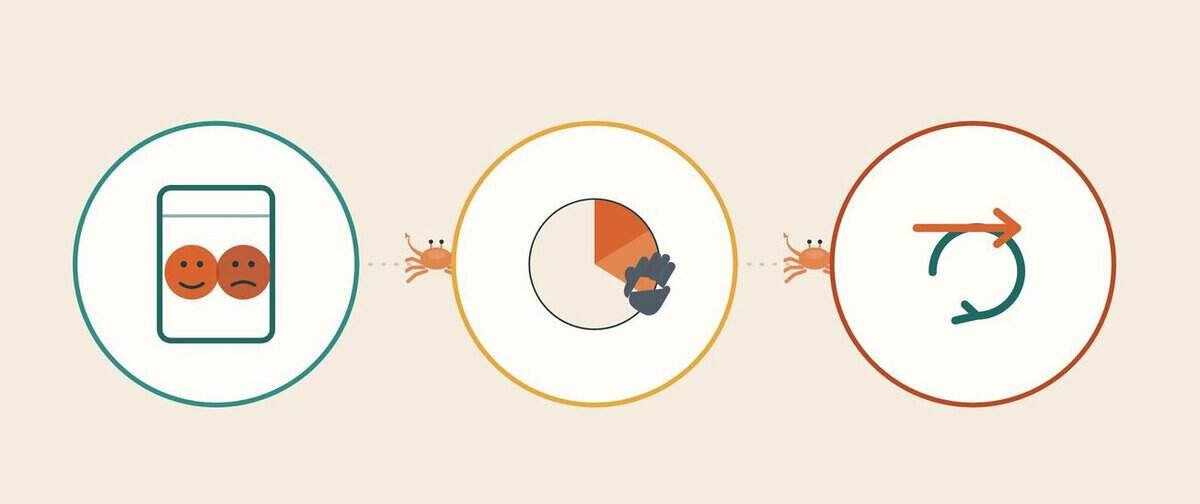
Social ComparisonWhen someone close to us succeeds, it acts as a mirror highlighting our own lack of progress. In product terms: when one team’s feature gets the keynote slot, other teams feel implicitly demoted — and may respond by withholding cooperation, disputing metrics, or lobbying for parity resources rather than differentiated bets. In marketing, obsessive competitive benchmarking is social comparison at company scale: instead of asking “what does our customer need?”, teams ask “what did the rival just ship?” — producing feature-parity checklists and me-too products. Comparison-driven roadmaps guarantee you are always climbing toward where a competitor was, never where the market is going. Expert tips:
| Zero-Sum ThinkingThe belief that success is a fixed pie: if one person wins, others lose by default. In product terms: this is the engine of the innovator’s dilemma. Teams resist new products because they fear cannibalizing existing revenue — “if the new product wins, my product loses.” Kodak invented the digital camera and buried it to protect film; Apple, famously, let the iPhone cannibalize the iPod on the logic that if anyone was going to eat their lunch, it should be them. Zero-sum thinking also distorts marketing strategy: brands fight over slices of an existing category instead of expanding the category itself. Abundance-oriented companies build platforms, ecosystems, and open APIs precisely because they believe a bigger pie beats a bigger slice. Expert tips:
|
Fear of ChangeGroups find comfort in the status quo; one person improving threatens the stability of everyone else. In product terms: fear of change lives in both the organization and the user. Internally, it appears as attachment to legacy processes, sunk-cost defense of old architectures, and “that’s not how we do things here.” Externally, it means users themselves can act as crabs — loss aversion makes people resist even objectively better redesigns (every major UI overhaul triggers a backlash). Good product design anticipates this: gradual rollouts, opt-in previews, migration paths, and change-management-aware onboarding are all ways of designing around the crab reflex rather than pretending it doesn’t exist. Expert tips:
| |
Cultural Contexts Similarities
The behavior is universal, but it takes some named forms in specific cultures — and each has a corporate mirror worth recognizing:
The Philippines — utak talangka (crab brain): describes sabotaging others out of envy. Its corporate cousin is “Not Invented Here” syndrome — teams dismissing or undermining ideas, acquisitions, or products that originated elsewhere, because someone else’s solution succeeding feels like their own competence failing. Countless post-acquisition product integrations die this way. | Tall Poppy Syndrome (Australia/UK): successful people get “cut down.” In organizations, the tall poppy is the internal innovation lab or star product team — visibly resourced, visibly celebrated, and quietly resented. The mainline business often starves it of distribution, data, and headcount until it withers, then cites its failure as proof innovation “doesn’t work here.” |
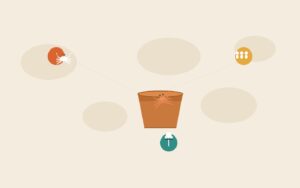 | Jante Law (Scandinavia): “you are not better than us.” As a corporate culture, this can suppress bold individual bets — but it also carries a lesson for marketing localization: aspirational, success-flaunting advertising that works in individualist markets can backfire in humility-oriented cultures. The same product may need “be extraordinary” messaging in one region and “quietly better for everyone” messaging in another. Crab dynamics don’t just shape teams; they shape how audiences receive claims of superiority. |
Expert tips:
- After an acquisition, leave roadmap authority with the acquired team for at least a year, in writing. The moment the acquirer’s PMs take over prioritization, “Not Invented Here” begins dismantling the thing you paid for.
- If you run an innovation lab, negotiate its distribution deal with the mainline business before the first prototype exists — specific sales quotas, specific data access, signed by both sides. Tall poppies don’t die from bad ideas; they die from vague promises of support.
- Localize the proof style, not just the language: in humility-oriented markets, replace superlatives with verifiable specifics — third-party benchmarks, named customer counts, measured outcomes. “Best in class” reads as bragging; “12,000 clinics, 4-minute median setup” reads as fact.
Common Examples
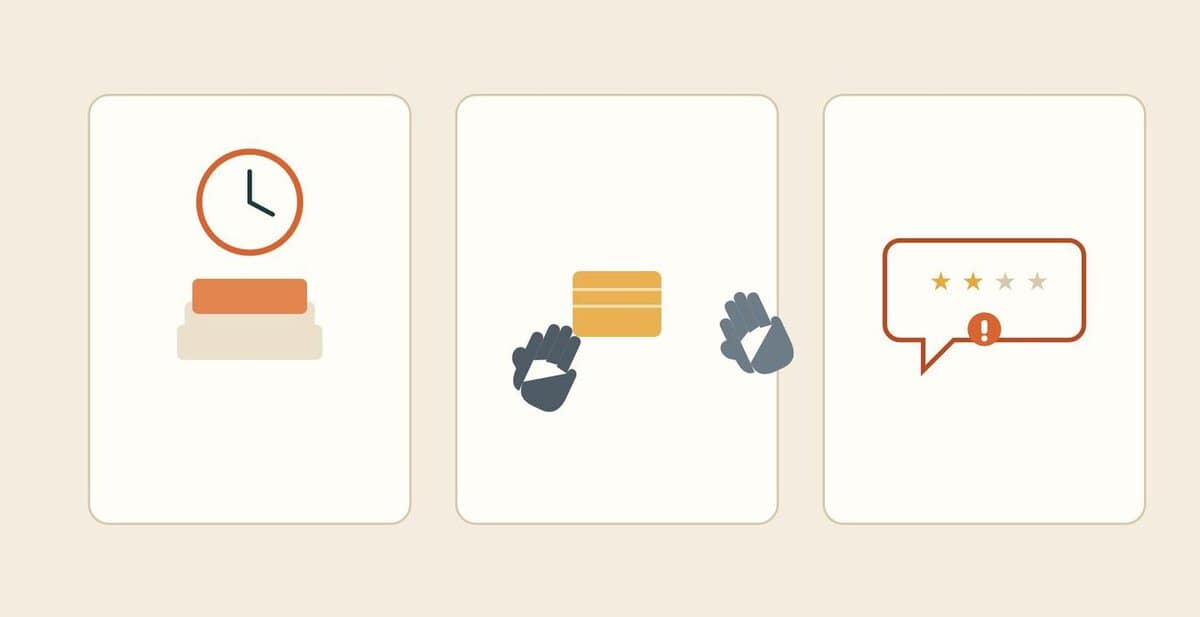
In the workplace / product org: a colleague withholds information from a high performer to block their promotion. The product version: an established business unit withholds customer data, sales-channel access, or engineering support from an internal startup — not through open opposition, but through slow-rolled tickets and deprioritized requests. The new product doesn’t get killed; it gets quietly suffocated.
In families / legacy businesses: when a family member tries to break a cycle, others use guilt to keep them “grounded.” The corporate analogue is the legacy product line treating the next-generation product as a betrayal: “that’s not who we are as a brand,” “our real customers won’t accept this.” Brand heritage becomes a leash instead of a launchpad, and disruptive entrants — unburdened by anyone’s guilt — take the market instead.
On social media / in the market: hate-following and negative comments to diminish achievements. The market versions are FUD marketing (spreading fear, uncertainty, and doubt about a rising competitor rather than improving one’s own offer), coordinated review-bombing of a successful launch, and reflexive public cynicism toward any new product category (“nobody needs this”) — the crowd’s way of pulling a climbing product back into the bucket.
Expert tips:
- Instrument the suffocation. Track internal ticket wait times and request-denial rates for new ventures against the mainline’s numbers. Quiet sabotage hides in anecdotes; it can’t hide in a dashboard reviewed monthly by an executive with authority over both sides.
- Give brand-heritage objections a burden of proof. “Our customers won’t accept this” is a testable claim — run it past fifty of those customers before it kills a roadmap item. Most heritage objections evaporate on contact with actual customer data.
- Answer FUD with specifics and never name the source. Publish the benchmark, the security audit, or the migration case study that disproves the claim; naming the attacker hands them your audience. And distinguish organic criticism from a pile-on: a sudden spike in one-star reviews with near-identical phrasing is a coordination signal, not a product signal.
How to Overcome It
The antidote is “lifting as you climb” — and in product organizations, each remedy can be operationalized.

Abundance mindset: someone else’s success doesn’t diminish your potential. Structurally, this means building ecosystems instead of walled gardens — platforms, APIs, partner programs, and developer communities where others’ wins enlarge your market. In marketing, it means category creation over share wars: educate the market, grow the pie, and welcome competitors as validation. In innovation strategy, it means letting new products cannibalize old ones on purpose, because self-disruption beats external disruption every time.
Supportive circles: surround yourself with people who celebrate your wins. In design practice, this is the difference between a critique culture and a criticism culture: healthy design critique exists to lift the work toward its own ambition (“how do we make this vision stronger?”), not to pull it toward the reviewer’s comfort zone (“make it more like what we already have”). Innovation programs need the same protection — executive sponsorship, ring-fenced resources, and separate success metrics so the mainline business can’t measure the new venture by the old venture’s yardstick.
Self-awareness: notice the twinge of envy and convert it into curiosity. For product teams, this is a discipline: when a competitor ships something impressive, the crab response is dismissal (“it’ll never scale”) or imitation; the curious response is analysis — what job is this doing for customers that we’re not? Frameworks like jobs-to-be-done, structured competitor teardowns, and pre-mortems institutionalize that conversion, turning resentment into research. Individually, it means catching yourself in a design review: are you improving the work, or just pulling it back down to where you feel comfortable?
Tips:
- Open your platform where you’re strong, not where you’re weak. Companies that expose their weakest capability as an API invite partners to fix their problems for free labor’s sake and get resentment back; expose the capability partners genuinely can’t build themselves, and the ecosystem compounds.
- In critique sessions, make every reviewer state what the design is trying to do before saying anything about what’s wrong. If they can’t articulate the intent, their feedback is about their preferences, and it waits until they can.
- Run competitor teardowns as a customer, not an analyst: buy the rival product, use it for two weeks to do a real task, and write up the job it does — not its feature list. Feature lists feed imitation; job descriptions feed differentiation.
- Schedule a pre-mortem for every major launch with one fixed prompt: “It’s six months later and this failed because our own organization pulled it down. What happened?” Naming the internal failure modes in advance is the cheapest crab repellent there is.
The One-line Summary for Builders
Every organization is a bucket.
The question is whether your processes, culture, and marketing exist to help the boldest ideas over the rim — or to make sure nothing ever gets out.