From Aviation Science to Industrial Sequencing: the Steffen Boarding Method.
Sequencing problems are among the oldest and most persistent challenges in operations engineering. Whether the constraint is a narrow aisle, a production bottleneck, a loading dock, or a warehouse corridor, the fundamental question is always the same: in what order should agents, objects, or tasks be processed so that interference between them is minimized and throughput is maximized?
In 2008, a physicist named Jason Steffen published a formal mathematical treatment of one specific instance of this problem: aircraft boarding. His paper, initially modest in scope, produced a sequencing strategy that outperformed every existing airline boarding policy by a significant margin. The result attracted attention well beyond aviation, because the underlying logic was not specific to airplanes.
It was a general principle about how to schedule the movement of discrete agents through a constrained linear environment toward assigned positions.
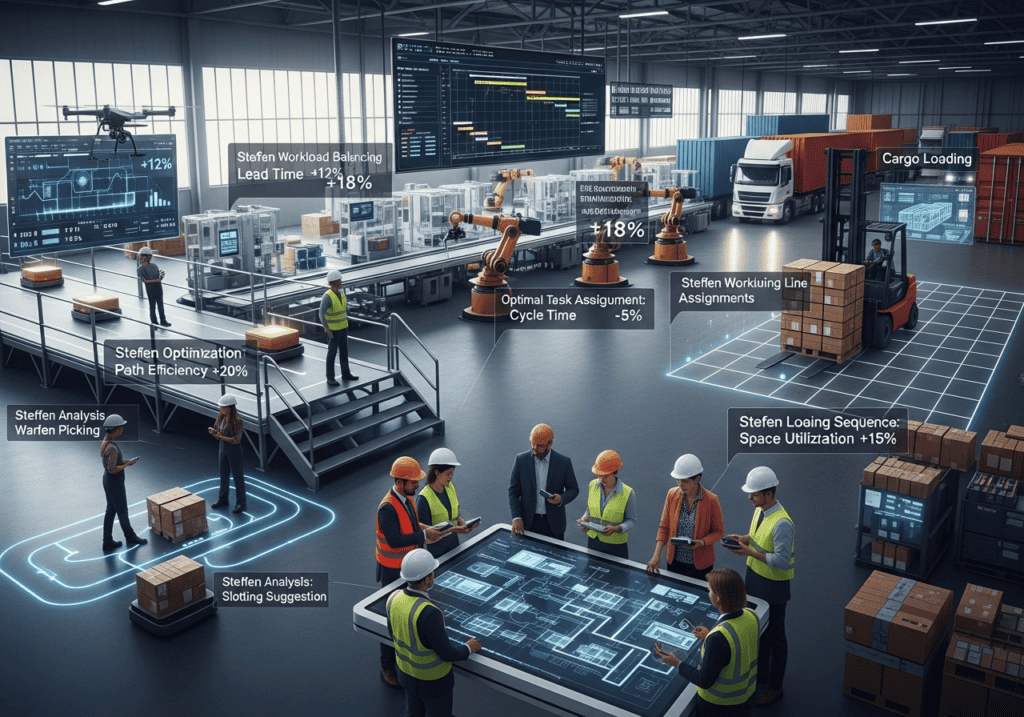
This article examines the Steffen Method in full, from its scientific origins through its experimental validation, its failure to gain adoption in commercial aviation, and most importantly, its transferability as an operational industrial framework. The practical value for engineers and operations managers lies not in boarding aircraft more efficiently, but in recognizing the structural pattern Steffen identified and applying it wherever similar interference dynamics occur: warehouse pick operations, cargo loading sequences, manufacturing line assignments, freight batching, and last-mile delivery routing.
Sequence problems of this kind are close cousins of the classic route puzzle: the applications of travelling salesman problem include delivery routes, circuit board drilling and warehouse picking. Traveling salesman problem applications all share the same pattern of finding the best order of visits.
Key Takeaways
- Identify the problem class before applying the solution: the Steffen principle applies only when three conditions are simultaneously present: a constrained path that does not allow bypassing, fixed destination assignments along that path, and a local operation at each destination that creates a blocking event. If any of these three is absent, the method does not apply and a different optimization framework is needed.
- Interference distance is the first parameter to calculate: before redesigning any sequence, measure the minimum spatial gap between two simultaneously active operations that eliminates blocking. This number depends on equipment footprint, aisle width, and lateral reach. Every sequencing decision flows from this figure. Using an arbitrary buffer instead of a measured one either wastes capacity or fails to eliminate the interference it was designed to prevent.
- Back-to-front zone logic is the worst structured option in real conditions: in aviation and in any analogous industrial environment, zone-based sequencing that clusters agents into groups without resolving intra-group spatial order produces worse outcomes than no sequencing at all. The zone provides a false sense of control while generating severe clustering within each group. Any facility currently using macro-zone dispatch without intra-zone spatial ordering should treat this as a regression, not a process.
- Individual path optimization and inter-agent interference are separate problems: minimizing each picker’s travel distance or each vehicle’s route length does not reduce the interference those agents impose on each other. A warehouse that has optimized individual pick paths but not inter-picker spatial separation has solved half the problem. The Steffen principle addresses the second half: what sequence of agents eliminates mutual blocking, independent of how efficient each individual trajectory is.
- Partial implementation captures most of the gain at a fraction of the cost: the WILMa variant — lateral class ordering without strict alternating rows — captures the majority of the Steffen method’s benefit with substantially simpler infrastructure requirements. In warehousing terms: sequencing operations by their lateral reach class (deep shelf before mid-shelf before face pick) before enforcing alternating-slot separation yields the largest share of available improvement. Do not delay deployment waiting for full implementation capability.
- Measurement must precede implementation. Interference events are invisible in standard productivity metrics.
- The compliance problem is an information problem, not a discipline problem Agents deviate from optimized sequences because they cannot see the spatial state of other agents in the same constrained path. A picker who shortcuts their route or a fork truck operator who takes an adjacent door simultaneously is making a rational local decision with incomplete information. The solution is to make inter-agent spatial state visible in real time, not to enforce stricter adherence to a predetermined list. Information-driven compliance is more robust and degrades more gracefully under exceptions.
- Steffen sequencing is the correct dispatch logic for AGV fleets and robotic pickers: automated systems eliminate the compliance problem entirely. An AGV fleet or robotic pick system that can be dispatched in a controlled sequence is the ideal environment for full Steffen-type ordering. If the facility has automated material handling but is dispatching vehicles using nearest-task or FIFO logic, it is leaving measurable throughput on the floor. Alternating-slot dispatch is a configuration change, not a capital investment, in most modern AGV management systems.
- Loading dock scheduling should include a spatial separation criterion: standard dock scheduling prioritizes by departure time. Adding a spatial separation rule — among trucks with similar departure priority, do not simultaneously load adjacent doors — eliminates the most costly fork truck interference events in the staging area with no infrastructure investment. Most dock management systems support this as a secondary sort criterion. The operational data required (door position, loading start time) is already captured in virtually every WMS.
- Slotting strategy should treat spatial separation of high-velocity SKUs as a constraint, not a secondary concern: placing multiple high-velocity SKUs in adjacent positions optimizes individual pick ergonomics while creating predictable inter-picker clustering in every wave that includes those SKUs. Where two candidate slotting positions are otherwise equivalent, spatial separation from other high-velocity items should be the tiebreaker. In facilities where this is architecturally impossible, a dedicated wide-aisle fast-pick zone that removes the interference constraint entirely is the correct structural response.
- Cross-dock staging is structurally identical to the aircraft aisle problem: a staging area with constrained fork truck access and fixed outbound door positions has all three structural features of the Steffen problem class. Pallet movements from staging to outbound doors should be sequenced so that simultaneously active movements are spatially separated in the staging grid. Facilities that already track pallet staging positions in their WMS can implement this as a dispatch sequencing rule with no hardware change.
- High operation-duration variance destroys the spatial separation guarantee: the Steffen method’s interference elimination depends on the loading operation completing before the next agent arrives at an adjacent position. When operation durations vary significantly — a picker who re-arranges bin contents, a fork truck that cannot immediately place a pallet cleanly — the gap that was designed into the sequence collapses and interference recurs. In environments with high duration variance, increase the interference buffer proportionally or apply a conservative partial implementation rather than the full alternating-slot sequence.
- Legacy WMS and MES platforms require a middleware approach, not a replacement: most scheduling systems deployed more than a decade ago have sequencing engines that do not support spatial separation as a native constraint parameter. Adding this logic as a middleware layer that intercepts dispatch signals and applies spatial ordering before they reach the operator is lower risk and lower cost than a platform upgrade. The middleware only needs to read current agent positions and pending operation locations — data that modern position tracking infrastructure already produces.
- The organizational barrier mirrors the technical barrier: both require making invisible costs visible Airlines have not adopted the Steffen method primarily because priority boarding generates revenue and interference costs are diffuse and unmeasured. Manufacturing and logistics operations face the same dynamic: the manager who oversees a zone picks up the phone about a missed shipment, not about the 40 minutes of aggregate fork truck dwell time that accumulated in staging because no one sequenced the door assignments. Making interference costs a line item in operational reporting — not absorbed into labor efficiency averages — is the organizational prerequisite for sustained adoption of any sequencing improvement.
The Economics of Boarding Inefficiency
Aircraft boarding is not a minor operational detail. For a single-aisle narrowbody aircraft operating a short-haul route, the turnaround time between landing and next departure is the primary constraint on aircraft utilization. An airline operating 150-seat aircraft on routes of 90 minutes to 2 hours can realistically schedule five or six rotations per aircraft per day. Boarding accounts for, on average, 15 to 25 minutes of the gate time budget. In a tight schedule, any overrun on boarding propagates directly into delays that compound across the day’s rotations.
The economic weight of this is not trivial. Industry estimates from pre-pandemic operations consistently placed the cost of a one-minute block delay for a narrowbody aircraft at between 60 and 120 USD when all factors are included: fuel burn at idle and taxi, crew time, gate fees, connecting passenger impacts, and compensation obligations under delay-triggered passenger rights regulations in multiple jurisdictions. A boarding process that runs 10 minutes over its planned duration on a single aircraft costs, at the low end, 600 USD per occurrence. Across a fleet of 100 aircraft making two gate appearances per day each, a systemic 10-minute boarding overrun represents over 40 million USD in annualized avoidable costs.
The industry has been aware of these figures for decades. Multiple consulting studies and internal airline analyses have modeled boarding time as a lever for improving aircraft utilization. The consistent finding is that current boarding strategies, as actually practiced, perform far below their theoretical potential. The gap is not primarily a function of passenger speed or aircraft configuration; it is a function of sequence design.
The Mechanism of Loss
The time cost of inefficient boarding is generated almost entirely by one phenomenon: aisle blocking.

When a passenger stops to load overhead baggage, they create a stationary obstruction in a single-lane corridor that cannot be bypassed. Every subsequent passenger behind the blocker is stalled. The time lost is not additive across blocked passengers — it is multiplicative, because blocked passengers are themselves occupying aisle positions that prevent passengers further back from reaching their rows, creating a cascade of secondary blockages.
This cascade effect is compounded when passengers in aisle and middle seats are boarded before window seat passengers in the same row. The window-seat passenger must wait while both the aisle and middle seat passengers stand, move into the aisle, allow the window passenger to pass, and then re-seat themselves. Each such event takes 15 to 30 seconds under ideal conditions. On a 150-seat aircraft with a 3-3 configuration, there are 50 rows, and in random or back-to-front boarding, a significant proportion of those rows will experience this lateral blocking event at least once, and many will experience it twice.
Back-to-front boarding, which remains the most widely deployed strategy among major carriers, appears logical at first glance: boarding rear rows first should allow front rows to board without interference from passengers still loading bags further back. In practice, it performs poorly because passengers in the same zone board in arbitrary row order within that zone. A passenger in row 28 who boards before a passenger in row 30 within the same rear zone still creates an aisle blocking event that stalls the row 30 passenger behind them.
The zone discipline controls the macro-sequence but does not resolve the intra-zone interference that drives most of the time loss.
Ground-Level Measurement
Real world scenario …. Time-motion studies conducted at multiple airports over the past fifteen years have produced consistent data. Random boarding — passengers board in no particular order — performs comparably to most structured zone strategies in real-world conditions, because the discipline of zone strategies breaks down during implementation. Passengers arrive at the gate at non-uniform rates, zone compliance is imperfect, families and groups create exceptions that gate agents accommodate, and frequent flyers with priority boarding rights further fragment the sequencing plan.
The result is that most commercial boarding processes, as observed rather than as designed, are effectively random with a light rear-weighted bias. The gap between the theoretical performance of a well-implemented zone strategy and the actual observed boarding time is typically 20 to 35 percent. Gate agents lack the tools and authority to enforce strict sequencing, and the commercial incentives that drive boarding policy — priority boarding as a loyalty benefit, family accommodation as a service standard, group seating as a revenue product — are incompatible with strict sequence optimization.
Operational note: airlines that have measured actual versus planned boarding time on a per-flight basis consistently find that approximately 60 percent of boarding overruns are attributable to aisle blocking events in the first 40 percent of the boarding process. Addressing the sequence of the first boarded cohort yields disproportionate improvement.
These numbers establish the scale of the problem that Steffen set out to solve. The inefficiency is real, measurable, and expensive. The question he asked was whether a mathematically derived sequence could eliminate aisle blocking as a systemic phenomenon rather than as a random event.
The Steffen Method: Origins, Logic, and Experimental Results
Jason Steffen was a postdoctoral researcher in astrophysics when he turned his attention to aircraft boarding in 2008. His background was in Markov chain Monte Carlo methods — statistical simulation techniques used to model systems with large numbers of interacting components evolving through probabilistic state transitions. The boarding problem, viewed through this lens, was a constrained optimization problem with a well-defined cost function: minimize total boarding time by finding the optimal permutation of passenger assignments to boarding sequence positions.
His initial paper, published in the Journal of Air Transport Management, used a computer simulation to evaluate a large number of possible boarding sequences and identify which structural properties correlated with minimum boarding time. The simulation modeled each passenger as an agent requiring a fixed time to stow luggage and a fixed time to move one seat-row forward along the aisle. Blocking events were modeled as delays that propagated backward through the queue. The model did not account for group travel, irregular luggage, or gate compliance failures, which is relevant to understanding both its predictive accuracy and its limitations.
The Structural Logic
The sequence Steffen identified as optimal has three defining properties:
- First, window seats board before middle seats, which board before aisle seats — the so-called WILMa (window, middle, aisle) ordering.
- Second, within each seat class, passengers are sequenced in alternating rows rather than consecutive rows.
- Third, the alternating-row sequencing is applied from rear to front within each class.
The alternating-row property is the critical and non-obvious element. If all window-seat passengers board simultaneously in consecutive row order from rear to front, they still create clustering at the overhead bins. A passenger in row 28 window and a passenger in row 29 window will compete for adjacent bin space and their simultaneous bag-loading events will create mutual interference even though they are not blocking each other in the aisle in the traditional sense.
By alternating rows — row 28, then row 26, then row 24, creating gaps between simultaneously active loading zones — the method ensures that each active bag-loading event occurs in spatial isolation. No two simultaneously boarding passengers are adjacent.
This spatial separation is the mechanism that eliminates aisle blocking as a systemic event. Passengers are never in a position where one is loading overhead bins while the next passenger in sequence needs to pass them. The corridor is always clear at the position immediately ahead of any active loading event.
Experimental Validation
The simulation results were striking enough to attract media attention, but Steffen followed up with a controlled physical experiment conducted in 2011 at a film studio in Los Angeles, using a mock aircraft interior with seats, overhead bins, and real volunteer passengers with carry-on luggage. The experiment compared six boarding strategies under controlled conditions with randomized participant assignments to minimize selection effects.
The six strategies tested were: random boarding (no sequence), back-to-front by block (two zones), back-to-front by row, the WILMa method (window-middle-aisle without alternating rows), the Steffen method (alternating WILMa), and a rotating zone variant. Each strategy was run multiple times with different participant groups.
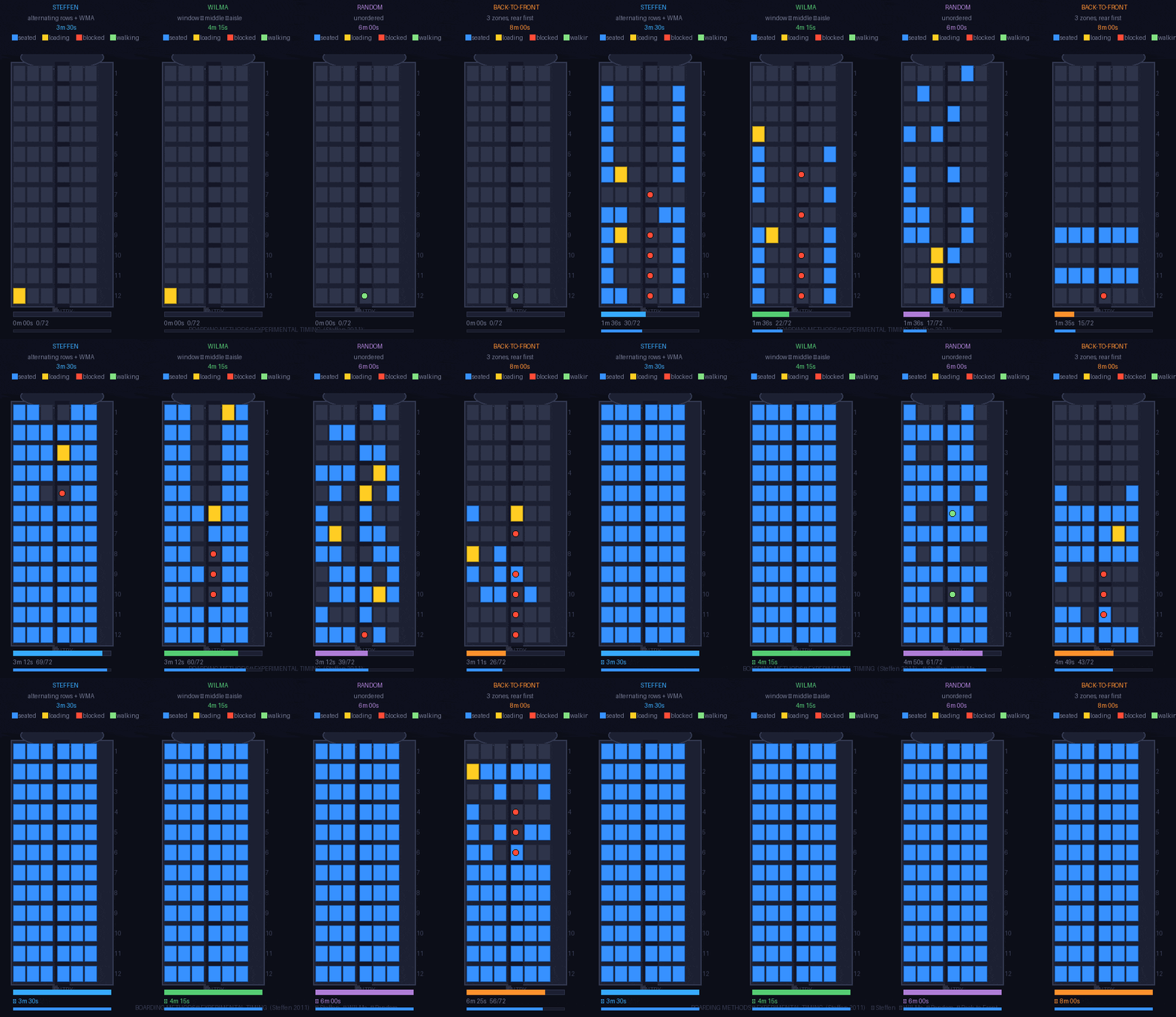
Results were unambiguous: the Steffen method produced boarding times averaging approximately 3 minutes and 30 seconds for the mock aircraft. Random boarding averaged approximately 6 minutes. Back-to-front by zone averaged approximately 8 minutes — slower than random, which confirmed the simulation findings that structured zone strategies with imperfect compliance perform worse than uncontrolled boarding. The WILMa method without alternating rows averaged approximately 4 minutes and 15 seconds, confirming that the window-middle-aisle ordering alone yields significant improvement, but that the alternating-row property produces a further substantial gain.
Key result: the Steffen method was approximately 50 percent faster than random boarding and over 55 percent faster than the standard back-to-front zone method that most major carriers use. No other tested strategy came within 20 percent of its performance.
Model Limitations
Steffen’s model abstracted away several real-world variables that are operationally significant. It assumed
Optimization of sequences is a field shaped in part by George Dantzig, whose simplex method is still taught for such scheduling problems.
- single passengers without companions
- uniform luggage loading times
- perfect compliance with the assigned boarding sequence
None of these assumptions hold in commercial operations. Group travel — families, corporate groups, leisure parties — accounts for a substantial fraction of passengers on most routes and requires contiguous seating that is structurally incompatible with a strict alternating-row sequence. Luggage loading time variance is high: a passenger with a roller bag that fits cleanly is fast; a passenger re-arranging existing bin contents to make space is not.
These limitations do not invalidate the method’s core finding, but they do quantify the gap between laboratory performance and field deployment. Simulations incorporating group travel at realistic rates (30 to 45 percent of passengers on leisure routes) show that the Steffen method’s advantage over random boarding drops from approximately 50 percent to approximately 20 to 25 percent under real conditions. That is still a very large improvement, but it requires realistic calibration to avoid overpromising during implementation planning.
An important alternative finding from the literature is that the WILMa method without strict alternating rows, despite being slower than the full Steffen method, is substantially more tolerant of compliance failures. A boarding sequence that assigns window, middle, and aisle passengers to separate boarding calls without specifying row order within each class is implementable with standard gate boarding systems, captures most of the interference-reduction benefit, and degrades gracefully when compliance is imperfect.
Several carriers have moved toward WILMa-type boarding without adopting the strict Steffen alternating sequence, and their results confirm this partial benefit.
Random No prescribed order | Back-to-Front Zoned, rear first | WILMa Window → Middle → Aisle | Steffen Alternating rows + WMA | |
| Core logic | Passengers enter in arrival order with no sequence enforcement. The operator assigns no positions to boarding groups. | The cabin is divided into 2–4 transverse zones. The rearmost zone boards first, then each successive zone forward. Within each zone, order is arbitrary. | All passengers are split by lateral seat class: window seats (A, F) board as a single group first, then middle (B, E), then aisle (C, D). Row order within each group is not specified. | Combines WILMa’s lateral ordering with an alternating-row interleave: within each seat class, even-numbered rows board before odd-numbered rows. This ensures no two simultaneously active bag-loading events occur in adjacent row positions. |
| Blocking mechanism addressed | None deliberately. Interference events are random and unmitigated. | Attempts to prevent front-of-plane passengers from blocking rear boarders. Fails within each zone because intra-zone row order remains random. | Eliminates lateral blocking (window passenger waiting for aisle passenger to clear the row). Does not address longitudinal aisle clustering. | Eliminates both lateral blocking and longitudinal clustering. The alternating-row gap ensures the aisle is spatially clear between any two simultaneously active loading positions. |
| Implementation complexity | None. | Low. Zone call and basic gate discipline. | Medium. Boarding pass encoding by seat column group. | High. Requires individual seat-level sequence assignment and strict per-passenger call order. |
| Advantages |
|
|
|
|
| Disadvantages |
|
|
|
|
| Works well when… |
|
|
|
|
| Works good when … |
|
|
|
|
| Use when | Default fallback. Use as the baseline in any environment where no sequencing infrastructure exists, or where group-travel exceptions are too numerous to manage. Accept the variance; do not pretend it is a strategy. | Commercial necessity. Use only when loyalty-tier boarding is a non-negotiable commercial requirement. Limit to 2 zones maximum. Accept that it will underperform random boarding in real conditions and plan turnaround times accordingly. | Practical optimum. It captures the majority of available sequencing gain with manageable implementation cost and acceptable compliance tolerance. The correct default for any operation where agent pre-assignment by lateral class is feasible. | Controlled systems only. The theoretical optimum; also the most fragile in the face of real-world variance. In industrial contexts, apply to AGV dispatch, robotic pick sequencing, and WMS-controlled fork truck operations. |
Performance figures from discrete-event simulation (12 rows × 6 seats, ENTRY_GAP=2, LOAD_TICKS=5). Real-world results vary with group-travel rate, luggage variance, and compliance rate. Steffen (2008), J. Air Transport Management.
From Aviation to a General Sequencing Principle
The Steffen Method is frequently described as a solution to an aircraft boarding problem. This framing is too narrow and has likely limited its influence beyond aviation.
The correct description is that the method is a solution to a class of interference problems that arise whenever multiple agents must move through a constrained linear path to reach assigned positions, and where the time cost of the process is dominated by blocking events rather than by travel time.
Structural Features of the Problem Class
Identifying this class of problems precisely is the prerequisite for applying the principle in industrial and logistics contexts. The class has three defining structural features:
The first feature is a constrained path.In the aircraft, this is the aisle. In a warehouse, it is a picking aisle or a loading dock access lane. In a production facility, it is a feeder line or a conveyor segment. The path is constrained in the sense that it permits only one-directional flow and does not allow passing. The critical constraint is not physical narrowness — it is the inability to bypass a blocked agent without leaving the path. | The second feature is assigned destinations along the path.Each agent must reach a specific position: a seat row, a bin location, a shelf slot, a pallet position on a trailer floor. The destinations are not interchangeable, and the assignment is fixed before the sequence begins. This distinguishes the problem from general queuing theory, where the destination is a service point rather than a fixed spatial location. |
The third feature is a local operation at the destination.In the aircraft, this is bag loading. In a warehouse, it is picking or placing a SKU. In a production line, it i s a fixturing or assembly operation. The operation takes a finite time during which the agent is stationary and occupies the path. The duration of this local operation is the primary source of blocking risk. |  |
When all three features are present, the interference dynamics that Steffen modeled in the aircraft context will recur. Agents that are sequenced into adjacent destination positions simultaneously will block each other. Agents sequenced with spatial gaps between their destination positions will not.
The optimization principle — sequence agents such that simultaneously active operations are spatially separated along the constrained path — applies directly.
The Interference Distance Parameter
A useful generalization of the Steffen principle introduces a parameter called interference distance, which is the minimum spatial separation between two simultaneously active destination positions that eliminates blocking.

In the aircraft, interference distance is approximately two seat rows, because a passenger loading overhead bins in row 28 does not physically obstruct a passenger loading bins in row 26 or row 30. In a warehouse picking aisle, interference distance depends on the reach distance of the picking operation and the width of the equipment used (hand, reach truck, or order picker).
Calculating interference distance for a given environment is the first step in applying Steffen-type sequencing outside aviation. The calculation requires knowing the physical footprint of the operating agent during the local operation, the aisle width, and the lateral reach of the operation. In a typical wide-aisle warehouse with reach truck picking, interference distance might be 4 to 6 meters — the combined footprint of the truck with forks extended and the aisle space it occupies during a pick cycle.
In a narrow-aisle environment with man-up order pickers, interference distance is shorter but the aisle itself is more severely constrained, making blocking events more costly when they occur.
Engineering note: interference distance is not a fixed property of the environment; it varies with equipment mix and operation type. If a facility uses multiple equipment types in the same aisle (reach trucks and walkie-riders, for example), the interference distance should be calculated for the largest footprint equipment to ensure the sequencing remains valid under all operating conditions.
Sequence Design vs. Schedule Optimization

A common error when first applying Steffen-type thinking to industrial environments is to conflate sequence design with schedule optimization. Steffen’s insight is about the order of a fixed set of operations — the permutation that minimizes interference. Schedule optimization, in the operations research sense, addresses start times, resource allocation, and makespan minimization across a set of tasks with dependencies and resource constraints. These are related but distinct problems:
The Steffen principle contributes specifically to the sequencing component: given a fixed set of operations that must occur at fixed locations along a constrained path, what order minimizes blocking? It does not, by itself, address how many agents should operate simultaneously, what their travel speed should be, or how to handle dependencies between operations. Those questions require additional optimization layers. The Steffen logic is one input to a larger scheduling problem, not a complete scheduling solution.
In practice, this means that applying Steffen-type sequencing to a manufacturing or logistics context will require integrating it with existing scheduling systems (MES, WMS, TMS) rather than replacing those systems. The sequence output from a Steffen-type analysis becomes a constraint or preference input to the broader schedule. This integration is not technically complex, but it requires that the scheduling system support sequence-constrained dispatching, which many legacy WMS and MES implementations do not.
Application to Warehousing and Order Fulfillment
The warehouse environment is the industrial context most directly analogous to aircraft boarding. The structural match is strong: a warehouse has constrained aisles, each aisle contains fixed storage positions (analogous to seat rows), picking operations are local operations that occupy the aisle for a finite duration, and multiple pickers operating simultaneously in the same aisle will interfere with each other whenever their simultaneously active pick positions are within each other’s interference distance.
Warehouse management has independently developed several concepts related to sequencing efficiency — pick path optimization, zone picking, batch picking, wave planning — but the Steffen framing adds a specific insight that these concepts do not fully capture: the spatial separation of simultaneously active operations is as important as the individual efficiency of each operation.
A perfectly optimized individual pick path can still produce high blocking rates if it is deployed simultaneously with other pickers whose paths bring them into adjacent positions at the same time.
Pick Path Sequencing
The direct application of Steffen-type logic to pick path sequencing involves designing waves or batches such that pickers assigned to the same aisle are sequenced with sufficient spacing in their pick lists to ensure that their simultaneously active pick positions are separated by at least the interference distance at all times during the pick.
In a conventional wave-picking WMS, picks are grouped by wave and assigned to pickers based on zone or weight balancing criteria. Within a wave, the WMS typically sequences picks on each picker’s list using a nearest-neighbor or S-curve algorithm that minimizes travel distance for that individual picker. This individual optimization ignores inter-picker interference. Two pickers can be assigned pick lists that are individually near-optimal but that cause them to converge on adjacent positions in the same aisle at the same time, creating mutual blocking.
The Steffen-type correction is to apply a second-pass sequencing step after individual pick path optimization that checks for predicted spatial conflicts between concurrent pickers and adjusts pick sequencing to maintain interference distance. This is computationally inexpensive if implemented as a constraint-satisfaction pass over the wave plan, because the number of inter-picker conflicts in a well-designed wave is typically small. The adjustment required is usually a minor reordering of picks within individual lists, not a redesign of the path.
Implementation note: in slotted warehouses with fixed pick faces, interference distance analysis should be re-run after any major reslotting event, because changes to SKU positions alter which pick-list combinations generate conflicts. A reslotting that moves a high-velocity SKU from aisle position 45 to position 46 can create new conflict patterns that the existing wave sequencing rules do not anticipate.

Loading Dock Scheduling
The loading dock is a second warehouse subsystem where Steffen-type sequencing applies. A loading dock with multiple door positions and a shared staging area has the structural properties of the boarding problem: the staging area is the constrained path, each door position is an assigned destination, and the act of positioning a loaded pallet at a door is the local operation that creates blocking when two fork trucks converge on adjacent door positions simultaneously.
In most distribution center dock operations, outbound loading is sequenced by departure time — the next truck to depart gets priority for dock labor. This is a reasonable first-order rule, but it ignores the spatial interference effects in the staging area. Two trucks departing within 30 minutes of each other whose door positions are adjacent will compete for staging space and fork truck access during the loading phase in a way that two trucks departing at the same times but assigned to doors at opposite ends of the dock will not.
Applying Steffen-type logic to dock scheduling means adding a spatial separation criterion to the departure-time-based priority rule: among trucks with similar departure priority, assign doors and schedule loading sequences such that simultaneously active loading events are spatially separated.
On a 12-door dock, this means that if doors 3 and 4 are being loaded simultaneously, door 5 should not begin loading until one of the adjacent operations is complete or until the staging footprints have moved sufficiently apart.
Slot Assignment and Slotting Strategy

Steffen-type thinking also informs slotting strategy, specifically the question of where to place high-velocity SKUs relative to each other. Standard slotting practice places high-velocity SKUs in the most accessible positions — typically the golden zone (waist-to-shoulder height) and the positions nearest to the pick-to-pack or ship-sorter induction point. This minimizes travel and ergonomic costs for individual picks.
However, if multiple high-velocity SKUs are slotted in adjacent positions, any pick wave that includes several of these SKUs will predictably cluster pickers in the same aisle segment. The interference cost of this clustering can exceed the travel cost savings from the accessible positioning.
The Steffen-aware slotting approach distributes high-velocity SKUs with spatial separation as an additional criterion alongside the standard ergonomic and travel metrics. This is not always possible given the constraint that the total number of premium slots is limited, but it is a useful tie-breaker when two candidate positions for a SKU are otherwise equivalent.
An alternative approach, suited to larger facilities, is to separate high-velocity SKUs into dedicated fast-pick zones with wide aisles designed to accommodate simultaneous multi-picker operation. This architectural solution removes the interference constraint by increasing aisle width beyond the interference distance for all expected equipment combinations, making the sequencing problem moot. The trade-off is floor space efficiency; wide-aisle fast-pick zones use significantly more square footage per stored position than standard narrow-aisle configurations.
Application to Manufacturing and Supply Chain Logistics
The manufacturing and logistics domain presents a more varied set of application environments than warehousing, because the constrained paths are more diverse in form and the local operations are more varied in duration and spatial footprint. Nonetheless, the underlying interference structure recurs in several important configurations, and the Steffen principle applies with appropriate parameterization in each:
Production Line Loading and Kitting
In assembly manufacturing — automotive, aerospace, electronics, and industrial equipment — components are delivered to fixed assembly stations along a production line. The line itself is the constrained path. Kitting carts, parts trolleys, or AGVs move along the line to deliver components to stations, perform the delivery, and return. The delivery operation at each station is the local operation that occupies the path.

When multiple delivery vehicles are operating simultaneously on the same line segment, they will interfere with each other if their simultaneous active delivery positions are within interference distance. In a high-density line with short station pitch (the spacing between adjacent stations), interference distance may span several stations. The sequencing of delivery runs — which stations are serviced in what order, and how delivery runs are batched across vehicles — directly affects the collision frequency between vehicles.
The Steffen-type optimization for this environment involves designing delivery runs such that no two vehicles in the same line segment are scheduled to be in active delivery mode at adjacent stations simultaneously. This is a stronger constraint than simply avoiding physical collisions (which is typically managed by the AGV guidance system or by line rules), because even a near-miss that requires one vehicle to wait for the other to clear counts as a blocking event with associated time cost.
Engineering note: in AGV-managed lines, the AGV system’s traffic management software typically handles collision avoidance reactively — vehicles slow or stop when proximity sensors detect a conflict. Applying Steffen-type sequencing proactively to the delivery schedule reduces the frequency at which the reactive system is triggered, which reduces both cycle time variability and wear on the AGV fleet from repeated start-stop cycles.
Freight Batching and Last-Mile DeliveryLast-mile delivery route sequencing is a well-studied problem in vehicle routing, but the Steffen principle adds a specific consideration that classical vehicle routing does not fully capture: the interference between delivery vehicles operating in the same street or access zone simultaneously (note: if operated by the same company … it could potentially highlight other planning problems). In dense urban delivery environments, multiple vehicles from the same carrier or from competing carriers will often converge on the same block or address cluster within a short time window, particularly during morning delivery peaks. When two delivery vehicles are simultaneously servicing adjacent addresses in a narrow street or shared loading zone, they create mutual blocking that adds time to both deliveries. Classical vehicle routing minimizes individual route distance or time but does not model inter-vehicle interference. The Steffen-type correction for delivery batching involves adding a temporal separation constraint to the route sequencing: when two vehicles’ routes bring them to adjacent addresses within the same constrained access zone, their arrival times at those addresses should be separated by at least the service time of the first arrival plus a buffer. Tip: this is implementable in modern TMS platforms that support time-window-constrained routing, by encoding the interference avoidance as a pseudo-time-window constraint on the second vehicle’s arrival. | Inbound Receiving and Cross-DockingCross-docking operations, where inbound freight is transferred directly to outbound trailers without storage, involve a staging area that is functionally identical to the aircraft aisle in its interference structure. Inbound pallets are staged in a constrained area while they await outbound door assignment, and the movement of pallets from inbound staging to outbound doors is the constrained-path operation. In a busy cross-dock, the staging area becomes congested when inbound arrivals cluster — which they inevitably do given the imprecision of inbound appointment scheduling. Fork truck operators moving pallets from staging to outbound doors interfere with each other when their simultaneous active pallet positions are adjacent in the staging grid. Steffen-type logic applied to the cross-dock involves sequencing outbound pallet movements such that simultaneously active movements are spatially separated in the staging grid. This requires that the WMS or dock management system track the staging position of each pallet and schedule fork truck dispatch with spatial separation as a constraint. |
Implementation Considerations: Systems, Constraints, and Adoption
The preceding chapters have described how the Steffen principle applies across a range of industrial environments. The consistent finding is that the principle is applicable wherever the structural conditions are met:
- a constrained path,
- assigned destinations,
- local operations that create blocking events.
The engineering logic is sound and, in most cases, computationally tractable. Implementation, however, encounters a predictable set of obstacles that are largely non-technical in nature, and that bear a structural resemblance to the obstacles that have prevented airlines from adopting the method in aviation.
Data Requirements
Implementing Steffen-type sequencing requires, as a prerequisite, accurate real-time position data for all agents operating in the constrained environment. In a warehouse, this means knowing where each picker is and what pick operation they are currently performing. In a production line, it means tracking the position and status of each delivery vehicle. In a cross-dock, it means tracking the current staging position of each pallet and the location of each active fork truck.
Many industrial facilities do not have this data at the granularity required. A WMS may track which wave a picker is assigned to and what their next pick location is, but it may not track their current physical position in real time. A production line may have station-level event tracking but not vehicle-level position tracking between stations.
The absence of this data does not make Steffen-type sequencing impossible, but it forces a more conservative implementation that uses larger interference buffers to compensate for positional uncertainty.
The technology required to provide this data is available and in increasing deployment in modern facilities: RFID-based picker tracking, AGV telemetry, vision-based position systems, and ultra-wideband indoor positioning. The capital cost of these systems has decreased substantially over the past decade, and the business case for deploying them is usually not driven solely by sequencing optimization — the same position data supports directed replenishment, safety compliance monitoring, and labor productivity measurement. Where position tracking infrastructure exists, adding Steffen-type sequencing logic is a software problem, not a hardware investment.
Integration with Existing Scheduling Systems

The second technical constraint is integration with existing WMS, MES, and TMS platforms. The Steffen sequencing logic must be implemented as a module that interfaces with the existing system’s dispatching and order management functions. In most cases, this means modifying the wave planning or dispatch sequencing logic to incorporate spatial separation constraints as a parameter alongside the existing criteria (distance, priority, zone balance, etc.).
Legacy WMS platforms, particularly those deployed more than ten years ago, often have limited configurability in their sequencing engines. The wave planning logic may be hard-coded or accessible only through vendor-specific scripting interfaces. Adding spatial separation as a sequencing criterion may require vendor involvement, a platform upgrade, or a middleware layer that intercepts dispatch signals and applies the spatial constraint before they are sent to pickers.
Modern WMS platforms with configurable rule-based dispatching (Manhattan Associates WM, Blue Yonder, SAP EWM, and several others) can accommodate additional sequencing constraints through their rules configuration interfaces without platform-level modification. The implementation effort in these environments is typically a configuration project rather than a development project, which reduces both cost and risk.
Implementation note: when integrating Steffen-type sequencing into an existing system, start with a simulation run against historical pick data before deploying to live operations. The simulation will identify whether the spatial separation constraints are compatible with the facility’s existing wave sizes and picker staffing levels. Overly tight interference buffers in facilities with high picker density can increase individual travel distances to the point where the interference savings are offset by added travel cost.
The Compliance Problem
The most persistent non-technical barrier to Steffen-type sequencing is the same one that has prevented its adoption in aviation: operator compliance. In the aircraft, passengers deviate from the prescribed sequence because they arrive at the gate at non-uniform times, they travel in groups, and gate agents lack enforcement tools. In industrial environments, the analogous failures occur when pickers deviate from the sequenced pick list to chase a shorter travel path, when fork truck operators prioritize their own efficiency judgment over dispatched sequence, or when supervisors override the sequence to address urgent exceptions without understanding the downstream interference effects.
perfect optimisation <> lower resilience to unexpected events
This is not a failure of operator intelligence or goodwill; it is a structural consequence of local optimization by agents who have visibility into their own immediate situation but not into the spatial state of other agents in the same environment. A picker who sees a shorter path to their next pick and takes it is making a rational local decision. The cost — a potential interference event with another picker — is not visible to them without a system that makes inter-agent spatial state transparent.
The solution is not tighter enforcement of sequence compliance, but better information design: when pickers and fork truck operators can see the current positions and status of other agents in their zone — through a heads-up display, a zone map on a handheld terminal, or audio cues from the WMS — they are capable of making locally adjusted decisions that respect the spatial separation constraint without strict adherence to a predetermined list.
This information-first approach to compliance is more robust than enforcement-based approaches and degrades more gracefully when unexpected events occur.
Organizational Resistance and the Theory-Practice Gap
The pattern observed in aviation — where a demonstrably superior method fails to achieve adoption because operational and organizational incentives favor the status quo — recurs in manufacturing and logistics with different surface characteristics but the same underlying structure.
- In aviation, the barriers are commercial (priority boarding as a revenue product) and behavioral (passenger compliance).
- In industrial settings, the barriers are typically organizational (existing metrics that do not capture interference costs) and political (changes to dispatching logic require IT project approval and cross-functional coordination).
The critical organizational barrier is measurement. If a distribution center measures picker productivity as picks per hour per individual, the pick productivity metric will not capture the interference cost imposed by one picker on another. A picker who moves quickly through a zone and achieves high individual pick rates may be generating high interference costs for adjacent pickers that do not appear in anyone’s performance report. The aggregate labor cost of inter-picker interference is absorbed into the facility’s average pick rate and is invisible to management unless specifically measured.
Making interference costs visible requires adding an interference measurement to the existing productivity reporting. This is possible if the facility has real-time position data: interference events can be defined as instances where two pickers are within interference distance in the same aisle simultaneously, and interference time can be logged as the duration of each such event. Reporting interference rate and interference time per wave alongside individual pick rates gives management a complete picture of where sequencing improvements are generating measurable value.
Without this measurement infrastructure, the Steffen-type sequencing improvement will be difficult to sustain. When an improvement is not measured, it is not managed, and it will erode under the pressure of other operational priorities.
The first implementation step — before changing any sequencing logic — should be to establish a baseline measurement of interference events under the current sequencing regime. This baseline serves both as a diagnostic tool and as the benchmark against which the improvement will be evaluated.
Partial Implementations and Acceptable Approximations
A pragmatic observation from Steffen’s own work applies here: the WILMa variant — window-middle-aisle ordering without strict alternating rows — captured the majority of the Steffen method’s boarding time improvement with substantially simpler implementation requirements. The same principle of partial implementation applies in industrial contexts:
A warehouse that cannot implement full real-time spatial separation sequencing can still capture a large fraction of the available benefit by applying a simpler rule: do not assign two pickers to the same aisle simultaneously unless the aisle is wide enough to accommodate both without interference. This is a binary rule that requires only aisle assignment tracking, which most WMS platforms already support, and no real-time position data. It eliminates the most severe interference events — two pickers in a narrow aisle at the same time — without eliminating all interference, and it is implementable with existing infrastructure.
Similarly, a cross-dock that cannot implement full pallet-level spatial sequencing can apply a simplified rule: do not dispatch two fork trucks to adjacent outbound doors simultaneously. This requires only door-level occupancy tracking, which is typically available in dock management systems. The rule is conservative — it permits some level of interference from pallets that are in transit rather than at the door — but it eliminates the most costly stationary blocking events with minimal system complexity.
These partial implementations are not substitutes for full Steffen-type sequencing, but they represent an accessible first step that generates measurable improvement with low implementation risk. The operational data generated by even a partial implementation — interference rates before and after, pick rate changes, dock labor productivity — builds the organizational evidence base for more sophisticated subsequent implementations.
Outro

The Steffen Method was developed to solve a specific problem in the specific aircraft industry. Its lasting contribution is not the solution itself but the clarity with which it identified the structural conditions that generate interference losses in any sequenced operation through a constrained path. Those conditions — a constrained path, fixed destination assignments, and local operations that create blocking — are not rare.
They appear in every warehouse, on every production line, in every cross-dock, and in every delivery fleet operating in dense urban corridors.
The method does not eliminate the need for engineering judgment. Interference distance must be calculated for each environment. Integration with existing systems requires configuration work. Compliance requires information design rather than enforcement. And partial implementations, while valuable, must be understood as approximations that capture a fraction of available improvement rather than the full potential.
What the method provides, above all, is a principled framing for a class of problems that operations engineering has historically addressed through heuristics and local optimization. Replacing those heuristics with a systematic spatial separation analysis, even in approximate form, yields consistent and measurable gains. The gap between the theoretical optimum and actual industrial practice is, in most facilities that have not considered interference sequencing explicitly, far larger than most engineers expect before they measure it.
FAQ
Does the Steffen method apply outside aviation, or is it specific to aircraft geometry?
It applies to any environment where agents move through a constrained path to perform a local operation at a fixed position — warehouse aisles, loading docks, production line feeder lanes, cross-dock staging areas. The aircraft geometry is the origin of the method, not a prerequisite for it. The alternating-row pattern must be recalculated for each environment using the interference distance specific to that operation and equipment.
Our WMS already optimizes pick paths — why would Steffen-type sequencing add anything?
Pick path optimization minimizes travel distance for one picker operating alone, with no other agents present. Steffen-type sequencing eliminates the blocking events that multiple pickers impose on each other when operating simultaneously in shared aisles — a completely separate problem. Both optimizations are needed and neither substitutes for the other.
What is the minimum data infrastructure required to apply this in a distribution center?
A static implementation — where spatial separation is enforced at wave planning time before operations begin — requires only slot position data, which any WMS already holds. Real-time position tracking is only needed for dynamic implementations that adjust dispatch sequences mid-wave as actual agent positions deviate from plan.
Does Steffen-type sequencing conflict with ABC velocity slotting?
It creates a partial conflict: standard ABC slotting clusters high-velocity SKUs in adjacent positions, which predictably concentrates pickers in the same aisle segment during every wave. The resolution is to apply spatial separation as a tiebreaker during slotting decisions, distributing A-class items across aisle positions rather than consolidating them in a single golden zone segment. The marginal travel distance cost of this distribution is small relative to the cumulative interference savings across all waves.
Back-to-front boarding is slower than random boarding in every experiment — why do airlines still use it?
Because it is structurally compatible with loyalty-tier priority boarding, which is a direct revenue product, and it creates a gate process that passengers perceive as orderly and fair. The throughput cost is real but diffuse — it appears in aggregate turnaround time averages, never as a line item attributable to the boarding sequence rule itself. The same dynamic explains why many industrial operations retain suboptimal sequencing strategies: the cost is invisible in standard reporting.
How does operation duration variance affect the method’s reliability?
The spatial separation guarantee depends on each operation completing before the next agent arrives at an adjacent position. High variance in operation duration — a picker re-arranging bin contents, a fork truck unable to place a pallet cleanly — collapses the planned gap and reintroduces blocking. In high-variance environments, increase the interference buffer proportionally or apply a conservative partial implementation rather than the full alternating-slot sequence.
Is the Steffen method applicable to AGV fleets and automated storage systems?
It is the ideal environment for full Steffen-type implementation, because automated systems eliminate the compliance problem entirely. An AGV fleet dispatched in alternating-slot order requires no position tracking infrastructure beyond what the AGV management system already provides, and the sequence is enforced mechanically rather than behaviorally. This is a configuration change in most modern AGV systems, not a capital investment.
How does the method handle exceptions — urgent orders, equipment breakdowns, group travel equivalents in logistics?
A single out-of-sequence agent can collapse the spatial separation for an entire batch in a strict implementation, which is the method’s primary operational fragility. The practical mitigation is to reserve explicit buffer slots in the sequence for exception handling, and to treat any exception insertion as triggering a re-sequencing of the remaining batch rather than simply inserting the exception at the front of the queue.
What does a realistic partial implementation look like in a manufacturing facility with no position tracking?
The highest-value partial rule requires no technology: do not dispatch two operators or vehicles to adjacent stations simultaneously. This binary constraint, enforceable with station-level occupancy tracking that most MES systems already support, eliminates the most severe blocking events while capturing a large fraction of the full method’s throughput improvement.
How should the interference distance parameter be calculated for a specific facility?
Measure the physical footprint of the operating agent during the local operation — forks extended, picker at full reach, assembly fixture open — including the aisle space it occupies. If the facility uses multiple equipment types in the same aisle, calculate interference distance for the largest footprint combination. Interference distance must be recalculated after any major equipment change or reslotting event, as both alter the spatial dynamics the sequencing was designed to address.
How is performance improvement measured and attributed to sequencing changes specifically?
Define an interference event as any instance where two agents are simultaneously within interference distance in the same constrained path, and log the duration of each event. Reporting interference rate and aggregate interference time per shift, alongside existing individual productivity metrics, isolates the sequencing contribution from other variables. Without this measurement, throughput improvements from sequencing changes are absorbed into average rate improvements and cannot be sustained or defended in budget reviews.
External Links on Steffen Boarding Method
International Standards
(hover the link to see our description of the content)
Glossary of Terms Used
First In First Out (FIFO): a method of inventory management and data processing where the oldest items or data entries are processed or sold before newer ones, ensuring that the first items added are the first to be removed or utilized.
Manufacturing Execution System (MES): a software solution that monitors, controls, and optimizes production processes in real-time, facilitating data collection, tracking of manufacturing operations, and integration with enterprise systems to enhance efficiency and productivity on the shop floor.
Stock Keeping Unit (SKU): a unique identifier assigned to a specific product or item in inventory management, used to track stock levels, sales, and variations in attributes such as size, color, or style.