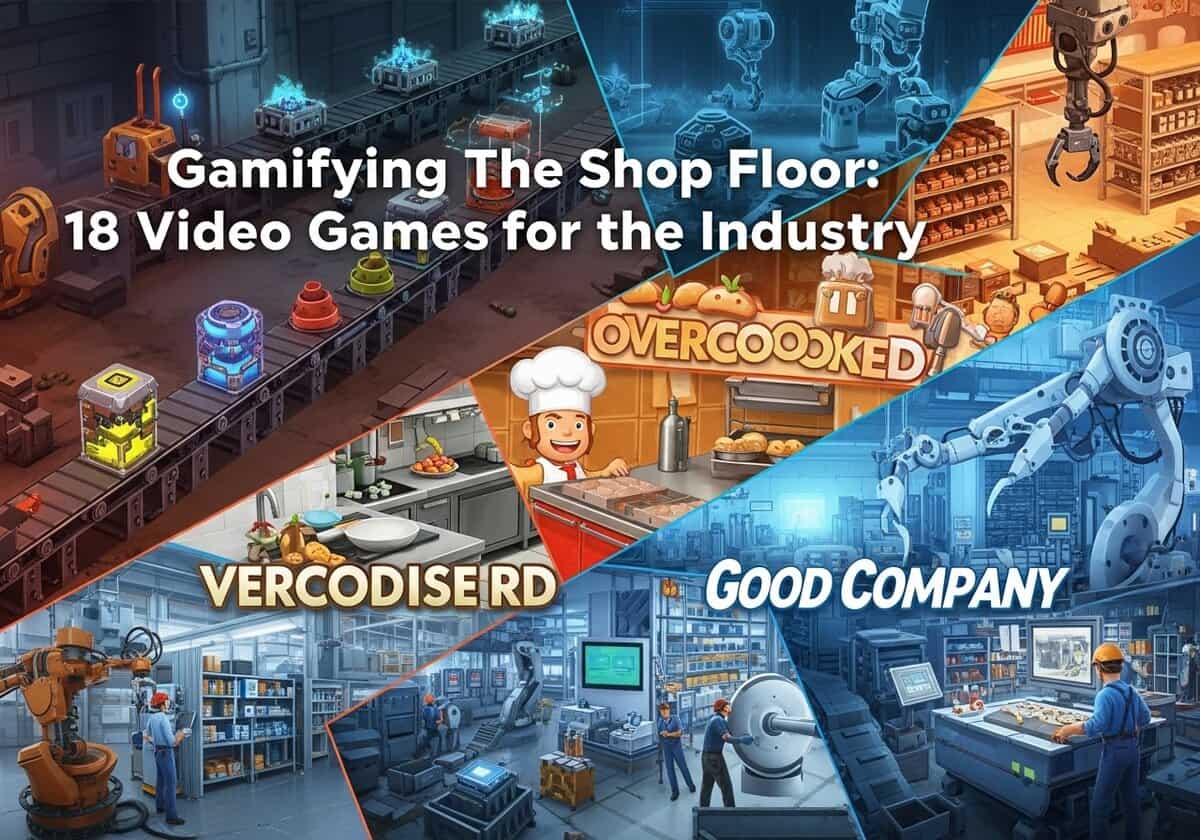
Manufacturing begins in the chaos of the job shop, where the primary constraint is human error and the lack of Standard Operating Procedures. The entry-level simulations in this list expose the friction of manual assembly and batch processing, forcing you to confront the immediate consequences of poor inventory management and workplace ergonomics. As you graduate to the “Fordist” tier, the focus shifts to line balancing and bottleneck analysis, demonstrating that a faster machine is useless if it simply piles inventory in front of a slower one.

At the expert level, these simulations transcend mere production to tackle the architectural complexity of global logistics and embedded systems engineering. Titles in the upper echelon demand a mastery of lean principles, requiring you to design self-correcting supply chains that span continents or star systems. Here, the challenge is no longer keeping the lights on, but optimizing the marginal cost of a single logic gate or ensuring that a resource shortage three nodes away doesn’t trigger a catastrophic cascade failure across your entire industrial empire.
These have the disadvantage of not be playable as table-top games in team sessions … but are worldwide available in many languages.
Our Personal Picks:
Pure Automation & Logistics
These titles define the modern factory automation genre. They focus on scaling production from manual crafting to fully automated mega-structures. The core loop involves resource extraction, complex processing chains, and managing throughput ratios.
Factorio
Top-down 2D open-world construction simulation:
- Players mine resources to build an automated rocket while defending against alien attacks.
- The objective is total automation and infinite scalability.
| Release: 2016 (Early Access), 2020 (Full Release). | Current availability: available on PC (Steam, GOG) and Nintendo Switch. | Gaming reviews: “Overwhelmingly Positive” on Steam (97% of ~150,000+ reviews); sold over 3.5 million copies; widely considered the genre-defining masterpiece. Many extensions. |
|
It teaches bottleneck analysis and some lean manufacturing principles. Players must constantly identify the slowest part of the chain (the constraint) and optimize it, mirroring real-world continuous improvement (Kaizen) and supply chain balancing.
Satisfactory
First-person open-world factory building on an alien planet:
- Focuses on verticality, exploration, and architectural organization of production lines.
- The goal is to construct a massive space elevator through increasingly complex part assembly.
| Release: 2019 (Epic Early Access), 2024 (Version 1.0 Full Release). | Current availability: PC (Steam, Epic); Console versions announced for late 2024/2025. | Gaming reviews: “Overwhelmingly Positive” on Steam (97% of ~150,000+ reviews); sold over 6 million copies. |
|
The first-person perspective highlights the importance of facility layout and spatial logistics. It demonstrates how poor floor planning leads to inefficient routing and visual clutter, simulating the challenges of designing accessible and safe industrial workspaces.
Dyson Sphere Program
Interplanetary industrial simulation spanning a procedurally generated galaxy:
- Players transport resources between star systems to construct a mega-structure around a star.
- The focus is on macro-logistics and managing energy grids across planets.
| Release: 2021 (Early Access) | Current availability: PC (Steam, Microsoft Store) | Gaming reviews: “Overwhelmingly Positive” on Steam (98% of ~70,000+ reviews); sold over 2.5 million copies. |
|
This simulates global (or interstellar) supply chain management. It forces players to manage lead times and transport buffers, showing how distant production hubs require different inventory strategies compared to local manufacturing.
The “Fordism” Simulators
These games simulate specific industrial sectors with a focus on line efficiency and profitability. They emphasize the economic trade-offs between speed, quality, and cost. The gameplay often mirrors the historical development of the assembly line.
Production Line: Car Factory Simulation
Isometric management simulation of a modern car factory:
- Players break down complex tasks into smaller, faster slots to maximize cars per hour.
- The objective is to achieve perfect flow while researching new technologies and competing on market price.
| Release: 2017 (Early Access), 2019 (Full Release) | Current availability: PC (Steam, GOG, Humble) | Gaming reviews: “Very Positive” on Steam (~83% positive); niche success within the management genre. |
|
It is a direct simulation of Henry Ford’s division of labor and Taylorism. It illustrates the concept of line balancing and the trade-off between specialized machinery and flexible production, making it an excellent tool for understanding process engineering.
Automation: The Car Company Tycoon Game
Detailed technical simulation of running an automotive company from 1946 to 2020:
- Players design engines and chassis with granular control over materials and engineering specs.
- The goal is to build vehicles that meet specific market demographic needs and profit margins.
| Release: 2015 (Early Access) | Current availability: PC (Steam); still in active development. | Gaming reviews: “Very Positive” on Steam (~93% positive); highly regarded by automotive enthusiasts for its engine physics. |
|
This title focuses heavily on car design, engineering constraints and KPI, rather line assembly and optimization itself. It demonstrates how material choices (e.g., cast iron vs. aluminum) impact cost, reliability, and manufacturing difficulty, simulating the R&D phase of industrial production.
Big Pharma
Isometric puzzle-strategy game about pharmaceutical manufacturing:
- Players route ingredients through processing machines to alter concentration and remove side effects.
- The objective is to patent and sell cures while managing limited factory floor space.
| Release: 2015 | Current availability: PC, PS4, Xbox One, Nintendo Switch. | Gaming reviews: “Very Positive” on Steam (~80% positive); praised for its unique theme but criticized for UI complexity |
|
The game highlights the relationship between process precision and product quality. It simulates the challenges of fitting complex equipment into fixed footprints and the ethical/economic decisions involved in producing high-quality medication versus cheap, lower-grade alternatives. The “Overcook” game, more serious (less fun?) with some market aspects.
The rest of this article is reserved for members
To limit scraping bots (currently 40,000 hits per day!),
we had to restrict access to full articles and tools to registered members only.
to access all the rest.