从航空科学到工业排序:斯蒂芬登板法。
Sequencing problems are among the oldest and most persistent challenges in operations engineering. Whether the constraint is a narrow aisle, a production bottleneck, a loading dock, or a warehouse corridor, the fundamental question is always the same: in what order should agents, objects, or tasks be processed so that interference between them is minimized and throughput is maximized?
In 2008, a physicist named Jason Steffen published a formal mathematical treatment of one specific instance of this problem: aircraft boarding. His paper, initially modest in scope, produced a sequencing strategy that outperformed every existing airline boarding policy by a significant margin. The result attracted attention well beyond aviation, because the underlying logic was not specific to airplanes.
It was a general principle about how to schedule the movement of discrete agents through a constrained linear environment toward assigned positions.
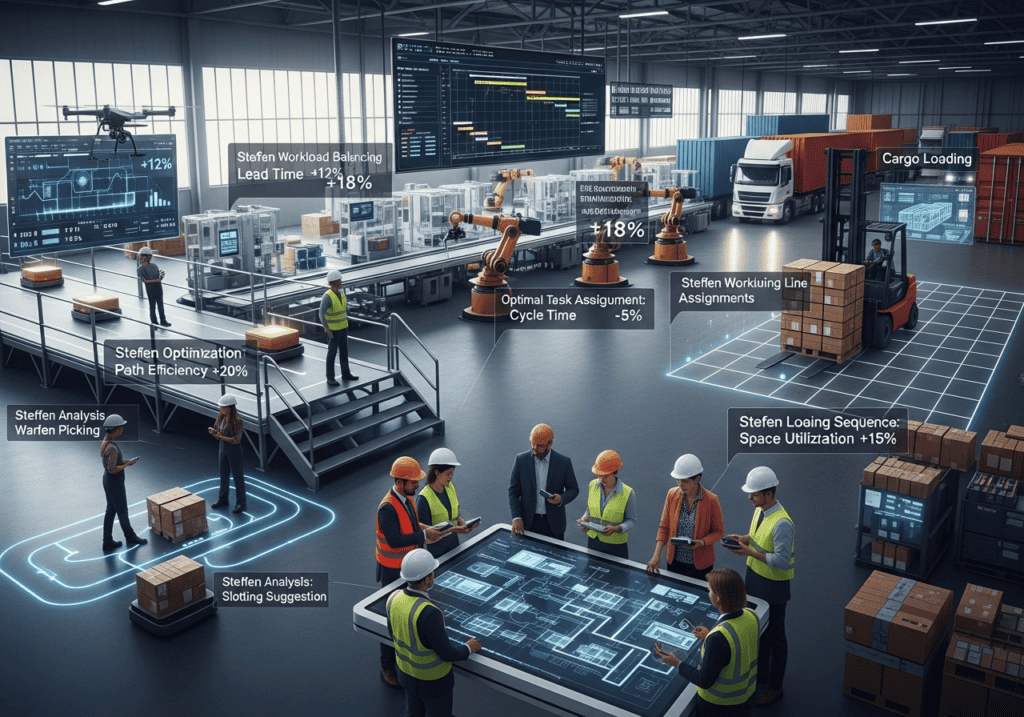
本文全面考察了斯特芬方法,从其科学起源到实验验证,再到未能被商业航空界采用,以及最重要的是,其作为可操作工业框架的可转移性。 对于工程师和运营经理来说,实际价值不在于更高效地登机,而在于认识到 Steffen 所发现的结构模式,并将其应用于任何出现类似干扰动态的地方:仓库拣货作业、货物装载顺序、生产线分配、货物批量处理和最后一公里配送路线。
这类序列问题与经典的路径难题密切相关:旅行商问题的应用包括配送路线、电路板钻孔和仓库拣货。旅行商问题的所有应用都遵循相同的模式,即找到最佳的访问顺序。
关键要点
- Identify the problem class before applying the solution: the Steffen principle applies only when three conditions are simultaneously present: a constrained path that does not allow bypassing, fixed destination assignments along that path, and a local operation at each destination that creates a blocking event. If any of these three is absent, the method does not apply and a different optimization framework is needed.
- Interference distance is the first parameter to calculate: before redesigning any sequence, measure the minimum spatial gap between two simultaneously active operations that eliminates blocking. This number depends on equipment footprint, aisle width, and lateral reach. Every sequencing decision flows from this figure. Using an arbitrary buffer instead of a measured one either wastes capacity or fails to eliminate the interference it was designed to prevent.
- Back-to-front zone logic is the worst structured option in real conditions: in aviation and in any analogous industrial environment, zone-based sequencing that clusters agents into groups without resolving intra-group spatial order produces worse outcomes than no sequencing at all. The zone provides a false sense of control while generating severe clustering within each group. Any facility currently using macro-zone dispatch without intra-zone spatial ordering should treat this as a regression, not a process.
- Individual path optimization and inter-agent interference are separate problems: minimizing each picker’s travel distance or each vehicle’s route length does not reduce the interference those agents impose on each other. A warehouse that has optimized individual pick paths but not inter-picker spatial separation has solved half the problem. The Steffen principle addresses the second half: what sequence of agents eliminates mutual blocking, independent of how efficient each individual trajectory is.
- Partial implementation captures most of the gain at a fraction of the cost: the WILMa variant — lateral class ordering without strict alternating rows — captures the majority of the Steffen method’s benefit with substantially simpler infrastructure requirements. In warehousing terms: sequencing operations by their lateral reach class (deep shelf before mid-shelf before face pick) before enforcing alternating-slot separation yields the largest share of available improvement. Do not delay deployment waiting for full implementation capability.
- Measurement must precede implementation. 干扰事件在标准生产力指标中是不可见的。
- The compliance problem is an information problem, not a discipline problem Agents deviate from optimized sequences because they cannot see the spatial state of other agents in the same constrained path. A picker who shortcuts their route or a fork truck operator who takes an adjacent door simultaneously is making a rational local decision with incomplete information. The solution is to make inter-agent spatial state visible in real time, not to enforce stricter adherence to a predetermined list. Information-driven compliance is more robust and degrades more gracefully under exceptions.
- Steffen排序是AGV车队和机器人拣选器的正确调度逻辑: automated systems eliminate the compliance problem entirely. An AGV fleet or robotic pick system that can be dispatched in a controlled sequence is the ideal environment for full Steffen-type ordering. If the facility has automated material handling but is dispatching vehicles using nearest-task or FIFO logic, it is leaving measurable throughput on the floor. Alternating-slot dispatch is a configuration change, not a capital investment, in most modern AGV management systems.
- Loading dock scheduling should include a spatial separation criterion: standard dock scheduling prioritizes by departure time. Adding a spatial separation rule — among trucks with similar departure priority, do not simultaneously load adjacent doors — eliminates the most costly fork truck interference events in the staging area with no infrastructure investment. Most dock management systems support this as a secondary sort criterion. The operational data required (door position, loading start time) is already captured in virtually every WMS.
- 货位布局策略应将高周转率 SKU 的空间分隔视为一项约束条件,而不是次要考虑因素: placing multiple high-velocity SKUs in adjacent positions optimizes individual pick ergonomics while creating predictable inter-picker clustering in every wave that includes those SKUs. Where two candidate slotting positions are otherwise equivalent, spatial separation from other high-velocity items should be the tiebreaker. In facilities where this is architecturally impossible, a dedicated wide-aisle fast-pick zone that removes the interference constraint entirely is the correct structural response.
- 如果两个候选插槽位置在其他方面是等效的,则与其他高速物品的空间分离应该是决胜局。 在建筑上不可能做到这一点的设施中,完全消除干扰约束的专用宽通道快速拣选区是正确的结构响应。
- High operation-duration variance destroys the spatial separation guarantee: the Steffen method’s interference elimination depends on the loading operation completing before the next agent arrives at an adjacent position. When operation durations vary significantly — a picker who re-arranges bin contents, a fork truck that cannot immediately place a pallet cleanly — the gap that was designed into the sequence collapses and interference recurs. In environments with high duration variance, increase the interference buffer proportionally or apply a conservative partial implementation rather than the full alternating-slot sequence.
- Legacy WMS and MES platforms require a middleware approach, not a replacement: most scheduling systems deployed more than a decade ago have sequencing engines that do not support spatial separation as a native constraint parameter. Adding this logic as a middleware layer that intercepts dispatch signals and applies spatial ordering before they reach the operator is lower risk and lower cost than a platform upgrade. The middleware only needs to read current agent positions and pending operation locations — data that modern position tracking infrastructure already produces.
- The organizational barrier mirrors the technical barrier: both require making invisible costs visible Airlines have not adopted the Steffen method primarily because priority boarding generates revenue and interference costs are diffuse and unmeasured. Manufacturing and logistics operations face the same dynamic: the manager who oversees a zone picks up the phone about a missed shipment, not about the 40 minutes of aggregate fork truck dwell time that accumulated in staging because no one sequenced the door assignments. Making interference costs a line item in operational reporting — not absorbed into labor efficiency averages — is the organizational prerequisite for sustained adoption of any sequencing improvement.
The Economics of Boarding Inefficiency
Aircraft boarding is not a minor operational detail. For a single-aisle narrowbody aircraft operating a short-haul route, the turnaround time between landing and next departure is the primary constraint on aircraft utilization. An airline operating 150-seat aircraft on routes of 90 minutes to 2 hours can realistically schedule five or six rotations per aircraft per day. Boarding accounts for, on average, 15 to 25 minutes of the gate time budget. In a tight schedule, any overrun on boarding propagates directly into delays that compound across the day’s rotations.
这其中的经济影响不容小觑。根据疫情前的运营情况,业内人士估计,窄体客机延误一分钟的成本在60至120美元之间,这其中包含了所有因素:怠速和滑行时的燃油消耗、机组人员时间、登机口费用、对转机旅客的影响,以及根据多个司法管辖区延误触发旅客权利法规的赔偿义务。单架飞机登机时间超出计划10分钟,最低成本为每次600美元。对于一个拥有100架飞机、每架飞机每天两次登机的机队来说,系统性的10分钟登机延误意味着每年超过4000万美元的可避免成本。
The industry has been aware of these figures for decades. Multiple consulting studies and internal airline analyses have modeled boarding time as a lever for improving aircraft utilization. The consistent finding is that current boarding strategies, as actually practiced, perform far below their theoretical potential. The gap is not primarily a function of passenger speed or aircraft configuration; it is a function of sequence design.
The Mechanism of Loss
The time cost of inefficient boarding is generated almost entirely by one phenomenon: aisle blocking.

When a passenger stops to load overhead baggage, they create a stationary obstruction in a single-lane corridor that cannot be bypassed. Every subsequent passenger behind the blocker is stalled. The time lost is not additive across blocked passengers — it is multiplicative, because blocked passengers are themselves occupying aisle positions that prevent passengers further back from reaching their rows, creating a cascade of secondary blockages.
This cascade effect is compounded when passengers in aisle and middle seats are boarded before window seat passengers in the same row. The window-seat passenger must wait while both the aisle and middle seat passengers stand, move into the aisle, allow the window passenger to pass, and then re-seat themselves. Each such event takes 15 to 30 seconds under ideal conditions. On a 150-seat aircraft with a 3-3 configuration, there are 50 rows, and in random or back-to-front boarding, a significant proportion of those rows will experience this lateral blocking event at least once, and many will experience it twice.
Back-to-front boarding, which remains the most widely deployed strategy among major carriers, appears logical at first glance: boarding rear rows first should allow front rows to board without interference from passengers still loading bags further back. In practice, it performs poorly because passengers in the same zone board in arbitrary row order within that zone. A passenger in row 28 who boards before a passenger in row 30 within the same rear zone still creates an aisle blocking event that stalls the row 30 passenger behind them.
The zone discipline controls the macro-sequence but does not resolve the intra-zone interference that drives most of the time loss.
Ground-Level Measurement
Real world scenario …. Time-motion studies conducted at multiple airports over the past fifteen years have produced consistent data. Random boarding — passengers board in no particular order — performs comparably to most structured zone strategies in real-world conditions, because the discipline of zone strategies breaks down during implementation. Passengers arrive at the gate at non-uniform rates, zone compliance is imperfect, families and groups create exceptions that gate agents accommodate, and frequent flyers with priority boarding rights further fragment the sequencing plan.
The result is that most commercial boarding processes, as observed rather than as designed, are effectively random with a light rear-weighted bias. The gap between the theoretical performance of a well-implemented zone strategy and the actual observed boarding time is typically 20 to 35 percent. Gate agents lack the tools and authority to enforce strict sequencing, and the commercial incentives that drive boarding policy — priority boarding as a loyalty benefit, family accommodation as a service standard, group seating as a revenue product — are incompatible with strict sequence optimization.
Operational note: airlines that have measured actual versus planned boarding time on a per-flight basis consistently find that approximately 60 percent of boarding overruns are attributable to aisle blocking events in the first 40 percent of the boarding process. Addressing the sequence of the first boarded cohort yields disproportionate improvement.
These numbers establish the scale of the problem that Steffen set out to solve. The inefficiency is real, measurable, and expensive. The question he asked was whether a mathematically derived sequence could eliminate aisle blocking as a systemic phenomenon rather than as a random event.
The Steffen Method: Origins, Logic, and Experimental Results
Jason Steffen was a postdoctoral researcher in astrophysics when he turned his attention to aircraft boarding in 2008. His background was in Markov chain Monte Carlo methods — statistical simulation techniques used to model systems with large numbers of interacting components evolving through probabilistic state transitions. The boarding problem, viewed through this lens, was a constrained optimization problem with a well-defined cost function: minimize total boarding time by finding the optimal permutation of passenger assignments to boarding sequence positions.
His initial paper, published in the Journal of Air Transport Management, used a computer simulation to evaluate a large number of possible boarding sequences and identify which structural properties correlated with minimum boarding time. The simulation modeled each passenger as an agent requiring a fixed time to stow luggage and a fixed time to move one seat-row forward along the aisle. Blocking events were modeled as delays that propagated backward through the queue. The model did not account for group travel, irregular luggage, or gate compliance failures, which is relevant to understanding both its predictive accuracy and its limitations.
The Structural Logic
The sequence Steffen identified as optimal has three defining properties:
- First, window seats board before middle seats, which board before aisle seats — the so-called WILMa (window, middle, aisle) ordering.
- 其次,在每个座位等级中,乘客按交替的排排列,而不是连续的排。
- Third, the alternating-row sequencing is applied from rear to front within each class.
The alternating-row property is the critical and non-obvious element. If all window-seat passengers board simultaneously in consecutive row order from rear to front, they still create clustering at the overhead bins. A passenger in row 28 window and a passenger in row 29 window will compete for adjacent bin space and their simultaneous bag-loading events will create mutual interference even though they are not blocking each other in the aisle in the traditional sense.
By alternating rows — row 28, then row 26, then row 24, creating gaps between simultaneously active loading zones — the method ensures that each active bag-loading event occurs in spatial isolation. No two simultaneously boarding passengers are adjacent.
This spatial separation is the mechanism that eliminates aisle blocking as a systemic event. Passengers are never in a position where one is loading overhead bins while the next passenger in sequence needs to pass them. The corridor is always clear at the position immediately ahead of any active loading event.
Experimental Validation
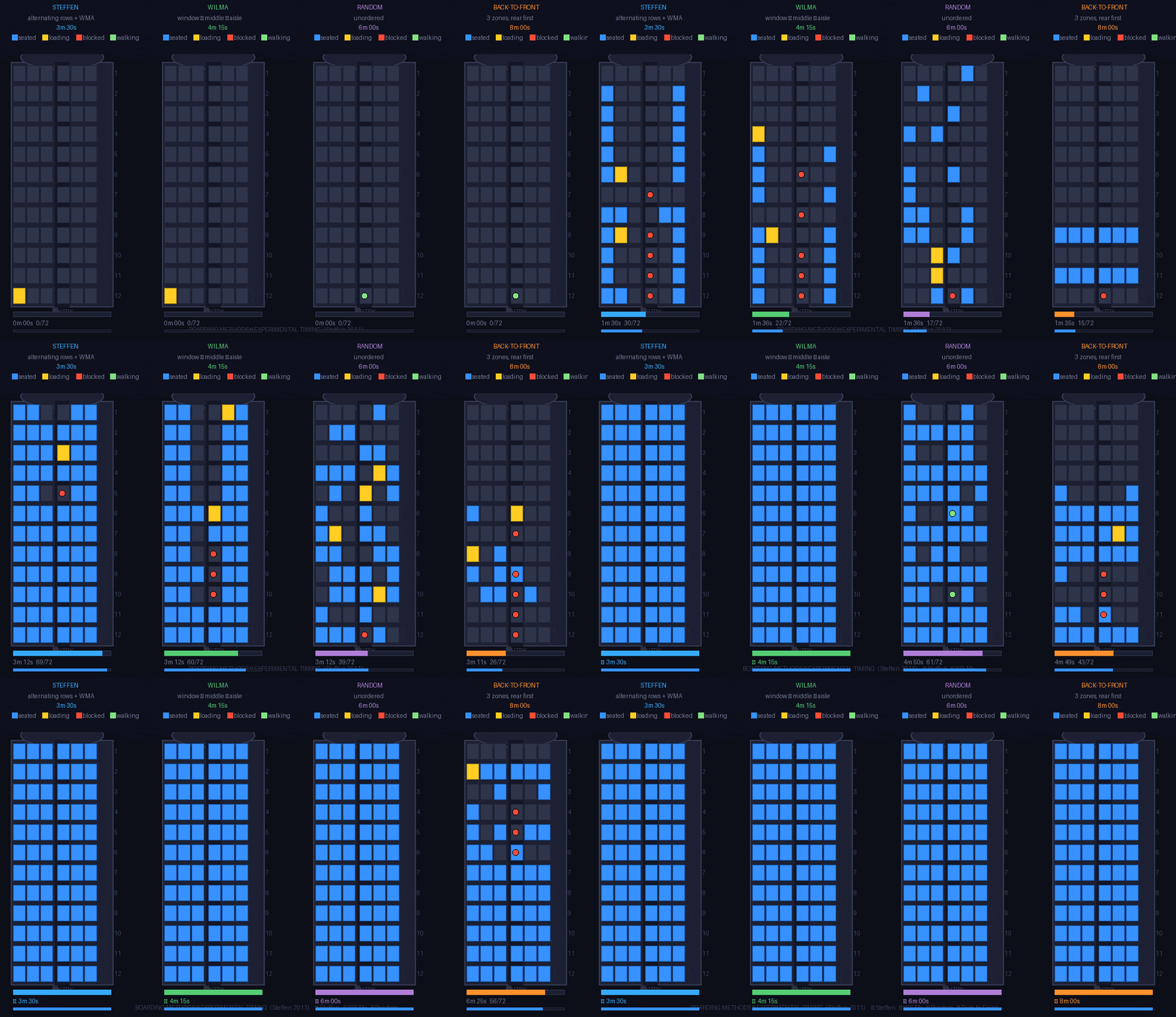
模拟结果令人瞩目,足以引起媒体关注。但斯特芬随后于2011年在洛杉矶一家电影制片厂进行了一项受控的物理实验。实验中使用了模拟飞机内部空间,包括座椅、头顶行李舱,并招募了携带随身行李的真实志愿者乘客。该实验在受控条件下比较了六种登机策略,并采用随机分配参与者的方式,以最大限度地减少选择效应。
The six strategies tested were: random boarding (no sequence), back-to-front by block (two zones), back-to-front by row, the WILMa method (window-middle-aisle without alternating rows), the Steffen method (alternating WILMa), and a rotating zone variant. Each strategy was run multiple times with different participant groups.
Results were unambiguous: the Steffen method produced boarding times averaging approximately 3 minutes and 30 seconds for the mock aircraft. Random boarding averaged approximately 6 minutes. Back-to-front by zone averaged approximately 8 minutes — slower than random, which confirmed the simulation findings that structured zone strategies with imperfect compliance perform worse than uncontrolled boarding. The WILMa method without alternating rows averaged approximately 4 minutes and 15 seconds, confirming that the window-middle-aisle ordering alone yields significant improvement, but that the alternating-row property produces a further substantial gain.
Key result: the Steffen method was approximately 50 percent faster than random boarding and over 55 percent faster than the standard back-to-front zone method that most major carriers use. No other tested strategy came within 20 percent of its performance.
Model Limitations
Steffen’s model abstracted away several real-world variables that are operationally significant. It assumed
序列优化领域在一定程度上是由乔治·丹齐格 (George Dantzig) 开创的,他的单纯形法至今仍被用于解决此类调度问题。
- single passengers without companions
- uniform luggage loading times
- perfect compliance with the assigned boarding sequence
None of these assumptions hold in commercial operations. Group travel — families, corporate groups, leisure parties — accounts for a substantial fraction of passengers on most routes and requires contiguous seating that is structurally incompatible with a strict alternating-row sequence. Luggage loading time variance is high: a passenger with a roller bag that fits cleanly is fast; a passenger re-arranging existing bin contents to make space is not.
These limitations do not invalidate the method’s core finding, but they do quantify the gap between laboratory performance and field deployment. Simulations incorporating group travel at realistic rates (30 to 45 percent of passengers on leisure routes) show that the Steffen method’s advantage over random boarding drops from approximately 50 percent to approximately 20 to 25 percent under real conditions. That is still a very large improvement, but it requires realistic calibration to avoid overpromising during implementation planning.
An important alternative finding from the literature is that the WILMa method without strict alternating rows, despite being slower than the full Steffen method, is substantially more tolerant of compliance failures. A boarding sequence that assigns window, middle, and aisle passengers to separate boarding calls without specifying row order within each class is implementable with standard gate boarding systems, captures most of the interference-reduction benefit, and degrades gracefully when compliance is imperfect.
Several carriers have moved toward WILMa-type boarding without adopting the strict Steffen alternating sequence, and their results confirm this partial benefit.
Random No prescribed order | Back-to-Front Zoned, rear first | WILMa Window → Middle → Aisle | Steffen Alternating rows + WMA | |
| Core logic | Passengers enter in arrival order with no sequence enforcement. The operator assigns no positions to boarding groups. | The cabin is divided into 2–4 transverse zones. The rearmost zone boards first, then each successive zone forward. Within each zone, order is arbitrary. | All passengers are split by lateral seat class: window seats (A, F) board as a single group first, then middle (B, E), then aisle (C, D). Row order within each group is not specified. | Combines WILMa’s lateral ordering with an alternating-row interleave: within each seat class, even-numbered rows board before odd-numbered rows. This ensures no two simultaneously active bag-loading events occur in adjacent row positions. |
| Blocking mechanism addressed | None deliberately. Interference events are random and unmitigated. | Attempts to prevent front-of-plane passengers from blocking rear boarders. Fails within each zone because intra-zone row order remains random. | Eliminates lateral blocking (window passenger waiting for aisle passenger to clear the row). Does not address longitudinal aisle clustering. | 消除横向阻塞和纵向集群。 |
| 交替行间隙确保任何两个同时有效的装载位置之间的通道在空间上畅通无阻。 | None. | Low. Zone call and basic gate discipline. | Medium. Boarding pass encoding by seat column group. | High. Requires individual seat-level sequence assignment and strict per-passenger call order. |
| 优势 |
|
|
|
|
| 缺点 |
|
|
|
|
| Works well when… |
|
|
|
|
| Works good when … |
|
|
|
|
| Use when | Default fallback. Use as the baseline in any environment where no sequencing infrastructure exists, or where group-travel exceptions are too numerous to manage. Accept the variance; do not pretend it is a strategy. | Commercial necessity. Use only when loyalty-tier boarding is a non-negotiable commercial requirement. Limit to 2 zones maximum. Accept that it will underperform random boarding in real conditions and plan turnaround times accordingly. | Practical optimum. It captures the majority of available sequencing gain with manageable implementation cost and acceptable compliance tolerance. The correct default for any operation where agent pre-assignment by lateral class is feasible. | Controlled systems only. The theoretical optimum; also the most fragile in the face of real-world variance. In industrial contexts, apply to AGV dispatch, robotic pick sequencing, and WMS-controlled fork truck operations. |
Performance figures from discrete-event simulation (12 rows × 6 seats, ENTRY_GAP=2, LOAD_TICKS=5). Real-world results vary with group-travel rate, luggage variance, and compliance rate. Steffen (2008), J. Air Transport Management.
从航空到通用排序原则
斯蒂芬方法常被描述为解决飞机登机问题的方案。这种定义过于狭隘,可能限制了其在航空领域之外的影响。
正确的描述是,该方法是解决一类干扰问题的方案,这类干扰问题是指当多个代理人必须沿着受限的线性路径移动才能到达指定位置时,该过程的时间成本主要受阻塞事件的影响,而不是受旅行时间的影响。
问题类的结构特征
准确识别这类问题是将该原则应用于工业和物流领域的前提。这类问题具有三个显著的结构特征:
第一个特点是路径受限。在飞机上,这叫做过道。在仓库里,这叫做拣货通道或装卸货平台通道。在生产车间里,这叫做给料线或传送带段。这条路径是受限的,因为它只允许单向通行,不允许错身。 关键的限制不是物理上的狭窄——而是无法在不离开路径的情况下绕过被阻挡的代理。 | 第二个特点是沿途分配目的地。每个搬运工必须到达特定位置:座位排、货箱位置、货架位或货车地板上的托盘位置。目的地不可互换,且在任务开始前已确定。 这使该问题与一般排队论中的问题区别开来,在一般排队论中,目的地是服务点而不是固定的空间位置。 |
第三个特点是在目的地进行本地操作。在飞机上,这指的是行李装载。在仓库里,这指的是拣选或放置SKU。在生产线上,这指的是…… 夹具或装配操作。该操作耗时有限,在此期间,代理保持静止并占据路径。此局部操作的持续时间是阻塞风险的主要来源。 |  |
当这三个特征同时存在时,Steffen 在飞机环境中模拟的干扰动态就会重现。同时到达相邻目的地的智能体会相互阻挡;而目的地之间存在空间间隙的智能体则不会。
优化原则——即对代理进行排序,使得同时进行的操作在空间上沿约束路径分离——可以直接应用。
干扰距离参数
Steffen 原理的一个有用推广引入了一个称为干扰距离的参数,它是两个同时活动的目标位置之间的最小空间距离,可以消除阻塞。

在飞机上,干扰距离大约是两排座位,因为在第 28 排装载行李的乘客不会在物理上阻碍在第 26 排或第 30 排装载行李的乘客。在仓库拣货通道中,干扰距离取决于拣货操作的触及距离和所用设备(手动、前移式叉车或拣货车)的宽度。
在航空以外的领域应用斯蒂芬式排序的第一步,就是计算特定环境下的干扰距离。该计算需要了解操作人员在本地作业期间的物理占地面积、通道宽度以及作业的横向范围。在典型的宽巷道仓库中,使用前移式叉车进行拣选时,干扰距离可能为 4 至 6 米——这是叉车伸出货叉后的占地面积加上其在一个拣选周期内占用的通道空间的总和。
在通道狭窄、拣货员站立作业的环境中,干扰距离较短,但通道本身受到的限制更为严格,因此发生阻塞事件时造成的损失更大。
工程注释: 干扰距离并非环境的固定属性,而是随设备组合和操作类型而变化。如果同一通道内使用多种设备(例如,前移式叉车和步行式叉车),则应计算占地面积最大的设备的干扰距离,以确保在所有操作条件下作业顺序仍然有效。
序列设计与进度优化

在工业环境中首次应用斯蒂芬式思维时,一个常见的错误是将顺序设计与调度优化混为一谈。斯蒂芬的洞见在于一组固定操作的顺序——即能够最大限度减少干扰的排列组合。而运筹学意义上的调度优化,则关注于在存在依赖关系和资源约束的一系列任务中,如何优化开始时间、资源分配以及最小化完工时间。这些是相关但又不同的问题:
Steffen原理主要针对排序问题:给定一组必须在受限路径上的固定位置执行的操作,如何安排操作顺序才能最大程度地减少阻塞?它本身并不能解决应该有多少个代理同时操作、它们的行进速度应该是多少,或者如何处理操作之间的依赖关系等问题。这些问题需要额外的优化层来解决。Steffen逻辑只是更大型调度问题的一个输入,而不是一个完整的调度解决方案。
实际上,这意味着将 Steffen 型排序应用于制造或物流环境需要将其与现有的调度系统(MES、WMS、TMS)集成,而不是替换这些系统。Steffen 型分析的排序输出将成为更广泛调度方案的约束或偏好输入。这种集成在技术上并不复杂,但它要求调度系统支持基于顺序的调度,而许多传统的 WMS 和 MES 系统并不支持这一点。
应用于仓储和订单履行
仓库环境是与飞机登机最直接相似的工业环境。二者在结构上高度相似:仓库通道狭窄,每个通道包含固定的存储位置(类似于座位排),拣货作业是占用通道且持续时间有限的局部作业,多个拣货员在同一通道内同时作业时,只要他们的同时作业位置处于彼此的干扰范围内,就会相互干扰。
仓库管理独立发展出了几个与排序效率相关的概念——拣货路径优化、区域拣货、批量拣货、波次计划—— 但 Steffen 的框架增加了一个这些概念没有完全捕捉到的具体见解:同时进行的运行的空间分离与每个运行的单独效率同样重要。
即使单个拣货路径经过完美优化,如果与其他拣货器同时部署,而其他拣货器的路径又使它们同时到达相邻位置,则仍然会产生很高的阻塞率。
拾取路径排序
将 Steffen 型逻辑直接应用于拣货路径排序涉及设计波次或批次,以便将分配到同一通道的拣货员的拣货清单按顺序排列,并留有足够的间距,以确保他们在拣货过程中同时进行的拣货位置始终至少间隔干扰距离。
在传统的波次拣货仓库管理系统(WMS)中,拣货任务按波次分组,并根据区域或重量平衡标准分配给拣货员。在同一波次内,WMS通常使用最近邻算法或S曲线算法对每个拣货员的拣货清单进行排序,以最大限度地减少每个拣货员的行走距离。这种个体优化忽略了拣货员之间的相互干扰。两个拣货员的拣货清单可能各自接近最优,但却导致他们同时到达同一通道的相邻位置,从而造成相互阻塞。
Steffen 型校正是在单个拾取路径优化之后,应用第二遍排序步骤,检查并发拾取器之间预测的空间冲突,并调整拾取顺序以保持干扰距离。如果将其作为对波次计划的约束满足过程来实现,则计算成本很低,因为设计良好的波次中拾取器之间的冲突数量通常很少。所需的调整通常只是对各个拾取列表中的拾取顺序进行微调,而不是重新设计路径。
实施说明: 在设有固定拣货面的槽位式仓库中,任何重大的货架位置调整后都应重新进行干扰距离分析,因为 SKU 位置的改变会影响哪些拣货单组合会产生冲突。例如,将高周转率 SKU 从 45 号货架位置移至 46 号货架位置的调整,可能会产生现有波次排序规则无法预见的新的冲突模式。

装卸码头调度
装卸货平台是第二个仓库子系统,适用 Steffen 型排序算法。具有多个门位和共享暂存区的装卸货平台具备装货问题的结构特征:暂存区是受限路径,每个门位都是一个指定的目的地,而将装载好的托盘放置在门位上是局部操作,当两辆叉车同时驶向相邻门位时,就会产生阻塞。
在大多数配送中心的装卸作业中,出库装货是按出发时间排序的——下一辆出发的卡车优先获得装卸工人的作业时间。这虽然是一条合理的初步规则,但却忽略了暂存区的空间干扰效应。两辆出发时间相隔不到30分钟且装卸门位置相邻的卡车,在装货阶段会争夺暂存空间和叉车作业权限;而两辆出发时间相同但装卸门位置不同的卡车则不会出现这种情况。
将 Steffen 型逻辑应用于码头调度意味着在基于出发时间的优先级规则中添加空间分离标准:在出发优先级相似的卡车中,分配车门并安排装载顺序,使得同时进行的装载事件在空间上分离。
在 12 门装卸平台上,这意味着如果 3 号门和 4 号门同时装货,则 5 号门不应开始装货,直到相邻操作之一完成或装卸区之间的距离足够大为止。
时位分配和时位策略

Steffen-type thinking also informs slotting strategy, specifically the question of where to place high-velocity SKUs relative to each other. Standard slotting practice places high-velocity SKUs in the most accessible positions — typically the golden zone (waist-to-shoulder height) and the positions nearest to the pick-to-pack or ship-sorter induction point. This minimizes travel and ergonomic costs for individual picks.
然而,如果多个高周转率的SKU被放置在相邻的货架位置,那么任何包含其中几个SKU的拣货波次都必然会导致拣货员聚集在同一通道段。这种聚集造成的干扰成本可能会超过便捷货架位置带来的出行成本节省。
Steffen 感知货架位分配方法在标准的人体工程学和运输指标之外,还以空间分离作为附加标准来分配高周转率 SKU。由于优质货架位总数有限,这种方法并非总是可行,但当两个候选 SKU 位置在其他方面都相同时,它不失为一个有效的决胜因素。
另一种更适合大型仓库的方案是将高周转率的SKU划分到专用的快速拣货区,并设置宽阔的通道,以适应多名拣货员同时操作。这种架构方案通过增加通道宽度,使其超过所有预期设备组合的干扰距离,从而消除了干扰限制,使排序问题不再重要。但其缺点是占用空间较大;宽通道快速拣货区每个存储位置占用的面积明显大于标准的窄通道配置。
应用于制造业和供应链物流
与仓储相比,制造和物流领域的应用环境更加多样化,因为受限路径的形式更加多样,局部操作的持续时间和空间范围也更加复杂。尽管如此,在几种重要的配置中,潜在的干扰结构仍然反复出现,并且在每种配置中,只要进行适当的参数化,Steffen 原理都适用:
生产线装载和套件
在装配制造领域——例如汽车、航空航天、电子和工业设备——零部件沿着生产线被运送到固定的装配工位。生产线本身就是一条受限路径。物料车、零件推车或自动导引车(AGV)沿着生产线移动,将零部件运送到各个工位,完成装配,然后返回。每个工位的装配作业就是占用该路径的局部作业。

当多辆配送车辆同时在同一线路段上运行时,如果它们的配送位置处于干扰距离内,就会相互干扰。在站点间距较小(相邻站点之间的距离)的高密度线路中,干扰距离可能跨越多个站点。配送顺序——即配送站点的先后顺序以及配送任务在不同车辆间的分批处理方式——直接影响车辆间的碰撞频率。
针对这种环境,Steffen 型优化算法旨在设计配送路线,确保同一线路段内任意两辆车不会同时在相邻站点处于配送状态。这比仅仅避免物理碰撞(通常由 AGV 导航系统或线路规则控制)更为严格,因为即使是险些相撞的情况,只要其中一辆车需要等待另一辆车通过,也会被视为阻塞事件,并产生相应的时间成本。
工程注释: 在AGV管理的生产线中,AGV系统的交通管理软件通常以被动的方式处理碰撞规避——当接近传感器检测到冲突时,车辆减速或停止。主动地将Steffen式排序应用于配送计划,可以降低被动系统触发的频率,从而减少循环时间波动,并降低AGV车队因反复启停造成的磨损。
货运批量处理和最后一公里配送最后一公里配送路线排序是车辆路径规划中一个研究较为深入的问题,但 Steffen 原理增加了一个经典车辆路径规划未能完全考虑到的具体因素:在同一街道或通道区域内同时运行的配送车辆之间的干扰(注意:如果由同一家公司运营……则可能会凸显其他规划问题)。 在人口密集的城市配送环境中,来自同一承运商或竞争对手的多辆配送车辆经常会在短时间内汇聚到同一街区或同一地址群,尤其是在早高峰时段。当两辆配送车辆同时在狭窄的街道或共享装卸区为相邻地址提供服务时,它们会相互阻塞,从而增加双方的配送时间。 传统的车辆路径规划方法可以最大限度地减少单个车辆的行驶距离或时间,但无法模拟车辆间的相互干扰。 Steffen 型配送批次校正涉及在路线排序中添加时间分离约束:当两辆车的路线将它们带到同一受限访问区域内的相邻地址时,它们到达这些地址的时间至少应相隔第一次到达的服务时间加上一个缓冲区。 提示: 在支持时间窗口约束路由的现代 TMS 平台上,可以通过将干扰避免编码为第二辆车到达的伪时间窗口约束来实现这一点。 | 入库接收和交叉转运交叉转运作业是指将入库货物直接转运至出库拖车,无需仓储。该作业涉及一个暂存区,其结构与飞机通道的干涉结构基本相同。入库托盘在等待分配出库门期间,会被暂存于一个受限区域内;托盘从入库暂存区到出库门的移动过程即为受限路径作业。 在繁忙的转运中心,由于入库预约安排的不精确性,入库货物聚集在暂存区时,暂存区就会变得拥挤。当叉车操作员同时操作的托盘位置在暂存区网格中相邻时,他们就会互相干扰,从而影响从暂存区到出库门的运输。 应用于交叉转运的斯蒂芬逻辑涉及对出库托盘移动进行排序,使同时进行的移动在暂存网格中空间上彼此分离。这要求仓库管理系统 (WMS) 或码头管理系统跟踪每个托盘的暂存位置,并以空间分离为约束条件来安排叉车调度。 |
实施注意事项:系统、约束和采用
前几章描述了斯特芬原理如何在各种工业环境中应用。一致的结论是,只要满足结构条件,该原理就适用:
- 一条受限的路径,
- 指定目的地,
- 导致阻塞事件的本地操作。
工程逻辑是合理的,而且在大多数情况下,计算上也是可行的。然而,实施过程中会遇到一系列可以预见的障碍,这些障碍大多是非技术性的,并且在结构上与航空公司在航空领域采用该方法所遇到的障碍非常相似。
数据要求
实施 Steffen 型排序的前提条件是,需要掌握受限环境中所有操作人员的准确实时位置数据。在仓库中,这意味着要知道每个拣货员的位置以及他们当前正在执行的拣货操作。在生产线上,这意味着要跟踪每辆送货车辆的位置和状态。在交叉转运中心,这意味着要跟踪每个托盘的当前暂存位置以及每辆正在使用的叉车的位置。
许多工业设施无法获得所需粒度的数据。仓库管理系统 (WMS) 可以跟踪拣货员被分配到哪个波次以及他们的下一个拣货位置,但可能无法实时跟踪他们的当前物理位置。生产线可能具备工位级别的事件跟踪功能,但无法跟踪工位之间的车辆位置。.
虽然缺少这些数据,但这并不妨碍进行 Steffen 型测序,但这迫使我们采用更保守的实现方式,即使用更大的干扰缓冲区来补偿位置不确定性。
提供这些数据所需的技术已经成熟,并在现代设施中得到日益广泛的应用:基于RFID的拣货员跟踪、AGV遥测、基于视觉的定位系统以及超宽带室内定位。这些系统的购置成本在过去十年中大幅下降,其部署的商业价值通常并非仅仅源于排序优化——同样的定位数据还可用于定向补货、安全合规性监控和劳动生产率评估。在已具备位置跟踪基础设施的情况下,添加Steffen类型的排序逻辑只是一个软件问题,而非硬件投资。
与现有调度系统的集成

第二个技术限制是与现有WMS、MES和TMS平台的集成。Steffen排序逻辑必须以模块的形式实现,并与现有系统的调度和订单管理功能进行接口。在大多数情况下,这意味着需要修改波浪规划或调度排序逻辑,将空间分离约束作为参数纳入现有标准(距离、优先级、区域平衡等)之中。
传统WMS平台,尤其是部署超过十年的平台,其排序引擎的可配置性通常有限。波次规划逻辑可能被硬编码,或者只能通过特定供应商的脚本接口访问。将空间间隔作为排序标准可能需要供应商参与、平台升级,或者需要一个中间件层来拦截调度信号,并在将其发送给拣货员之前应用空间约束。
现代WMS平台(例如Manhattan Associates WM、Blue Yonder、SAP EWM等)具备可配置的基于规则的调度功能,无需修改平台层级,即可通过其规则配置接口适应额外的排序约束。在这些环境中,实施工作通常属于配置项目而非开发项目,从而降低了成本和风险。
实施说明: 将 Steffen 型排序系统集成到现有系统时,应先利用历史拣货数据进行模拟运行,然后再部署到实际操作中。模拟运行将确定空间隔离限制是否与工厂现有的拣货波次和拣货员配置水平相符。在拣货员密度高的工厂中,过窄的干扰缓冲区会增加单个拣货员的行走距离,以至于节省的干扰被增加的行走成本所抵消。
合规问题
阻碍斯蒂芬式排序的最大非技术性障碍,与航空业采用该排序方法的障碍相同:运营方的合规性。在飞机上,乘客会偏离预定的顺序,因为他们到达登机口的时间不统一,而且他们往往结伴而行,登机口工作人员也缺乏有效的执行手段。在工业环境中,类似的失误也会出现:拣货员为了追求更短的路线而偏离排序后的拣货清单;叉车操作员优先考虑自身效率而忽视调度顺序;或者主管在不了解后续影响的情况下,为了处理紧急突发情况而擅自更改顺序。
完美优化 降低对突发事件的应变能力
这并非操作员缺乏智能或善意,而是其局部优化策略的结构性后果。这些操作员只能看到自身所处环境,却无法感知同一环境中其他操作员的空间状态。例如,拣货员如果发现一条通往下一个拣货点的路径更短并选择走这条路,这便是理性的局部决策。然而,如果没有一个能够透明化操作员间空间状态的系统,操作员就无法感知到这种策略的代价——与其他拣货员发生潜在冲突的风险。
解决之道并非加强对序列合规性的执行,而是改进信息设计: 当拣货员和叉车操作员能够通过抬头显示器、手持终端上的区域地图或 WMS 的音频提示看到其区域内其他人员的当前位置和状态时,他们就能够做出符合空间分离限制的本地调整决策,而无需严格遵守预定的列表。
这种以信息为先的合规方法比以强制执行为基础的方法更稳健,并且在发生意外事件时能够更优雅地降级。
组织阻力与理论实践差距
航空业观察到的这种模式——即一种明显更优越的方法未能得到采用,因为运营和组织激励机制倾向于维持现状——在制造业和物流业中反复出现,尽管表面特征不同,但底层结构相同。
- 在航空领域,障碍既有商业方面的(优先登机作为一种盈利产品),也有行为方面的(乘客的配合程度)。
- 在工业环境中,障碍通常是组织上的(现有指标无法反映干扰成本)和政治上的(调度逻辑的改变需要 IT 项目批准和跨职能协调)。
组织层面的关键障碍在于衡量标准。如果配送中心以每人每小时拣货次数来衡量拣货员的生产效率,那么这一指标就无法反映出一位拣货员对另一位拣货员造成的干扰成本。一位拣货员虽然在拣货区内移动迅速,个人拣货效率很高,但可能对相邻的拣货员造成了很高的干扰成本,而这些成本并不会体现在任何人的绩效报告中。拣货员间干扰的总人工成本会被计入配送中心的平均拣货效率中,除非进行专门的测量,否则管理层无法察觉。
要使干扰成本可视化,需要在现有的生产力报告中增加干扰测量指标。如果工厂拥有实时位置数据,这便可实现:干扰事件可以定义为两名拣货员同时位于同一通道且处于干扰范围内的情况,干扰时间可以记录为每次此类事件的持续时间。将每波次的干扰率和干扰时间与单个拣货员的拣货率一起报告,可以让管理层全面了解排序改进在哪些方面产生了可衡量的价值。
如果没有这种测量基础设施,Steffen 式排序改进就难以持续。如果一项改进没有被测量,就无法进行管理,最终会在其他运营优先事项的压力下逐渐消失。
在更改任何测序逻辑之前,首要的实施步骤应该是建立当前测序方案下干扰事件的基线测量值。该基线既可用作诊断工具,也可用作评估改进效果的基准。
部分实现和可接受的近似值
Steffen 本人的一项务实观察也适用于此:WILMa 变体——即采用靠窗-中间-过道顺序,但不严格交替排列——在实现要求显著降低的情况下,实现了 Steffen 方法的大部分登机时间缩短效果。这种部分实施的原则同样适用于工业领域:
即使仓库无法实现完全实时的空间分离排序,仍然可以通过应用更简单的规则来获得大部分可用效益: 除非通道足够宽,可以容纳两名拣货员而不会互相干扰,否则不要同时安排两名拣货员在同一通道上工作。 这是一条二元规则,仅需通道分配跟踪(大多数仓库管理系统平台已支持此功能),无需实时位置数据。它能消除最严重的干扰事件——例如两名拣货员同时在狭窄通道内作业——但无法完全消除所有干扰,而且可以利用现有基础设施进行实施。
同样,无法实现完整托盘级空间排序的交叉转运中心可以应用简化的规则: 不要同时派两辆叉车到相邻的出货门。 这只需要对装卸货位进行门级占用情况跟踪,而这通常在装卸管理系统中即可实现。该规则较为保守——允许运输途中的托盘(而非已到达装卸货位的托盘)造成一定程度的阻碍——但它以最小的系统复杂性消除了代价最高的固定阻塞事件。
这些局部实施方案并不能完全替代完整的斯蒂芬式排序方案,但它们代表了一个易于操作的第一步,能够在较低的实施风险下带来可衡量的改进。即使是局部实施方案也能产生运营数据——例如实施前后的干扰率、拣货率变化以及码头工人生产率——从而为后续更复杂的实施方案构建组织层面的证据基础。
其他

斯特芬方法最初是为了解决特定航空业的特定问题而开发的。它真正的贡献不在于解决方案本身,而在于它清晰地识别出了在任何受限路径上的顺序操作中产生干扰损耗的结构性条件。这些条件——受限路径、固定目的地分配以及造成阻塞的局部操作——并非罕见。
它们出现在每个仓库、每条生产线、每个转运站以及在人口密集的城市走廊中运营的每个送货车队中。
该方法并不能完全消除工程判断的必要性。干扰距离必须针对每种环境进行计算。与现有系统的集成需要进行配置工作。合规性需要信息设计而非强制执行。部分实施虽然有价值,但必须理解为近似值,它只能捕捉到可用改进的一小部分,而非全部潜力。
该方法最重要的作用在于,它为一类问题提供了一个原则性的框架,而运筹学历来都是通过启发式方法和局部优化来解决这类问题。即使只是近似地用系统的空间分离分析来取代这些启发式方法,也能带来持续且可衡量的收益。在大多数尚未明确考虑干扰排序的工厂中,理论最优值与实际工业实践之间的差距远比大多数工程师在测量之前预想的要大得多。
常问问题
Steffen 方法是否适用于航空以外的领域,还是仅适用于飞机几何形状?
该方法适用于任何智能体沿受限路径移动并在固定位置执行局部操作的环境,例如仓库通道、装卸货平台、生产线供料通道和交叉转运暂存区。飞行器几何形状是该方法的起源,而非其必要条件。对于每种环境,都必须使用特定操作和设备的干扰距离重新计算交替行模式。
我们的 WMS 已经优化了拣货路径——为什么 Steffen 型排序还能增加什么呢?
拣货路径优化旨在最大限度地缩短单个拣货员单独作业时的行走距离,前提是没有其他拣货员在场。Steffen 型排序则消除了多个拣货员在共享通道中同时作业时相互阻塞的情况——这是一个完全不同的问题。这两种优化方法都不可或缺,彼此不能替代。
在配送中心应用此功能所需的最低数据基础设施是什么?
静态实现方案(即在作业开始前的波次规划阶段强制执行空间分离)仅需要槽位位置数据,而任何仓库管理系统 (WMS) 都已具备此数据。实时位置跟踪仅适用于动态实现方案,该方案会在作业进行过程中,根据实际代理位置与计划位置的偏差调整调度顺序。
Steffen 型排序与 ABC 速度槽划分是否冲突?
这会造成部分冲突:标准的ABC货架定位方式会将高周转率的SKU集中在相邻位置,这不可避免地导致拣货员在每一波次中都集中在同一个通道段。解决方案是在货架定位决策中采用空间分离作为决胜因素,将A类商品分散到不同的通道位置,而不是集中放在单一的黄金区域。这种分散方式的边际移动距离成本相对于所有波次中累计减少的干扰而言很小。
在所有实验中,从后往前登机都比随机登机慢——为什么航空公司仍然使用这种方式?
因为它在结构上与会员等级优先登机(一种直接盈利的产品)相兼容,并且创造了一种乘客认为有序公平的登机流程。吞吐量成本是真实存在的,但却是分散的——它体现在总体周转时间平均值中,而不是作为登机顺序规则本身的单独项目列出。同样的道理也解释了为什么许多工业运营仍然采用次优的排序策略:这种成本在标准报告中是看不见的。
操作持续时间的变化如何影响该方法的可靠性?
空间分离保证取决于每个操作在下一个代理到达相邻位置之前完成。操作持续时间的较大波动(例如拣货员重新整理货箱内容物,或叉车无法干净利落地放置托盘)会导致预定间隙缩小,并重新引入阻塞。在高波动性环境中,应按比例增加干扰缓冲区,或采用保守的部分实现方案,而不是完整的交替时隙序列。
Steffen 方法是否适用于 AGV 车队和自动化存储系统?
这是全面实施 Steffen 式自动化系统的理想环境,因为自动化系统彻底解决了合规性问题。采用交替时隙调度的 AGV 车队无需 AGV 管理系统之外的任何位置跟踪基础设施,并且调度顺序是通过机械方式而非行为方式强制执行的。这在大多数现代 AGV 系统中只是配置上的更改,无需资本投资。
该方法如何处理异常情况——紧急订单、设备故障、物流中的团体旅行等?
在严格的实现中,单个顺序错误的代理就可能导致整个批次的空间分离崩溃,这是该方法的主要操作缺陷。实际的缓解措施是在序列中预留显式的缓冲区空间用于异常处理,并将任何异常插入视为触发剩余批次的重新排序,而不是简单地将异常插入队列的前端。
在没有位置跟踪功能的制造工厂中,实际可行的部分实施方案是什么样的?
最高价值的部分规则无需任何技术:禁止同时派遣两名操作员或车辆前往相邻站点。这条二元约束可通过大多数MES系统已支持的站点级占用跟踪功能强制执行,它既能消除最严重的阻塞事件,又能充分利用完整方法的大部分吞吐量提升效果。
如何计算特定设施的干扰距离参数?
测量操作代理在本地作业期间的物理占地面积——叉车伸展、拣选器完全伸展、装配夹具打开——包括其占用的通道空间。如果工厂在同一通道中使用多种设备类型,则计算占地面积最大的组合的干扰距离。任何重大设备变更或重新布局事件发生后,都必须重新计算干扰距离,因为这两种情况都会改变排序设计所要解决的空间动态问题。
如何衡量性能提升并将其具体归因于排序变化?
将干扰事件定义为两个代理同时位于同一受限路径上的干扰距离内的任何情况,并记录每次事件的持续时间。报告每班次的干扰率和总干扰时间,以及现有的个人生产力指标,可以将排序的贡献与其他变量的影响区分开来。如果没有这项测量,排序变更带来的吞吐量提升将被平均速率的提升所抵消,从而无法在预算审查中得到维持或论证。
关于斯蒂芬登板法的外部链接
(将鼠标悬停在链接上即可查看内容描述)
常用术语表
First In First Out (FIFO): 一种库存管理和数据处理方法,其中最旧的项目或数据条目在较新的项目之前被处理或出售,以确保最先添加的项目最先被移除或使用。
Manufacturing Execution System (MES): 一款软件解决方案,可实时监控、控制和优化生产流程,方便数据收集、制造操作跟踪以及与企业系统的集成,从而提高车间效率和生产力。
Stock Keeping Unit (SKU): 库存管理中分配给特定产品或物品的唯一标识符,用于跟踪库存水平、销售情况以及尺寸、颜色或样式等属性的变化。