From Aviation Science to Industrial Sequencing: the Steffen Boarding तरीका.
Sequencing problems are among the oldest and most persistent challenges in operations engineering. Whether the constraint is a narrow aisle, a production bottleneck, a loading dock, or a warehouse corridor, the fundamental question is always the same: in what order should agents, objects, or tasks be processed so that interference between them is minimized and throughput is maximized?
In 2008, a physicist named Jason Steffen published a formal mathematical treatment of one specific instance of this problem: aircraft boarding. His paper, initially modest in scope, produced a sequencing strategy that outperformed every existing airline boarding policy by a significant margin. The result attracted attention well beyond aviation, because the underlying logic was not specific to airplanes.
It was a general principle about how to schedule the movement of discrete agents through a constrained linear environment toward assigned positions.
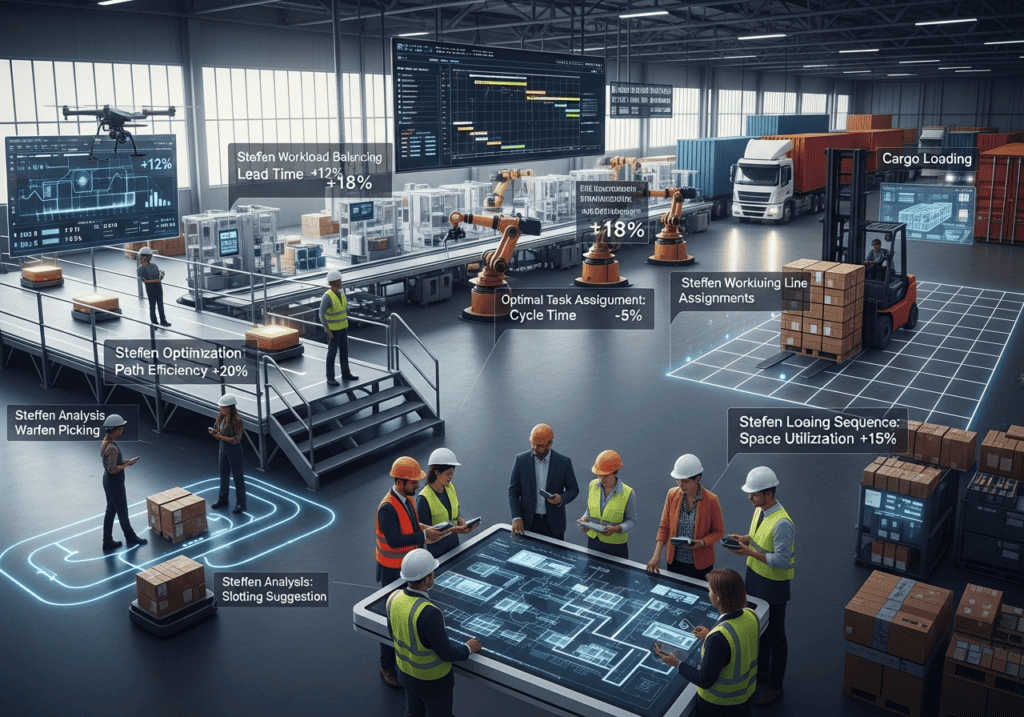
This article examines the Steffen Method in full, from its scientific origins through its experimental सत्यापन, its failure to gain adoption in commercial aviation, and most importantly, its transferability as an operational industrial framework. The practical value for engineers and operations managers lies not in boarding aircraft more efficiently, but in recognizing the structural pattern Steffen identified and applying it wherever similar interference dynamics occur: warehouse pick operations, cargo loading sequences, उत्पादन line assignments, freight batching, and last-mile delivery routing.
मुख्य बातें
- Identify the problem class before applying the solution: the Steffen principle applies only when three conditions are simultaneously present: a constrained path that does not allow bypassing, fixed destination assignments along that path, and a local operation at each destination that creates a blocking event. If any of these three is absent, the method does not apply and a different optimization framework is needed.
- Interference distance is the first parameter to calculate: before redesigning any sequence, measure the minimum spatial gap between two simultaneously active operations that eliminates blocking. This number depends on equipment footprint, aisle width, and lateral reach. Every sequencing decision flows from this figure. Using an arbitrary buffer instead of a measured one either wastes capacity or fails to eliminate the interference it was designed to prevent.
- Back-to-front zone logic is the worst structured option in real conditions: in aviation and in any analogous industrial environment, zone-based sequencing that clusters agents into groups without resolving intra-group spatial order produces worse outcomes than no sequencing at all. The zone provides a false sense of control while generating severe clustering within each group. Any facility currently using macro-zone dispatch without intra-zone spatial ordering should treat this as a regression, not a process.
- Individual path optimization and inter-agent interference are separate problems: minimizing each picker’s travel distance or each vehicle’s route length does not reduce the interference those agents impose on each other. A warehouse that has optimized individual pick paths but not inter-picker spatial separation has solved half the problem. The Steffen principle addresses the second half: what sequence of agents eliminates mutual blocking, independent of how efficient each individual trajectory is.
- Partial implementation captures most of the gain at a fraction of the cost: the WILMa variant — lateral class ordering without strict alternating rows — captures the majority of the Steffen method’s benefit with substantially simpler infrastructure requirements. In warehousing terms: sequencing operations by their lateral reach class (deep shelf before mid-shelf before face pick) before enforcing alternating-slot separation yields the largest share of available improvement. Do not delay deployment waiting for full implementation capability.
- Measurement must precede implementation. मानक उत्पादकता मापदंडों में हस्तक्षेप की घटनाएं अदृश्य होती हैं।
- The compliance problem is an information problem, not a discipline problem Agents deviate from optimized sequences because they cannot see the spatial state of other agents in the same constrained path. A picker who shortcuts their route or a fork truck operator who takes an adjacent door simultaneously is making a rational local decision with incomplete information. The solution is to make inter-agent spatial state visible in real time, not to enforce stricter adherence to a predetermined list. Information-driven compliance is more robust and degrades more gracefully under exceptions.
- Steffen sequencing is the correct dispatch logic for AGV fleets and रोबोटिक pickers: automated systems eliminate the compliance problem entirely. An AGV fleet or robotic pick system that can be dispatched in a controlled sequence is the ideal environment for full Steffen-type ordering. If the facility has automated material handling but is dispatching vehicles using nearest-task or FIFO logic, it is leaving measurable throughput on the floor. Alternating-slot dispatch is a configuration change, not a capital investment, in most modern AGV management systems.
- Loading dock scheduling should include a spatial separation criterion: standard dock scheduling prioritizes by departure time. Adding a spatial separation rule — among trucks with similar departure priority, do not simultaneously load adjacent doors — eliminates the most costly fork truck interference events in the staging area with no infrastructure investment. Most dock management systems support this as a secondary sort criterion. The operational data required (door position, loading start time) is already captured in virtually every WMS.
- Slotting strategy should treat spatial separation of उच्च वेग SKUs as a constraint, not a secondary concern: एकाधिक उच्च-वेग SKU को आसन्न स्थितियों में रखने से व्यक्तिगत चयन अनुकूलित हो जाता है एर्गोनॉमिक्स while creating predictable inter-picker clustering in every wave that includes those SKUs. Where two candidate slotting positions are otherwise equivalent, spatial separation from other high-velocity items should be the tiebreaker. In facilities where this is architecturally impossible, a dedicated wide-aisle fast-pick zone that removes the interference constraint entirely is the correct structural response.
- Cross-dock staging is structurally identical to the aircraft aisle problem: a staging area with constrained fork truck access and fixed outbound door positions has all three structural features of the Steffen problem class. Pallet movements from staging to outbound doors should be sequenced so that simultaneously active movements are spatially separated in the staging grid. Facilities that already track pallet staging positions in their WMS can implement this as a dispatch sequencing rule with no hardware change.
- High operation-duration variance destroys the spatial separation guarantee: the Steffen method’s interference elimination depends on the loading operation completing before the next agent arrives at an adjacent position. When operation durations vary significantly — a picker who re-arranges bin contents, a fork truck that cannot immediately place a pallet cleanly — the gap that was designed into the sequence collapses and interference recurs. In environments with high duration variance, increase the interference buffer proportionally or apply a conservative partial implementation rather than the full alternating-slot sequence.
- Legacy WMS and MES platforms require a middleware approach, not a replacement: most scheduling systems deployed more than a decade ago have sequencing engines that do not support spatial separation as a native constraint parameter. Adding this logic as a middleware layer that intercepts dispatch signals and applies spatial ordering before they reach the operator is lower risk and lower cost than a platform upgrade. The middleware only needs to read current agent positions and pending operation locations — data that modern position tracking infrastructure already produces.
- The organizational barrier mirrors the technical barrier: both require making invisible costs visible Airlines have not adopted the Steffen method primarily because priority boarding generates revenue and interference costs are diffuse and unmeasured. Manufacturing and logistics operations face the same dynamic: the manager who oversees a zone picks up the phone about a missed shipment, not about the 40 minutes of aggregate fork truck dwell time that accumulated in staging because no one sequenced the door assignments. Making interference costs a line item in operational reporting — not absorbed into labor efficiency averages — is the organizational prerequisite for sustained adoption of any sequencing improvement.
The Economics of Boarding Inefficiency
Aircraft boarding is not a minor operational detail. For a single-aisle narrowbody aircraft operating a short-haul route, the turnaround time between landing and next departure is the primary constraint on aircraft utilization. An airline operating 150-seat aircraft on routes of 90 minutes to 2 hours can realistically schedule five or six rotations per aircraft per day. Boarding accounts for, on average, 15 to 25 minutes of the gate time budget. In a tight schedule, any overrun on boarding propagates directly into delays that compound across the day’s rotations.
The economic weight of this is not trivial. Industry estimates from pre-pandemic operations consistently placed the cost of a one-minute block delay for a narrowbody aircraft at between 60 and 120 USD when all factors are included: fuel burn at idle and taxi, crew time, gate fees, connecting passenger impacts, and compensation obligations under delay-triggered passenger rights नियमों in multiple jurisdictions. A boarding process that runs 10 minutes over its planned duration on a single aircraft costs, at the low end, 600 USD per occurrence. Across a fleet of 100 aircraft making two gate appearances per day each, a systemic 10-minute boarding overrun represents over 40 million USD in annualized avoidable costs.
The industry has been aware of these figures for decades. Multiple consulting studies and internal airline analyses have modeled boarding time as a lever for improving aircraft utilization. The consistent finding is that current boarding strategies, as actually practiced, perform far below their theoretical potential. The gap is not primarily a function of passenger speed or aircraft configuration; it is a function of sequence design.
The Mechanism of Loss
The time cost of inefficient boarding is generated almost entirely by one phenomenon: aisle blocking.

When a passenger stops to load overhead baggage, they create a stationary obstruction in a single-lane corridor that cannot be bypassed. Every subsequent passenger behind the blocker is stalled. The time lost is not additive across blocked passengers — it is multiplicative, because blocked passengers are themselves occupying aisle positions that prevent passengers further back from reaching their rows, creating a cascade of secondary blockages.
This cascade effect is compounded when passengers in aisle and middle seats are boarded before window seat passengers in the same row. The window-seat passenger must wait while both the aisle and middle seat passengers stand, move into the aisle, allow the window passenger to pass, and then re-seat themselves. Each such event takes 15 to 30 seconds under ideal conditions. On a 150-seat aircraft with a 3-3 configuration, there are 50 rows, and in random or back-to-front boarding, a significant proportion of those rows will experience this lateral blocking event at least once, and many will experience it twice.
Back-to-front boarding, which remains the most widely deployed strategy among major carriers, appears logical at first glance: boarding rear rows first should allow front rows to board without interference from passengers still loading bags further back. In practice, it performs poorly because passengers in the same zone board in arbitrary row order within that zone. A passenger in row 28 who boards before a passenger in row 30 within the same rear zone still creates an aisle blocking event that stalls the row 30 passenger behind them.
The zone discipline controls the macro-sequence but does not resolve the intra-zone interference that drives most of the time loss.
Ground-Level Measurement
Real world scenario …. Time-motion studies conducted at multiple airports over the past fifteen years have produced consistent data. Random boarding — passengers board in no particular order — performs comparably to most structured zone strategies in real-world conditions, because the discipline of zone strategies breaks down during implementation. Passengers arrive at the gate at non-uniform rates, zone compliance is imperfect, families and groups create exceptions that gate agents accommodate, and frequent flyers with priority boarding rights further fragment the sequencing plan.
The result is that most commercial boarding processes, as observed rather than as designed, are effectively random with a light rear-weighted bias. The gap between the theoretical performance of a well-implemented zone strategy and the actual observed boarding time is typically 20 to 35 percent. Gate agents lack the tools and authority to enforce strict sequencing, and the commercial incentives that drive boarding policy — priority boarding as a loyalty benefit, family accommodation as a service standard, group seating as a revenue product — are incompatible with strict sequence optimization.
Operational note: airlines that have measured actual versus planned boarding time on a per-flight basis consistently find that approximately 60 percent of boarding overruns are attributable to aisle blocking events in the first 40 percent of the boarding process. Addressing the sequence of the first boarded cohort yields disproportionate improvement.
These numbers establish the scale of the problem that Steffen set out to solve. The inefficiency is real, measurable, and expensive. The question he asked was whether a mathematically derived sequence could eliminate aisle blocking as a systemic phenomenon rather than as a random event.
The Steffen Method: Origins, Logic, and Experimental Results
जेसन स्टेफेन खगोल भौतिकी में पोस्टडॉक्टोरल शोधकर्ता थे जब उन्होंने 2008 में विमान में सवार होने की घटनाओं पर अपना ध्यान केंद्रित किया। उनकी पृष्ठभूमि मार्कोव श्रृंखला में थी। मोंटे कार्लो methods — statistical simulation techniques used to model systems with large numbers of interacting components evolving through probabilistic state transitions. The boarding problem, viewed through this lens, was a constrained optimization problem with a well-defined cost function: minimize total boarding time by finding the optimal permutation of passenger assignments to boarding sequence positions.
His initial paper, published in the Journal of Air Transport Management, used a computer simulation to evaluate a large number of possible boarding sequences and identify which structural properties correlated with minimum boarding time. The simulation modeled each passenger as an agent requiring a fixed time to stow luggage and a fixed time to move one seat-row forward along the aisle. Blocking events were modeled as delays that propagated backward through the queue. The model did not account for group travel, irregular luggage, or gate compliance failures, which is relevant to understanding both its predictive accuracy and its limitations.
The Structural Logic
The sequence Steffen identified as optimal has three defining properties:
- सबसे पहले, मध्य सीटों से पहले विंडो सीट बोर्ड, जो गलियारे की सीटों से पहले बोर्ड होता है - तथाकथित विल्मा (खिड़की, मध्य, गलियारा) ऑर्डरिंग।
- Second, within each seat class, passengers are sequenced in alternating rows rather than consecutive rows.
- Third, the alternating-row sequencing is applied from rear to front within each class.
The alternating-row property is the critical and non-obvious element. If all window-seat passengers board simultaneously in consecutive row order from rear to front, they still create clustering at the overhead bins. A passenger in row 28 window and a passenger in row 29 window will compete for adjacent bin space and their simultaneous bag-loading events will create mutual interference even though they are not blocking each other in the aisle in the traditional sense.
By alternating rows — row 28, then row 26, then row 24, creating gaps between simultaneously active loading zones — the method ensures that each active bag-loading event occurs in spatial isolation. No two simultaneously boarding passengers are adjacent.
This spatial separation is the mechanism that eliminates aisle blocking as a systemic event. Passengers are never in a position where one is loading overhead bins while the next passenger in sequence needs to pass them. The corridor is always clear at the position immediately ahead of any active loading event.
Experimental Validation
The simulation results were striking enough to attract media attention, but Steffen followed up with a controlled physical experiment conducted in 2011 at a फिल्म studio in Los Angeles, using a mock aircraft interior with seats, overhead bins, and real volunteer passengers with carry-on luggage. The experiment compared six boarding strategies under controlled conditions with randomized participant assignments to minimize selection effects.
The six strategies tested were: random boarding (no sequence), back-to-front by block (two zones), back-to-front by row, the WILMa method (window-middle-aisle without alternating rows), the Steffen method (alternating WILMa), and a rotating zone variant. Each strategy was run multiple times with different participant groups.
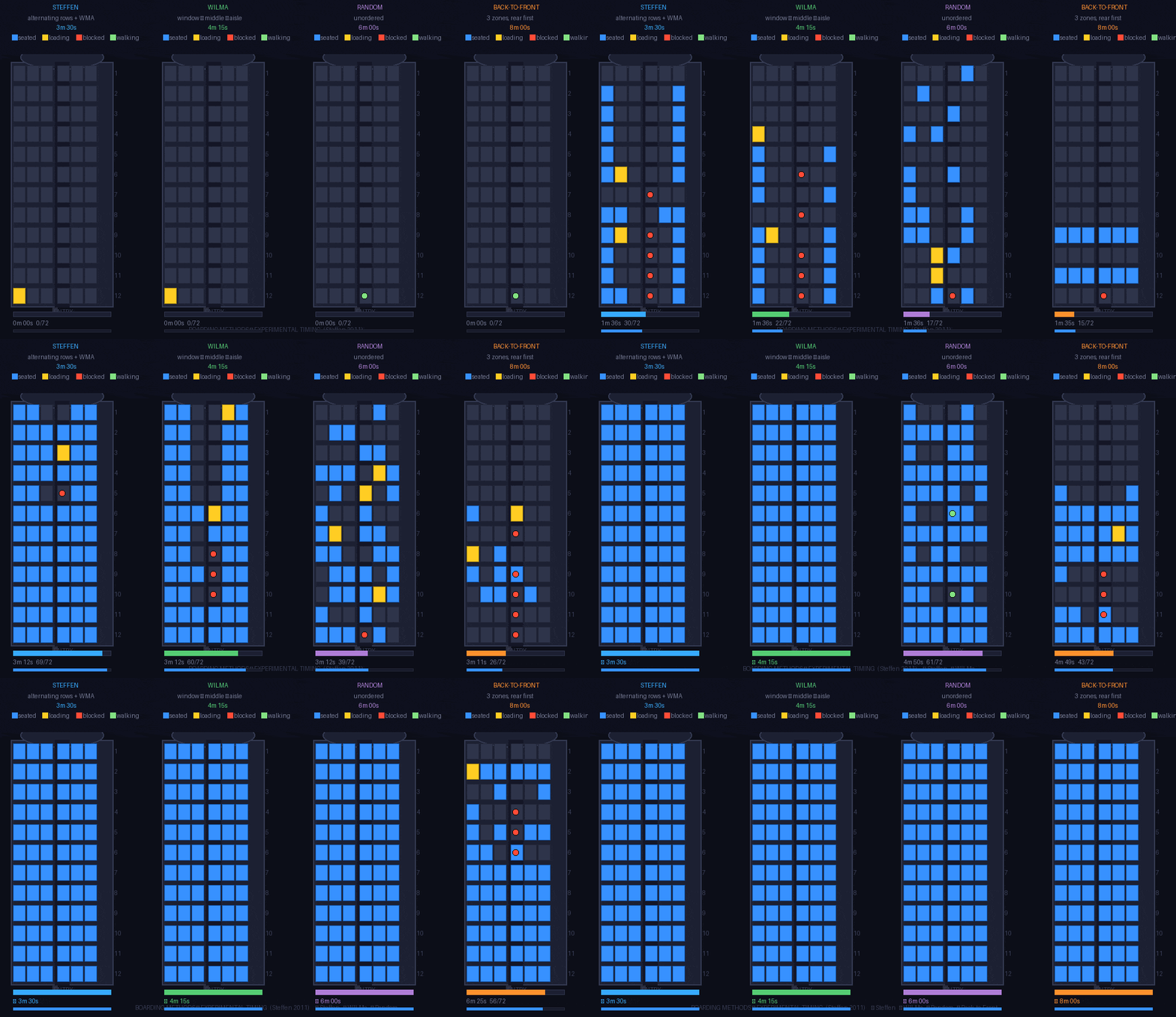
Results were unambiguous: the Steffen method produced boarding times averaging approximately 3 minutes and 30 seconds for the mock aircraft. Random boarding averaged approximately 6 minutes. Back-to-front by zone averaged approximately 8 minutes — slower than random, which confirmed the simulation findings that structured zone strategies with imperfect compliance perform worse than uncontrolled boarding. The WILMa method without alternating rows averaged approximately 4 minutes and 15 seconds, confirming that the window-middle-aisle ordering alone yields significant improvement, but that the alternating-row property produces a further substantial gain.
Key result: the Steffen method was approximately 50 percent faster than random boarding and over 55 percent faster than the standard back-to-front zone method that most major carriers use. No other tested strategy came within 20 percent of its performance.
Model Limitations
Steffen’s model abstracted away several real-world variables that are operationally significant. It assumed
- single passengers without companions
- uniform luggage loading times
- perfect compliance with the assigned boarding sequence
None of these assumptions hold in commercial operations. Group travel — families, corporate groups, leisure parties — accounts for a substantial fraction of passengers on most routes and requires contiguous seating that is structurally incompatible with a strict alternating-row sequence. Luggage loading time variance is high: a passenger with a roller bag that fits cleanly is fast; a passenger re-arranging existing bin contents to make space is not.
These limitations do not invalidate the method’s core finding, but they do quantify the gap between laboratory performance and field deployment. Simulations incorporating group travel at realistic rates (30 to 45 percent of passengers on leisure routes) show that the Steffen method’s advantage over random boarding drops from approximately 50 percent to approximately 20 to 25 percent under real conditions. That is still a very large improvement, but it requires realistic calibration to avoid overpromising during implementation planning.
An important alternative finding from the literature is that the WILMa method without strict alternating rows, despite being slower than the full Steffen method, is substantially more tolerant of compliance failures. A boarding sequence that assigns window, middle, and aisle passengers to separate boarding calls without specifying row order within each class is implementable with standard gate boarding systems, captures most of the interference-reduction benefit, and degrades gracefully when compliance is imperfect.
Several carriers have moved toward WILMa-type boarding without adopting the strict Steffen alternating sequence, and their results confirm this partial benefit.
|
Random No prescribed order |
Back-to-Front Zoned, rear first |
WILMa Window → Middle → Aisle |
Steffen Alternating rows + WMA |
|
| Core logic | Passengers enter in arrival order with no sequence enforcement. The operator assigns no positions to boarding groups. | The cabin is divided into 2–4 transverse zones. The rearmost zone boards first, then each successive zone forward. Within each zone, order is arbitrary. | All passengers are split by lateral seat class: window seats (A, F) board as a single group first, then middle (B, E), then aisle (C, D). Row order within each group is not specified. | Combines WILMa’s lateral ordering with an alternating-row interleave: within each seat class, even-numbered rows board before odd-numbered rows. This ensures no two simultaneously active bag-loading events occur in adjacent row positions. |
| Blocking mechanism addressed |
None deliberately. Interference events are random and unmitigated. |
Attempts to prevent front-of-plane passengers from blocking rear boarders. Fails within each zone because intra-zone row order remains random. | पार्श्व अवरोधन को समाप्त करता है (खिड़की पर यात्री पंक्ति खाली करने के लिए गलियारे के यात्री की प्रतीक्षा कर रहा है)। | अनुदैर्ध्य गलियारे क्लस्टरिंग को संबोधित नहीं करता है। |
| Implementation complexity | None. | Low. Zone call and basic gate discipline. | Medium. Boarding pass encoding by seat column group. | High. Requires individual seat-level sequence assignment and strict per-passenger call order. |
| लाभ |
|
|
|
|
| Disadvantages |
|
|
|
|
| Works well when… |
|
|
|
|
| Works good when … |
|
|
|
|
| Use when | Default fallback. Use as the baseline in any environment where no sequencing infrastructure exists, or where group-travel exceptions are too numerous to manage. Accept the variance; do not pretend it is a strategy. |
Commercial necessity. Use only when loyalty-tier boarding is a non-negotiable commercial requirement. Limit to 2 zones maximum. Accept that it will underperform random boarding in real conditions and plan turnaround times accordingly. |
Practical optimum. It captures the majority of available sequencing gain with manageable implementation cost and acceptable compliance tolerance. The correct default for any operation where agent pre-assignment by lateral class is feasible. |
Controlled systems only. The theoretical optimum; also the most fragile in the face of real-world variance. In industrial contexts, apply to AGV dispatch, robotic pick sequencing, and WMS-controlled fork truck operations. |
Performance figures from discrete-event simulation (12 rows × 6 seats, ENTRY_GAP=2, LOAD_TICKS=5). Real-world results vary with group-travel rate, luggage variance, and compliance rate. Steffen (2008), J. Air Transport Management.
The rest of this article is reserved for members
To limit scraping bots (currently 40,000 hits per day!),
we had to restrict access to full articles and tools to registered members only.
to access all the rest.
अक्सर पूछे जाने वाले प्रश्न
क्या स्टेफेन विधि विमानन के बाहर भी लागू होती है, या यह विमान ज्यामिति के लिए विशिष्ट है?
यह विधि उन सभी वातावरणों पर लागू होती है जहाँ एजेंट एक सीमित पथ से होकर एक निश्चित स्थान पर स्थानीय क्रिया करते हैं — जैसे गोदाम के गलियारे, लोडिंग डॉक, उत्पादन लाइन की फीडर लेन, क्रॉस-डॉक स्टेजिंग क्षेत्र। विमान की ज्यामिति इस विधि का मूल है, न कि इसकी पूर्व शर्त। प्रत्येक वातावरण के लिए उस क्रिया और उपकरण से संबंधित विशिष्ट हस्तक्षेप दूरी का उपयोग करके वैकल्पिक-पंक्ति पैटर्न की पुनर्गणना की जानी चाहिए।
हमारा WMS पहले से ही पिक पाथ को ऑप्टिमाइज़ करता है - तो स्टेफेन-प्रकार की सीक्वेंसिंग से इसमें क्या नया जुड़ेगा?
पिक पाथ ऑप्टिमाइजेशन अकेले काम करने वाले एक पिकर के लिए तय की गई दूरी को कम करता है, जब वहां कोई अन्य एजेंट मौजूद न हो। स्टेफेन-टाइप सीक्वेंसिंग उन अवरोधों को खत्म करता है जो कई पिकर एक साथ साझा गलियारों में काम करते समय एक-दूसरे पर डालते हैं - यह एक पूरी तरह से अलग समस्या है। दोनों ऑप्टिमाइजेशन आवश्यक हैं और कोई भी दूसरे का विकल्प नहीं है।
वितरण केंद्र में इसे लागू करने के लिए आवश्यक न्यूनतम डेटा अवसंरचना क्या है?
एक स्थिर कार्यान्वयन — जिसमें संचालन शुरू होने से पहले तरंग नियोजन के समय स्थानिक पृथक्करण लागू किया जाता है — के लिए केवल स्लॉट स्थिति डेटा की आवश्यकता होती है, जो किसी भी WMS के पास पहले से ही मौजूद होता है। वास्तविक समय स्थिति ट्रैकिंग केवल गतिशील कार्यान्वयनों के लिए आवश्यक है जो तरंग के मध्य में प्रेषण अनुक्रमों को समायोजित करते हैं क्योंकि वास्तविक एजेंट स्थितियाँ योजना से विचलित होती हैं।
क्या स्टेफेन-प्रकार की सीक्वेंसिंग एबीसी वेलोसिटी स्लॉटिंग के साथ विरोधाभास करती है?
इससे एक आंशिक समस्या उत्पन्न होती है: मानक एबीसी स्लॉटिंग प्रणाली उच्च गति वाले एसकेयू को आसन्न स्थानों पर समूहित करती है, जिससे हर चरण में पिकर्स एक ही गलियारे में केंद्रित हो जाते हैं। इसका समाधान यह है कि स्लॉटिंग निर्णयों के दौरान स्थानिक पृथक्करण को निर्णायक कारक के रूप में लागू किया जाए, जिससे ए-श्रेणी की वस्तुओं को एक ही गोल्डन ज़ोन खंड में समेकित करने के बजाय विभिन्न गलियारों में वितरित किया जा सके। इस वितरण की सीमांत यात्रा दूरी लागत सभी चरणों में संचयी हस्तक्षेप बचत की तुलना में कम है।
हर प्रयोग में यह साबित हो चुका है कि आगे से पीछे की ओर चढ़ने की विधि अनियमित रूप से चढ़ने की विधि से धीमी है — फिर भी एयरलाइनें इसका उपयोग क्यों करती हैं?
क्योंकि यह लॉयल्टी-टियर प्रायोरिटी बोर्डिंग के साथ संरचनात्मक रूप से संगत है, जो एक प्रत्यक्ष राजस्व उत्पाद है, और यह एक ऐसी गेट प्रक्रिया बनाता है जिसे यात्री व्यवस्थित और निष्पक्ष मानते हैं। थ्रूपुट लागत वास्तविक है लेकिन अस्पष्ट है - यह कुल टर्नअराउंड समय औसत में दिखाई देती है, कभी भी बोर्डिंग अनुक्रम नियम से संबंधित एक अलग मद के रूप में नहीं। यही कारण है कि कई औद्योगिक संचालन कम अनुकूल अनुक्रमण रणनीतियों को बनाए रखते हैं: मानक रिपोर्टिंग में लागत अदृश्य होती है।
ऑपरेशन की अवधि में होने वाला बदलाव विधि की विश्वसनीयता को कैसे प्रभावित करता है?
स्थानिक पृथक्करण की गारंटी इस बात पर निर्भर करती है कि प्रत्येक ऑपरेशन अगले एजेंट के निकटवर्ती स्थान पर पहुंचने से पहले पूरा हो जाए। ऑपरेशन की अवधि में अत्यधिक भिन्नता — जैसे कि पिकर द्वारा बिन की सामग्री को पुनर्व्यवस्थित करना, फोर्क ट्रक द्वारा पैलेट को ठीक से न रख पाना — नियोजित अंतराल को समाप्त कर देती है और अवरोध उत्पन्न कर देती है। अत्यधिक भिन्नता वाले वातावरण में, हस्तक्षेप बफर को आनुपातिक रूप से बढ़ाएँ या पूर्ण वैकल्पिक-स्लॉट अनुक्रम के बजाय एक रूढ़िवादी आंशिक कार्यान्वयन लागू करें।
क्या स्टेफेन विधि एजीवी फ्लीट और स्वचालित भंडारण प्रणालियों पर लागू होती है?
यह स्टीफ़न-प्रकार के पूर्ण कार्यान्वयन के लिए आदर्श वातावरण है, क्योंकि स्वचालित प्रणालियाँ अनुपालन समस्या को पूरी तरह से समाप्त कर देती हैं। वैकल्पिक स्लॉट क्रम में तैनात AGV बेड़े को AGV प्रबंधन प्रणाली द्वारा पहले से प्रदान की गई स्थिति ट्रैकिंग अवसंरचना के अतिरिक्त किसी अन्य अवसंरचना की आवश्यकता नहीं होती है, और अनुक्रम व्यवहारिक रूप से नहीं बल्कि यांत्रिक रूप से लागू किया जाता है। अधिकांश आधुनिक AGV प्रणालियों में यह एक विन्यास परिवर्तन है, पूंजी निवेश नहीं।
यह विधि अपवादों को कैसे संभालती है — जैसे कि तत्काल आदेश, उपकरण की खराबी, रसद में समूह यात्रा के समकक्ष कार्य?
एक सख्त कार्यान्वयन में, अनुक्रम से बाहर का एक एजेंट पूरे बैच के लिए स्थानिक पृथक्करण को ध्वस्त कर सकता है, जो इस विधि की प्राथमिक परिचालन कमजोरी है। इसका व्यावहारिक समाधान यह है कि अपवादों से निपटने के लिए अनुक्रम में स्पष्ट बफर स्लॉट आरक्षित किए जाएं, और किसी भी अपवाद के आने पर उसे कतार के सबसे आगे डालने के बजाय शेष बैच के पुनः अनुक्रमण को ट्रिगर करने के रूप में माना जाए।
बिना पोजीशन ट्रैकिंग के किसी विनिर्माण संयंत्र में व्यावहारिक आंशिक कार्यान्वयन कैसा दिखेगा?
सबसे महत्वपूर्ण आंशिक नियम के लिए किसी तकनीक की आवश्यकता नहीं होती: दो ऑपरेटरों या वाहनों को एक ही समय में आस-पास के स्टेशनों पर न भेजें। यह द्विआधारी प्रतिबंध, जिसे स्टेशन-स्तरीय ऑक्यूपेंसी ट्रैकिंग के साथ लागू किया जा सकता है (जो कि अधिकांश एमईएस सिस्टम पहले से ही समर्थित है), सबसे गंभीर अवरोध पैदा करने वाली घटनाओं को समाप्त करता है, साथ ही साथ पूरी विधि के थ्रूपुट सुधार के एक बड़े हिस्से को भी शामिल करता है।
किसी विशिष्ट सुविधा के लिए व्यतिकरण दूरी पैरामीटर की गणना कैसे की जानी चाहिए?
स्थानीय संचालन के दौरान ऑपरेटिंग एजेंट के भौतिक आकार को मापें — फोर्क फैले हुए हों, पिकर पूरी तरह से फैला हो, असेंबली फिक्स्चर खुला हो — जिसमें गलियारे में उसके द्वारा घेरा गया स्थान भी शामिल है। यदि सुविधा एक ही गलियारे में कई प्रकार के उपकरणों का उपयोग करती है, तो सबसे बड़े आकार के संयोजन के लिए हस्तक्षेप दूरी की गणना करें। किसी भी बड़े उपकरण परिवर्तन या स्लॉट में बदलाव के बाद हस्तक्षेप दूरी की पुनः गणना की जानी चाहिए, क्योंकि ये दोनों ही स्थानिक गतिशीलता को बदल देते हैं जिसके लिए अनुक्रमण को डिज़ाइन किया गया था।
प्रदर्शन में सुधार को कैसे मापा जाता है और इसे विशेष रूप से अनुक्रमण परिवर्तनों से कैसे जोड़ा जाता है?
किसी भी ऐसी स्थिति को हस्तक्षेप घटना के रूप में परिभाषित करें जहां दो एजेंट एक ही सीमित पथ में एक साथ हस्तक्षेप दूरी के भीतर हों, और प्रत्येक घटना की अवधि को रिकॉर्ड करें। हस्तक्षेप दर और प्रति शिफ्ट कुल हस्तक्षेप समय की रिपोर्टिंग, मौजूदा व्यक्तिगत उत्पादकता मेट्रिक्स के साथ, अन्य चरों से अनुक्रमण योगदान को अलग करती है। इस माप के बिना, अनुक्रमण परिवर्तनों से होने वाले थ्रूपुट सुधार औसत दर सुधारों में समाहित हो जाते हैं और बजट समीक्षाओं में इन्हें बनाए रखना या इनका बचाव करना संभव नहीं होता।
स्टेफेन बोर्डिंग पद्धति पर बाहरी लिंक
अंतर्राष्ट्रीय मानक
(सामग्री का हमारा विवरण देखने के लिए लिंक पर होवर करें)
प्रयुक्त शब्दों की शब्दावली
First In First Out (FIFO): इन्वेंट्री प्रबंधन और डेटा प्रोसेसिंग की एक ऐसी विधि जिसमें सबसे पुरानी वस्तुओं या डेटा प्रविष्टियों को नई वस्तुओं या प्रविष्टियों से पहले संसाधित या बेचा जाता है, यह सुनिश्चित करते हुए कि सबसे पहले जोड़ी गई वस्तुएं ही सबसे पहले हटाई या उपयोग की जाएं।
Stock Keeping Unit (SKU): इन्वेंट्री प्रबंधन में किसी विशिष्ट उत्पाद या वस्तु को सौंपा गया एक अद्वितीय पहचानकर्ता, जिसका उपयोग स्टॉक स्तर, बिक्री और आकार, रंग या शैली जैसे गुणों में भिन्नता को ट्रैक करने के लिए किया जाता है।