A pick & place machine (P&P or PnP) is an automated industrial system designed to rapidly and precisely pick up small components from a known location and place them onto a target surface or assembly with high repeatability. Originally developed for the electronics manufacturing industry (SMT), these machines rely on a combination of computer-controlled motion systems, vacuum or mechanical grippers, and vision-based alignment to handle components ranging from a few millimeters down to fractions of a millimeter. Operating at speeds that can exceed tens of thousands of placements per hour, they bring a level of accuracy and consistency that no human operator could sustain over a production run, making them a cornerstone of modern high-volume manufacturing.
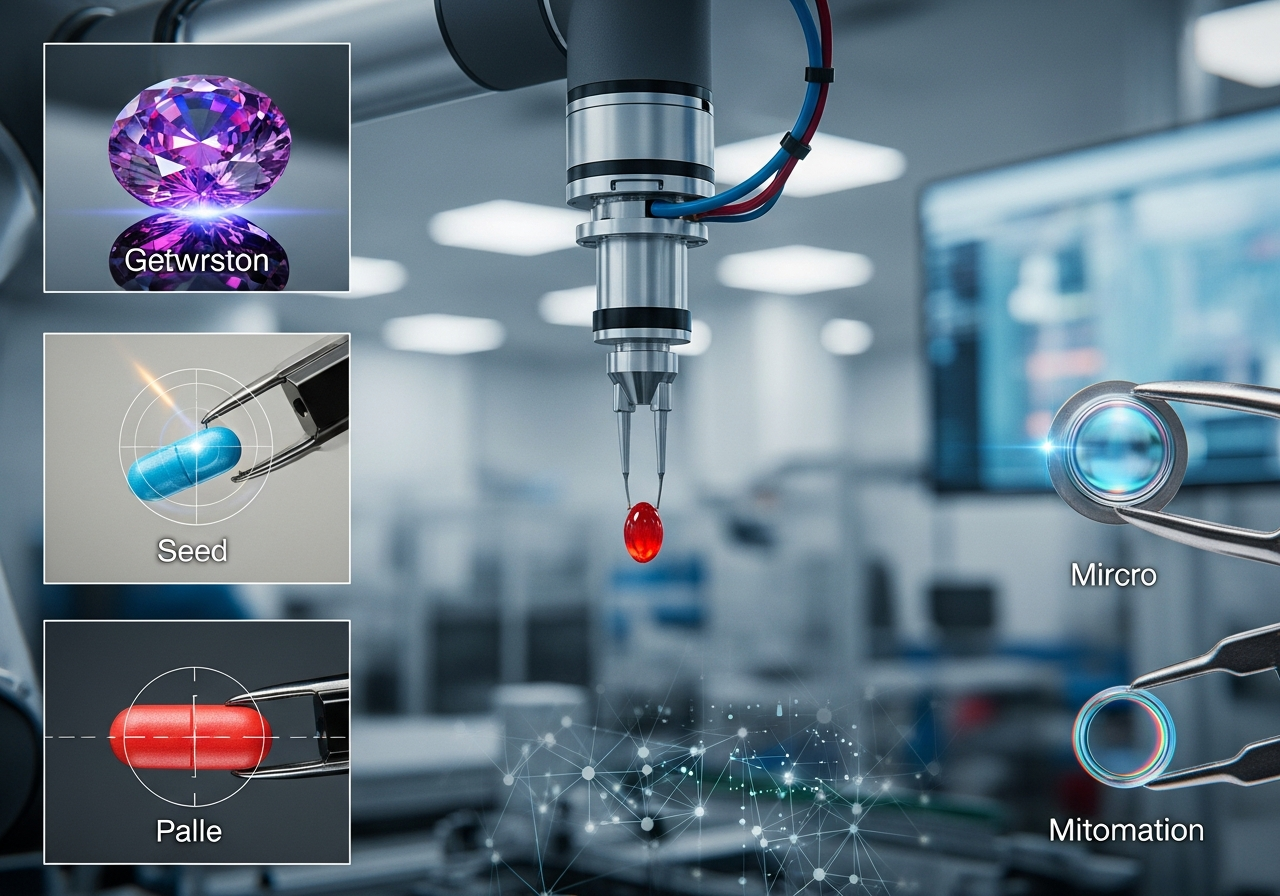
What makes pick and place technology so compelling beyond electronics is the universality of its core capability: the controlled, repeatable manipulation of small objects in three-dimensional space. Whether the object is a gemstone, a seed, a pill, or a micro-lens, the fundamental challenge is always the same — identify it, orient it correctly, move it without damage, and deposit it in exactly the right location. P&P machines solve this problem elegantly and at scale, which is why their value extends far beyond circuit boards.
This transferability becomes even more powerful when combined with modern sensing and software. Computer vision systems can distinguish between object types, detect defects, and confirm correct placement in real time. Force-sensitive grippers can handle fragile biological or optical materials without crushing them. And programmable motion paths mean the same physical machine can be reconfigured for an entirely different product with a software update rather than a hardware overhaul. Across pharmaceuticals, jewelry, agri-tech, medical devices, and beyond, the pick and place principle quietly underpins a growing share of precision manufacturing — one placement at a time.
What Pick & Place Usually Is
Typical Surface-Mount Technology (SMT) electronic application:
And more versatile and bigger robot or cobots (not for SMT):
1. Pharmaceutical Blister Packing
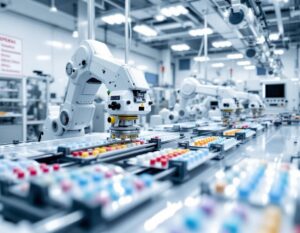
Pharmaceutical blister packing involves placing individual doses — pills, capsules, soft gels, or lozenges — into pre-formed plastic or aluminum cavities before a foil seal is applied. This application is already well-established and represents one of the earliest adoptions of P&P technology outside electronics. Machines in this space are highly specialized, often integrated into broader packaging lines that include cavity forming, foil sealing, printing, and cartoning. Regulatory requirements from bodies like the FDA or EMA demand full traceability, so modern systems log every placement event, flag missing or broken tablets, and can reject non-conforming blisters automatically before they reach the sealing station.
The key benefit over manual or bulk-filling methods is the elimination of dose errors and cross-contamination, which are critical in a regulated environment where a single missing tablet in a blister pack can trigger a costly recall. Vision systems that verify tablet color, shape, and size before placement add an extra layer of quality assurance that bulk filling simply cannot provide. The main risk lies in handling friable or oddly shaped tablets that can break under vacuum suction, so nozzle geometry and suction pressure must be carefully tuned per product. A practical tip is to invest early in changeover tooling standardization, as pharmaceutical lines switch products frequently and downtime during changeover is one of the largest hidden costs.
The rest of this article is reserved for members
To limit scraping bots (currently 40,000 hits per day!),
we had to restrict access to full articles and tools to registered members only.
to access all the rest.