Differentiable Manifolds (geom)
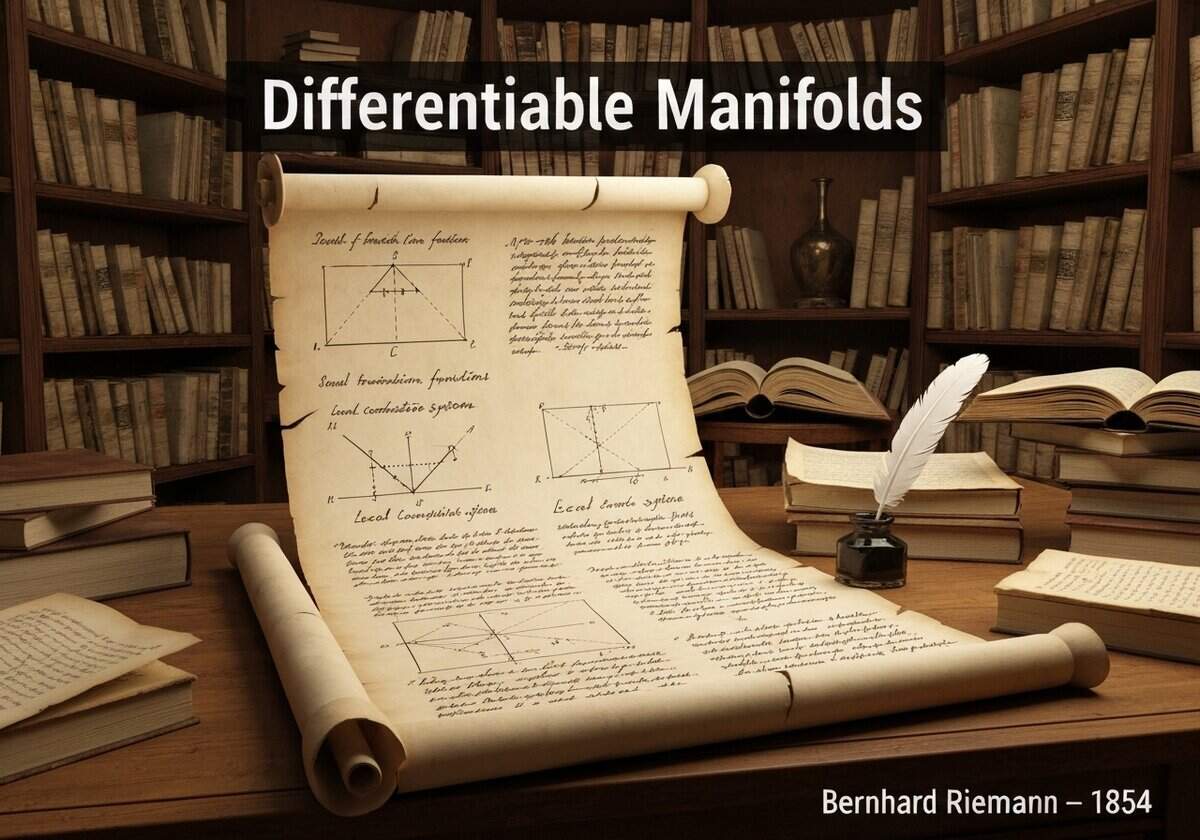
A differentiable manifold is a topological space that is locally similar to Euclidean space, allowing calculus to be applied. Each point has a neighborhood that is homeomorphic to an open subset of \(\mathbb{R}^n\). These local coordinate systems, called charts, are related by smooth transition functions, forming an atlas that defines the manifold’s differentiable structure.
A differentiable manifold is the central object of study in differential geometry. The concept formalizes the idea of a “curved space” of any dimension. While globally a manifold can be complex (like a sphere or a torus), locally, around any point, it looks like a flat piece of Euclidean space. This local “flatness” is key, as it allows us to use the tools of multivariable calculus.
The formal definition involves a set of points M, a topology on M, and an atlas. An atlas is a collection of charts, where each chart is a pair (U, φ), with U being an open subset of M and φ being a homeomorphism from U to an open subset of \(\mathbb{R}^n\). For any two overlapping charts, (U, φ) and (V, ψ), the transition map \(\psi \circ \phi^{-1}\) from \(\phi(U \cap V)\) to \(\psi(U \cap V)\) must be a diffeomorphism (infinitely differentiable with a differentiable inverse). This compatibility condition ensures that calculus performed in one coordinate system is consistent with calculus performed in another.
This structure allows for the definition of tangent spaces, vector fields, and differential forms on the manifold, independent of any particular coordinate system. It provides a framework for studying geometry intrinsically, without needing to embed the space in a higher-dimensional ambient space.
UNESCO Nomenclature: 1204
– Geometry
Precursors
- Euclidean geometry
- Non-Euclidean geometries (Lobachevsky, Bolyai)
- Theory of surfaces by Carl Friedrich Gauss
- Coordinate systems by René Descartes
- Early concepts of topology
Applications
- general relativity (spacetime is modeled as a 4d lorentzian manifold)
- robotics (configuration spaces of robots are manifolds)
- computer graphics (representing complex surfaces)
- string theory
- classical mechanics (phase space is a symplectic manifold)
Potential Innovations Ideas
Due to scrapping bot traffic, currently more than 40k per day, this content is reserved to community members.
> Login < or > Register < (100% free) to access this, so as all other restricted content and tools.
Related to: manifold, topology, differentiable structure, atlas, chart, euclidean space, calculus, geometry.