Product Design, Manufacturing & Innovation Resources
Home » Riemannian Geometry

Riemannian Geometry

1854
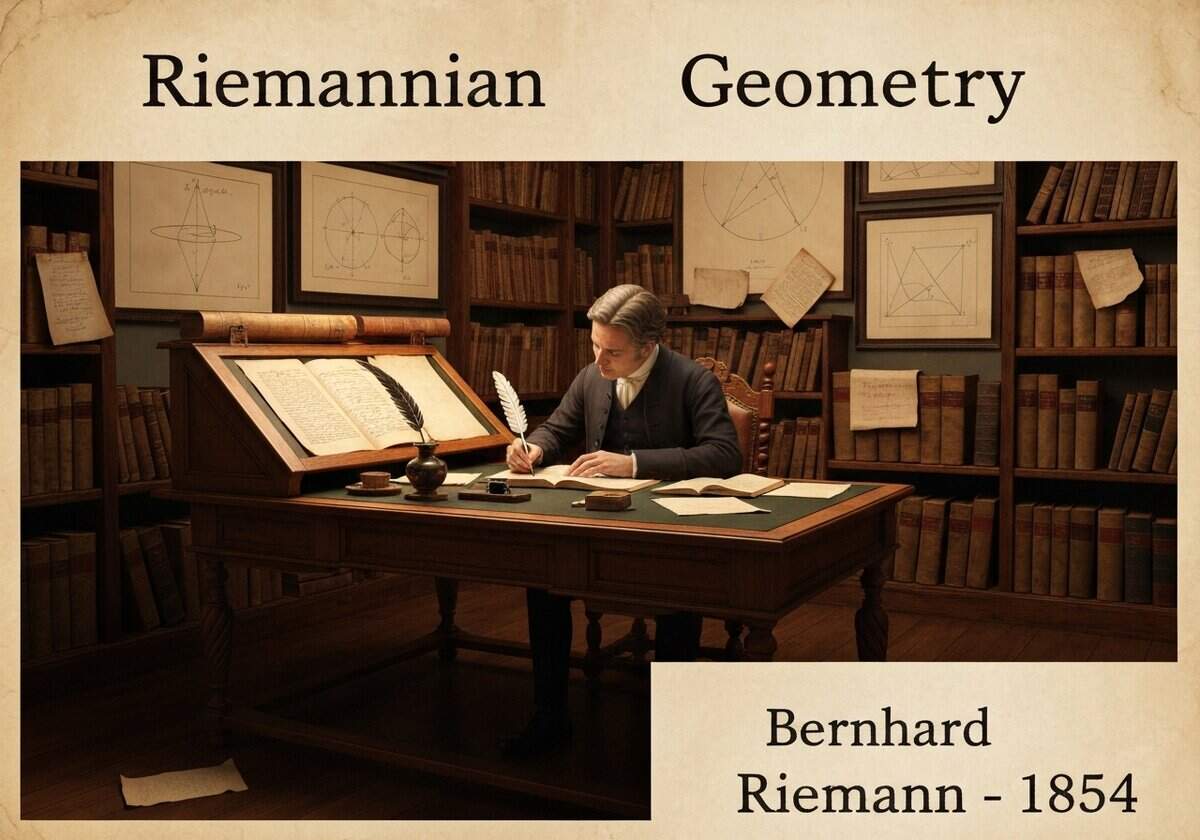
  • Bernhard Riemann
Study of Riemannian geometry with antique desk and parchment papers.

(generated image for illustration only)

Riemannian geometry is the branch of differential geometry that studies Riemannian manifolds—smooth manifolds equipped with a Riemannian metric. This metric is a collection of inner products on the tangent spaces, varying smoothly from point to point. It allows for the definition of local geometric notions like angle, length of curves, surface area, and volume, leading to a generalized notion of curvature.
Riemannian geometry, introduced in Bernhard Riemann’s 1854 lecture “On the Hypotheses which lie at the Bases of Geometry,” generalizes Gauss’s theory of surfaces to any number of dimensions. The key object is a Riemannian manifold, which is a differentiable manifold where each tangent space \(T_p M\) at a point \(p\) is equipped with an inner product \(g_p\), called the Riemannian metric. This metric must vary smoothly as \(p\) varies over the manifold.

The metric tensor \(g\) allows one to measure the length of tangent vectors and the angle between them. Consequently, one can define the length of a curve by integrating the length of its velocity vector. The shortest path between two points is called a geodesic, which generalizes the concept of a “straight line” to curved spaces. The deviation of geodesics from each other reveals the curvature of the manifold.

The full description of curvature in Riemannian geometry is captured by the Riemann curvature tensor, \(R(u, v)w\). This tensor is a multilinear map that quantifies the extent to which the covariant derivative fails to commute. It contains all the intrinsic geometric information of the manifold and generalizes the single value of Gaussian curvature for surfaces. Contractions of the Riemann tensor yield other important curvature measures like the Ricci tensor and scalar curvature, which are central to Einstein’s theory of general relativity.

UNESCO Nomenclature: 1204
– Geometry

Type

Abstract System

Disruption

Revolutionary

Usage

Widespread Use

Precursors

  • Gauss’s theory of surfaces (Disquisitiones generales circa superficies curvas)
  • Non-Euclidean geometries of Lobachevsky and Bolyai
  • Development of tensor calculus by Ricci-Curbastro and Levi-Civita
  • Concept of a manifold

Applications

  • general theory of relativity (spacetime is a pseudo-riemannian manifold)
  • data science (manifold learning techniques)
  • robotics (motion planning in configuration spaces)
  • geodesy (modeling the earth’s shape)
  • computer vision (shape analysis)

Patents:

NA

Potential Innovations Ideas

  • designing ai algorithms that learn the “shape” of data to improve classification and regression tasks
  • creating advanced navigation systems for autonomous vehicles that operate in complex, dynamic environments
  • developing new cosmological models to explain dark matter and dark energy by modifying the geometry of spacetime
  • engineering novel metamaterials with custom-designed refractive indices based on riemannian principles
  • building more realistic physics engines for simulations and video games that handle curved spaces
  • analyzing brain connectivity data (connectomics) by modeling the brain as a complex manifold
  • improving statistical methods for shape analysis in medical imaging and computational anatomy
  • creating quantum computing algorithms that leverage the geometry of the state space (hilbert space)
Related to: riemannian manifold, metric tensor, tangent space, curvature, geodesic, general relativity, riemann, inner product.

Historical Context

Riemannian Geometry

1828
1848
1850
1854
1884
1896
1900
1827
1829
1850
1854
1854
1895
1899
1900

(if date is unknown or not relevant, e.g. "fluid mechanics", a rounded estimation of its notable emergence is provided)

10th year anniversary

Full size images and downloads are only available, 100% free, for registered members.

> Login <