
在游戏和市场营销中,心理学理论的应用通过数据和统计分析得以衡量、完善和放大。数以百万计的用户的行为模式被收集和处理,从而可以统计出他们的行为模式。 验证 的设计选择。A/B 测试等技术可提供经验证据,证明哪些刺激能最有效地推动用户行动,而播放器细分则可提供与特定行为特征产生共鸣的个性化内容。
预测分析和机器学习模型可以识别玩家何时可能退出游戏或进行购买,从而实现主动、自动的干预。这种社会科学与数据驱动验证的融合创造了一个强大的循环,在这个循环中,心理假设得到大规模测试,由此产生的洞察力被用于不断优化游戏系统,以留住玩家并实现盈利。
本文是三部分中的第一部分:
- 游戏和营销中的数据驱动和统计技巧
- 认知科学技巧在游戏和营销中的应用
- 更多应用于游戏和营销的认知科学技巧
第 #1 部分:游戏和营销中的数据驱动和统计技巧
1.A/B 测试
這 方法 通过受控实验直接观察用户行为,从而消除设计决策中的开发人员偏见。心理机制的作用在于对潜意识偏好的测量。用户可能不会有意识地知道为什么他们喜欢一种设计而不是另一种设计,但他们的行为却揭示了对特定刺激更有利的反应,无论是颜色、形状还是价位。这就提供了经验证据,证明什么样的设计选择会带来更高的参与度或转化率。
执行过程需要一个强大的 IT 后端,能够将实时玩家群细分为不同的群体(A 组、B 组等),并为他们提供不同版本的游戏元素。然后对从这些组别收集到的数据进行统计分析。这包括计算转换率、参与时间或留存率等指标,并使用统计显著性检验(如卡方检验或 t 检验)来确认所观察到的差异不是由于随机机会造成的。这种数据处理在服务器上进行,服务器收集并汇总来自数百万游戏客户端的事件日志。
游戏应用: 在一款手机益智游戏中,开发人员希望提高 "炸弹 "的使用率。他们测试了两个图标:一个是带有引信的经典黑色球体,另一个是脉动的神秘水晶。一周内,50% 的新玩家看到球体(A),50% 的新玩家看到水晶(B)。服务器会记录每个玩家的使用率,统计分析显示奥术水晶的使用频率要高出 15%,这也促使了奥术水晶的永久使用。
您可以找到有关 A/B 测试方法的完整评论:

2.玩家细分

玩家细分是通过吸引个人身份和游戏风格来实现的。通过对用户进行分组,游戏可以提供符合他们内在动机的内容。被归类为 "探索者 "的玩家会积极响应涉及探索的任务,而 "竞争者 "则会更多地参与排行榜和玩家对玩家的内容。这种个性化会让玩家感觉到游戏理解并迎合用户,从而加强他们与游戏的联系。
这一过程是数据密集型的,首先要收集大量的玩家行为,如在不同游戏模式中花费的时间、购买记录和社交互动。然后使用机器学习算法,特别是 K-Means 等聚类算法来识别这些数据中的模式,并将玩家划分为不同的群体。网络基础设施必须支持实时数据标记和检索,这样游戏客户端就能针对玩家的特定群体请求并显示适当的内容或优惠。
游戏应用: 一款太空模拟游戏收集玩家活动数据。游戏识别出经常使用市场和驾驶运输船的 "交易商 "群体。这部分玩家会收到有关商品价格变动和运输稀有商品的独家任务的个性化游戏新闻信息,而这些内容不会向 "战斗机飞行员 "部分的玩家展示。
3.漏斗分析
漏斗分析的心理影响源于优化用户旅程和减少摩擦。通过识别大量用户停止前进的点(辍学点),开发人员可以解决根本原因,这通常是沮丧、困惑或厌倦。消除用户体验中的这些障碍,可以防止导致用户放弃游戏的负面情绪,并保持玩家的前进动力和参与度。
在数学上,漏斗是用户从一个步骤到下一个步骤的流量百分比的可视化。例如
- 步骤 1(完成教程)可能有 100% 个用户、
- 步骤 2(达到 5 级)可能有 80%、
- 步骤 3(首次购买)可能有 5%。
IT 基础设施的作用是记录每个用户完成每个预定义关键事件的情况。然后,数据分析平台会查询这个庞大的数据集,计算每个连续步骤之间的转换率,将漏斗可视化,并突出显示最大的下降百分比。
游戏应用: 在一款城市建设游戏中,他们发现在 "建造发电厂 "教程任务之后,有 70% 的玩家大量流失。通过分析漏斗,他们推测这一步骤对新用户来说过于复杂。他们把这个任务分成了三个更小、更简单的任务:"建造一个风力涡轮机"、"连接一条电力线 "和 "为一座建筑供电"。更改后,该阶段的下降率降至 20%。
4.热图

热图将玩家的总体行为转化为直观的视觉形式,利用了人脑在模式识别方面的优势。在地图上看到玩家经常死亡的 "热门 "红色区域,就会立即传达出玩家在游戏中的行为模式。 设计问题 而无需阅读复杂的图表。这样,设计师就能对玩家在特定领域遇到的挫折或困难的集体体验感同身受,从而促使设计更有针对性、更有效。 设计变更.
Technically, heatmaps are generated by capturing the X, Y (and sometimes Z) coordinates of specific player events, such as deaths, clicks, or ability usage, and storing them in a database. This can generate millions of data points per day. A rendering layer then aggregates these coordinates into a 2D or 3D grid. Statistical density functions are applied to this grid, assigning a color value (e.g., from blue for low density to red for high density) to each cell based on the number of events it contains. This visualization is then overlaid onto the game map for analysis.
游戏应用: 在第一人称射击游戏中,一个关卡 设计师 reviews a heatmap of player deaths on a warehouse map. They see a bright red spot in a long hallway, indicating an unusually high number of deaths. They realize a single sniper position has an unfair line of sight. They add a large crate to the middle of the hallway to provide cover, and subsequent heatmaps show the death concentration has dissipated.

5. Predictive Analytics
This technique leverages the psychological principle of proactive intervention. By identifying a player’s likely future behavior, the system can act to reinforce positive outcomes or prevent negative ones. For a player predicted to make a purchase, presenting a relevant offer feels like a serendipitous and valuable opportunity. For a player predicted to churn (quit the game), receiving a special bonus or a message from a “friend” can re-engage them by creating a renewed sense of value or social obligation.
Predictive analytics is built on machine learning models, particularly classification and regression models. These models are trained on historical data from thousands of players who have already churned or made purchases. The models identify complex patterns in gameplay metrics (e.g., session length decrease, social interaction drop) that are statistically correlated with those outcomes. The IT system then runs these models on the data of the current player base in near-real-time to assign a “churn probability” or “purchase propensity” score to each user, triggering automated in-game actions when a score crosses a certain threshold.
Game example: a monster-collection game uses a model that predicts player churn. When a player’s churn probability score exceeds 75%, the system automatically triggers a “special event” for them: an in-game character sends them a message saying, “We miss you! Here is a rare Incubator to help you hatch your next creature.” This targeted incentive aims to prevent the player from leaving the game.
6. Dynamic Difficulty Adjustment

Dynamic difficulty adjustment (DDA) targets the psychological state of “flow,” where a player is fully immersed and the challenge level perfectly matches their skill. If a game is too hard, it causes frustration; if it’s too easy, it leads to boredom. DDA seeks to keep the player in that optimal channel of engagement by subtly increasing or decreasing the challenge, making the player feel competent and constantly stimulated without becoming overwhelmed.
The system works by defining and tracking key performance metrics (KPMs) for a player, such as accuracy percentage, level completion time, or resource collection rate. A statistical algorithm, often a simple rule-based system or a more complex Bayesian model, compares the player’s current KPMs against a pre-defined “ideal performance” baseline. If the player is performing too well, the system might increase enemy health or decrease resource availability. The network ensures these adjustments are made seamlessly from the server without interrupting gameplay.
游戏应用: in a racing game, if a player wins three races in a row by more than 10 seconds each, the DDA system subtly increases the AI opponents’ top speed and cornering ability in the next race. Conversely, if a player loses three consecutive races, the system might slightly decrease the opponents’ aggression, keeping the races competitive and engaging.
7. Personalized In-Game Offers

Personalization taps into the “relevance” principle; an offer is more likely to be accepted if it aligns with the individual’s existing behaviors and preferences. Seeing an offer for a sword a player has inspected multiple times in the past creates a feeling of being understood and catered to. This reduces the perceived “spamminess” of monetization and frames the purchase as a logical next step in their personal game journey.
This is achieved by creating a detailed profile of each player’s in-game behavior, stored in a server-side database. This includes data on items they have used, characters they play, and even items they have previewed but not bought. When an offer opportunity arises, a server-side script queries this profile. Using simple rule-based logic or a machine learning recommendation engine, it selects the most relevant offer from a catalog of possibilities to present to the player via the game’s user interface.
游戏应用: a role-playing game tracks that a player almost exclusively plays as a Mage character. When a weekend sale begins, instead of showing a generic “50% Off” banner, the game presents that player with a specific offer: “50% Off the Archmage’s Robe of Power,” an item directly relevant to their playstyle, increasing the chance of a purchase.
8. Churn Prediction and Prevention
This leverages loss aversion, the psychological idea that people are more motivated to avoid a loss than to acquire a gain.

When the system predicts a player is about to churn, it can intervene. The intervention—a bonus, a new challenge, a message—frames continued play as avoiding the loss of progress, community standing, or a special opportunity. This can be more powerful than a simple reward, as it reframes the decision to quit as an active loss.
The technical implementation is nearly identical to predictive analytics but is specifically focused on the “churn” outcome. Machine learning models are trained on historical data of players who have quit, identifying leading indicators such as declining session frequency, shorter session durations, or reduced social interaction. The IT system assigns a churn risk score to each active player. An automated marketing or content delivery system is configured to trigger specific retention campaigns (e.g., push notifications, in-game mail with gifts) for players whose risk score crosses a critical threshold.
游戏应用: in a social farming game, the system flags a high-level player whose login frequency has dropped from daily to once a week. The system automatically sends a push notification to their phone: “Your friend Beatrice just sent you a ‘Golden Tractor Fuel’ gift! Log in within 24 hours to claim it before it expires.” This combines a gift with social 压力 and urgency to prevent churn.
9. Time Series Analysis

Time series analysis allows developers to understand the rhythm and pulse of their game community, tapping into the collective behavior of the player base. By identifying weekly or seasonal patterns, they can align game events with times of naturally high engagement to maximize participation. This creates a sense of a living world that has its own tempo, encouraging players to align their own schedules with the game’s, for example, by logging in on weekends for special events.
This is a purely statistical technique that models time-stamped data points to identify trends, seasonality, and cyclical patterns. Data such as daily active users, revenue, or logins per hour are plotted over time. Mathematical models like ARIMA (AutoRegressive Integrated Moving Average) can then be applied to this data to forecast future behavior. This requires a robust data warehousing solution capable of storing and processing massive volumes of historical, time-stamped event data.
游戏应用: the developers of an online multiplayer game use time series analysis on their player login data. They discover that logins peak every Saturday at 8 PM UTC. To capitalize on this, they schedule their most important weekly world boss event to begin every Saturday at 8:15 PM UTC, ensuring maximum player participation and excitement.
10.群组分析

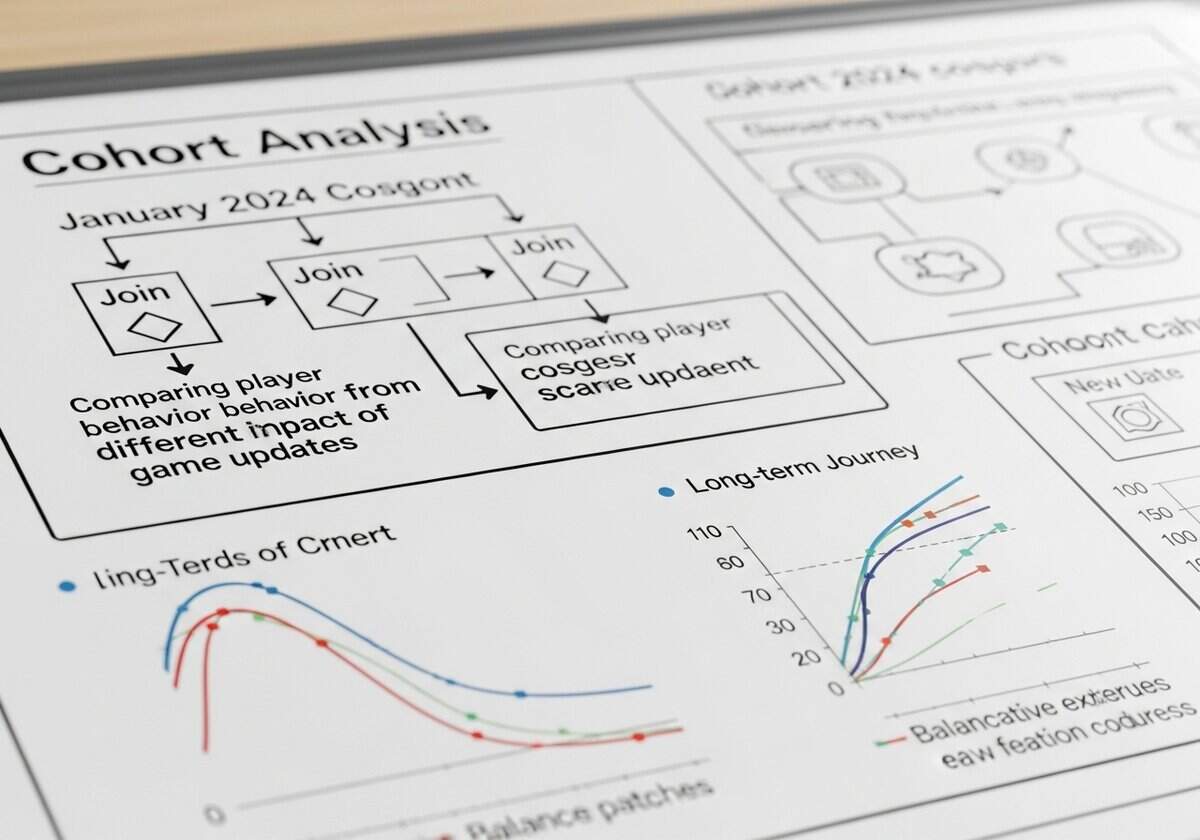
队列分析的工作原理是将玩家行为置于共同的起始体验背景下。通过比较一月份的 "第一周 "玩家和二月份的 "第一周 "玩家,开发人员可以分离出游戏更新的影响。这样,开发人员就能了解具体的变化会如何影响新用户的长期旅程。从心理学角度讲,这有助于开发人员对特定时代的 "新玩家体验 "产生共鸣,了解特定的平衡补丁或新功能是如何影响该群体的集体旅程的。
这种方法是根据用户的共同特征进行分组,最常见的是用户的加入日期(如 "2024 年 1 月组群")。
IT 基础设施必须在每个用户创建时为其标记群组标识符。然后,就可以查询数据库,跟踪这些特定群体在一段时间内的行为。例如,查询可以计算一月份用户群在 30 天、60 天和 90 天后仍处于活动状态的百分比,并将这些保留曲线与二月份用户群的保留曲线进行比较。
游戏应用: 一款奇幻角色扮演游戏于 3 月 1 日发布了 "宠物 "重大更新。通过队列分析,他们比较了 "二月队列"(不带宠物练级)和 "三月队列"(带宠物练级)的 30 天留存率。他们发现三月组玩家的留存率要高出 10%,验证了新宠物系统对玩家参与度的长期积极影响。
本帖继续 第 #2 部分:游戏和营销中的认知科学技巧

常用术语表
User experience (UX): 用户与产品、系统或服务交互时的整体满意度和感知,涵盖整个交互过程中的可用性、可访问性、设计和情感反应。
User Interface (UI): 一种支持用户与软件应用程序之间交互的系统,包括视觉元素、控件和整体布局,以方便用户执行任务并增强体验。