How to plan and execute a pilot run to validate tooling, assembly processes, and Quality Control before committing to mass production.
Translating prototype performance into repeatable production requires a methodical pilot production run that focuses on validating the manufacturing process rather than the product design. A properly executed pilot production run surfaces tooling weaknesses, assembly bottlenecks, and quality-control gaps under real cycle times and operator conditions, reducing the likelihood of costly rework when volume starts.
You will find in this article tips to define pilot objectives, selecting pilot quantity and production lines, and preparing operator training, together with a metrics-driven methodology for measuring First Pass Yield, cycle time, scrap rate and process capability. It also lays out pragmatic tests for validating tooling, jigs, fixtures and die life under production loads, plus structured steps to finalize work instructions, quality control plans, traceability and corrective actions based on pilot feedback.
Key Takeaways

- Confirm manufacturing capability before committing to volume
- Define pilot size, production line, footprint and training
- Measure FPY, takt time, cycle time, scrap and capability
- Stress test molds, fixtures and tooling for wear
- Lock down work instructions, inspection plans, traceability links
- Use formal Go/No‑Go gates and regulatory release checklists
- be familiar with the PPAP and the R@R concepts
Validate Manufacturing Processes Not Product Design
Pilot objectives must target manufacturing process validation, not product concept checks.
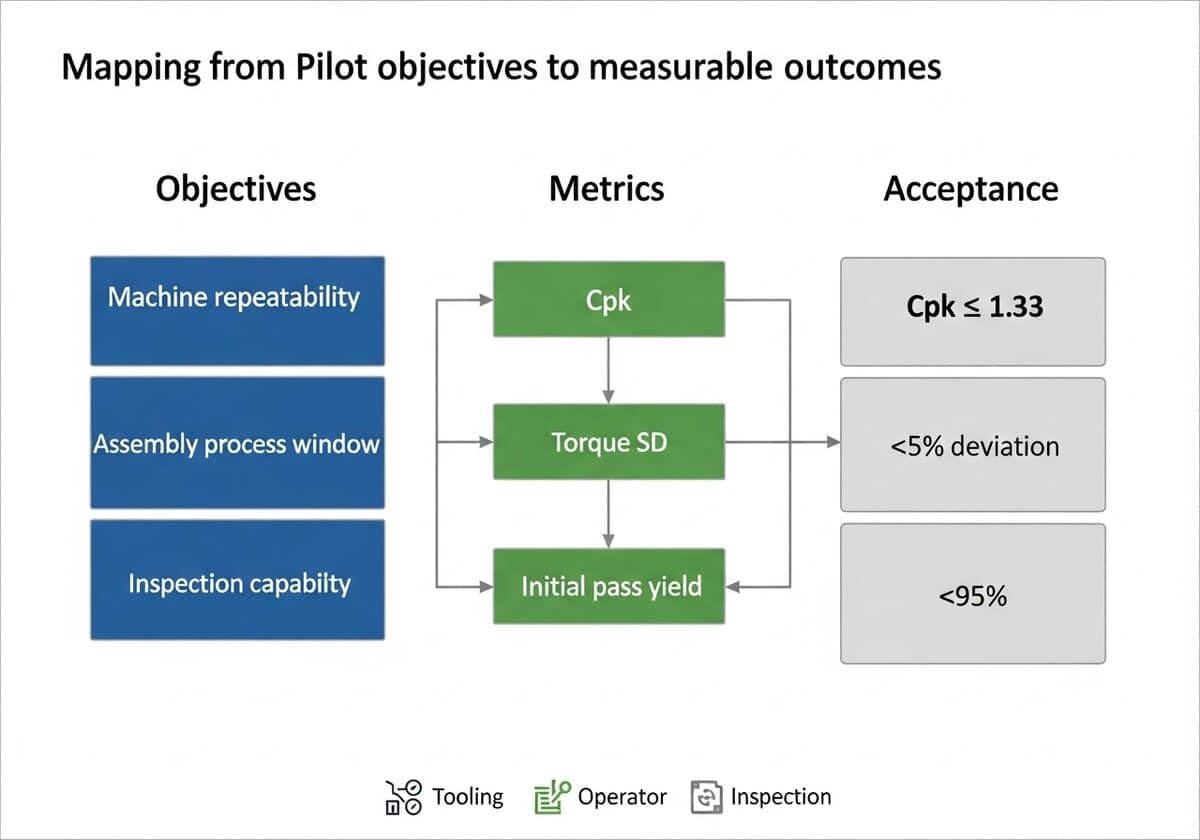
Define measurable outcomes for equipment setup, operator procedure adherence, and inspection gating. Use the pilot run to validate tooling, assembly processes, and quality control before committing to mass production.
Set numerical targets up front, such as for example:
- aim for process capability Cpk ≥ 1.33 for critical dimensions
- reduce defects toward Six Sigma guidance of 3.4 DPMO where feasible.
- specify a target initial pass yield (IPY) such as ≥95% for noncritical assemblies.
- Include acceptable scrap rates and cycle time windows tied to takt time.
Takt Time definition: in lean production, Takt Time is the calculated pace at which a product must be completed to satisfy customer demand. It essentially acts as the “heartbeat” of the production process, aligning manufacturing speed with the rate of customer orders. Takt time is determined by the simple formula: \(\text{Takt Time} = \frac{\text{Total Available Production Time}}{\text{Total Customer Demand for that Period}}\). The primary goal of establishing a takt time is to perfectly match production output with customer requirements, thereby minimizing waste through overproduction or underproduction and ensuring a smooth, continuous workflow. This key lean manufacturing metric is not a measure of how long it takes to produce a single unit (that’s cycle time), but rather the rhythm that the production system must maintain to meet its commitments.

Typical process objectives:
- Confirm machine repeatability under production cadence.
- Validate assembly sequence and torque/force windows.
- Prove inspection repeatability and throughput.
Each bullet shall become a discrete test with pass/fail criteria and measurement method.
Use established sampling and acceptance schemes such as ANSI/ASQ Z1.4 for lot sampling and classify defects by critical, major, minor severity. For critical defects set AQL = 0; for major items consider AQL 0.65–1.5 depending on risk. Capture run-length data to support Weibull or life estimates for tooling and fixture wear.
Weibull distribution in manufacturing validation: the Weibull distribution is a continuous probability distribution that is widely used in reliability engineering to model the time until failure of a component or system. Its strength lies in its flexibility, which is defined by its key parameters:
- Shape parameter (β or k): this is the most crucial parameter as it indicates the nature of the failure rate over time.
- β < 1: suggests a decreasing failure rate, often indicative of “infant mortality” where early failures are common due to manufacturing defects or initial issues.
- β = 1: indicates a constant failure rate, characteristic of random failures during the useful life of a product.
- β > 1: points to an increasing failure rate, signaling wear-out failures as the product ages.
- Scale parameter (η or λ): also known as the characteristic life, represents the time at which 63.2% of the population will have failed. It essentially stretches or compresses the distribution along the time axis.
- Location parameter (γ): this optional third parameter represents a failure-free period. If it’s greater than zero, it indicates a period of time during which no failures are expected to occur.
For more details, see our article specifically on this topic:

Collect a focused dataset during the trial and map it to decision metrics. The table below summarizes typical pairings.
| Process | Metric | Acceptance |
|---|---|---|
| Injection molding | Dimensional Cpk | ≥1.33 |
| Assembly torque | Torque deviation (SD) | ≤5% of setpoint |
| Inspection | Initial pass yield | ≥95% |
Document objectives, measurement plans, and exit criteria in a pilot protocol signed by both manufacturing and quality together. Include traceability requirements and required data fields for each part number collected.
Tip: require a minimum run length that produces at least 30 independent samples per critical characteristic to support basic capability analysis.
Tip: check with your company rules and domain authority if validation samples shall be kept and for how long.
The rest of this article is reserved for members
To limit scraping bots (currently 40,000 hits per day!),
we had to restrict access to full articles and tools to registered members only.
to access all the rest.