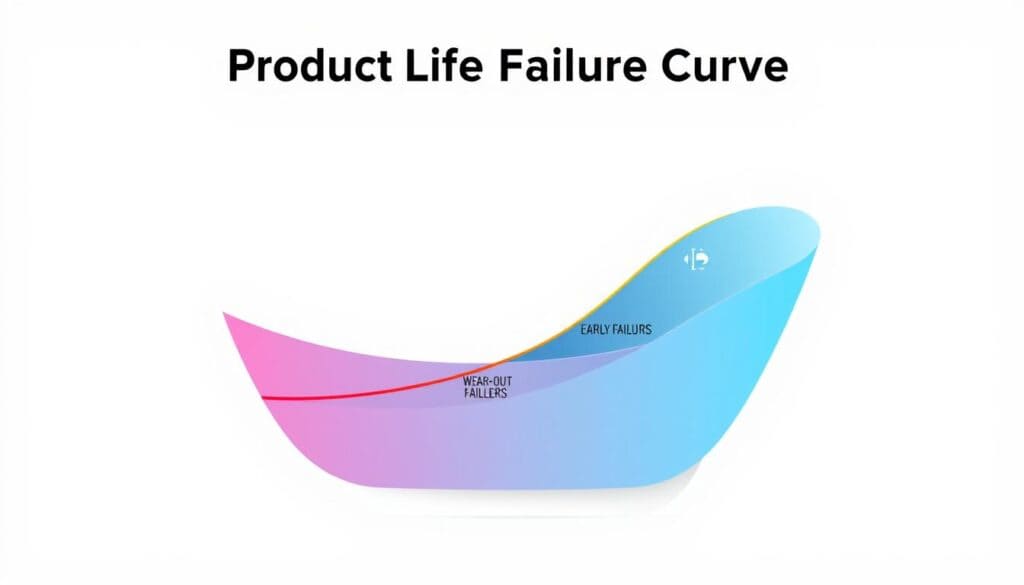
Have you heard about the famed failure rate shown by the bathtub curve? It highlights key phases in a product’s life cycle. The product life failure curve is crucial in reliability modeling. It shows how products fail over time through three main stages. These stages are Infant Mortality, Normal Life, and Wear-Out. This curve isn’t just theory. It’s a practical tool for industries to reduce risks and make their products last longer.
The “Infant Mortality” phase starts with a high failure rate. This is due to issues like manufacturing defects or flawed designs. After this, there’s the “Normal Life” period where failure rates level off. This shows the product working well during its main use phase. But, as time goes on, products enter the “Wear-Out” phase. Here, failures spike because of wear and tear.
Understanding the product life failure curve has many practical uses. It’s key for predictive maintenance. This knowledge lets reliability engineers fix problems before they get worse. With this insight, companies can improve their products’ quality, safety, and lifespan. This leads to happier customers and lower running costs.
Key Takeaways
- The product life failure curve visualizes the lifespan failures of products in three distinct phases: Infant Mortality, Normal Life, and Wear-Out.
- High failure rates in the initial stage are often due to manufacturing defects or design flaws.
- The “Normal Life” period showcases a consistent and low failure rate, attributed to random, less frequent failures.
- In the “Wear-Out” phase, the failure rate surges as components deteriorate or degrade over time.
- Implementing predictive maintenance strategies can effectively preempt failures, particularly during the wear-out stage.
The Three Stages of the Bathtub Curve
The bathtub curve is a tool used in systems engineering. It shows the failure rate of a product over time. This curve has three main parts: the Infant Mortality Period, the Normal Life Period, and the Wear-Out Period. Knowing these phases helps improve product reliability.
Infant Mortality Period
The first stage is the Infant Mortality Period. It starts right after a product is launched. This stage has a high failure rate. The causes are manufacturing defects, design flaws, or installation errors. To lower these failures, strict quality control and early testing are key.
Normal Life Period
Then comes the Normal Life Period. The failure rate is lower and stable here. Failures happen randomly and are due to wear, use changes, or human mistakes. Regular maintenance and monitoring help keep failures low.
Wear-Out Period
The last stage is the Wear-Out Period. The product’s failure rate goes up as it gets older. Parts wear out with long use. It’s often cheaper to replace or upgrade the product than to keep fixing it. Planning for this phase helps manage a product’s life better.
Below is a summary of the three stages:
| Stage | Characteristics | Failure Rate | Key Causes |
|---|---|---|---|
| Infant Mortality Period | High failure rate soon after deployment | Decreasing | Defects in materials, design flaws, installation issues |
| Normal Life Period | Stable, low failure rate | Constant | Wear, human errors, variations in usage |
| Wear-Out Period | Increasing failure rate as product deteriorates | Increasing | Component aging, prolonged usage |
Importance of Product Life Failure Curve in Reliability Engineering
The product life failure curve, especially the bathtub curve, is key in reliability engineering. It helps experts predict how systems will perform over time. They use this info to make important decisions on maintenance, what resources to use, and how to avoid problems.
Knowing a product’s life stage is crucial. It helps decide what action to take next. In the infant mortality stage, the focus is on fixing bugs and testing. Skipping preventive maintenance here could cause more issues.
In the normal life period, using preventative maintenance keeps things running smoothly and prevents downtime. In the wear-out period, fixing problems becomes more important. That’s because things start to fail more often.
To analyze life data, experts use different methods. These include probability plotting and various regression techniques. The Weibull distribution is a common choice for this analysis. It comes in several forms depending on the data and needed insights.
| Life Data Analysis Methods | Common Distributions | Parameter Estimation | Results |
|---|---|---|---|
| Probability Plotting | Weibull | Probability Plotting | Reliability Given Time |
| Rank Regression on X (RRX) | Exponential | Rank Regression on X (RRX) | Probability of Failure Given Time |
| Rank Regression on Y (RRY) | Lognormal | Rank Regression on Y (RRY) | Mean Life (MTTF or MTBF) |
| Maximum Likelihood Estimation (MLE) | Normal | Maximum Likelihood Estimation (MLE) | Failure Rate |
Maintenance management strategies approaches combines sensors with digital tools for better asset management. The product life failure curve helps organizations cut costs while improving performance. It does this through good failure prediction and making smart choices ahead of time.
The rest of this article is reserved for members
To limit scraping bots (currently 40,000 hits per day!),
we had to restrict access to full articles and tools to registered members only.
to access all the rest.
FAQ
What is the Product Life Failure Curve?
The Product Life Failure Curve is shown by the Bathtub Curve. It’s a key tool in reliability engineering. It shows how a product’s failure rate changes over time. This highlights when failures happen due to making defects, use, or aging.
How is the Bathtub Curve structured?
The Bathtub Curve shows three key phases: Infant Mortality, Normal Life, and Wear-Out. Each phase has its own failure rate and causes. This helps with maintenance strategies and reliability plans.
What occurs during the Infant Mortality Period?
During the Infant Mortality Period, failures are high but decrease over time. This decrease comes as defects get fixed. Issues here usually come from bad materials, design mistakes, and installation errors.
How is the Normal Life Period different?
The Normal Life Period features a steady, low failure rate. It’s marked by consistent use with little failure. It’s the best time for preventive maintenance to keep things running smoothly.
What defines the Wear-Out Period?
The Wear-Out Period sees more failures because parts get old. Predictive maintenance is key here. It helps manage the risk of failures. Doing so optimizes repairs and replacements.
Why is the Bathtub Curve important for failure prediction?
The Bathtub Curve is key for predicting failures. It shows where a product is in its life. Knowing this helps plan maintenance or fix issues early. This reduces downtime and costs.
What are the benefits of using the Product Life Failure Curve in predictive maintenance?
The Curve helps in predictive maintenance by scheduling it just right. It helps avoid unexpected failures and extends equipment life. It also makes maintenance more efficient. This boosts reliability and keeps assets running.
External Links on Product Reliability and Legal Warranty
International Standards
(hover the link to see our description of the content)
Glossary of Terms Used
Design for Reliability (DfR): a systematic approach to product development that emphasizes reliability throughout the design process, incorporating techniques to identify and mitigate potential failure modes, ensuring consistent performance and longevity in operational environments.
Failure Mode and Effects Analysis (FMEA): a systematic method for evaluating potential failure modes within a system, process, or product, assessing their effects on performance, and prioritizing risks to improve reliability and safety through corrective actions.
Life Cycle Assessment (LCA): a systematic analysis of the environmental impacts associated with all stages of a product's life, from raw material extraction through production, use, and disposal, aimed at identifying opportunities for improvement and informing decision-making.
Mean Time Between Failures (MTBF): average time elapsed between consecutive failures of a system or component during operation, typically measured in hours. It is used as a reliability metric to assess the performance and maintenance needs of equipment.
Statistical Process Control (SPC): a method of quality control that employs statistical techniques to monitor and control a process, ensuring it operates at its full potential by identifying variations and maintaining consistent output within specified limits.
Total quality management (TQM): a management approach focused on long-term success through customer satisfaction, involving all members of an organization in continuous improvement of processes, products, and services to enhance quality and performance.