Product Design, Manufacturing & Innovation Resources
Home » Rational Numbers

Rational Numbers

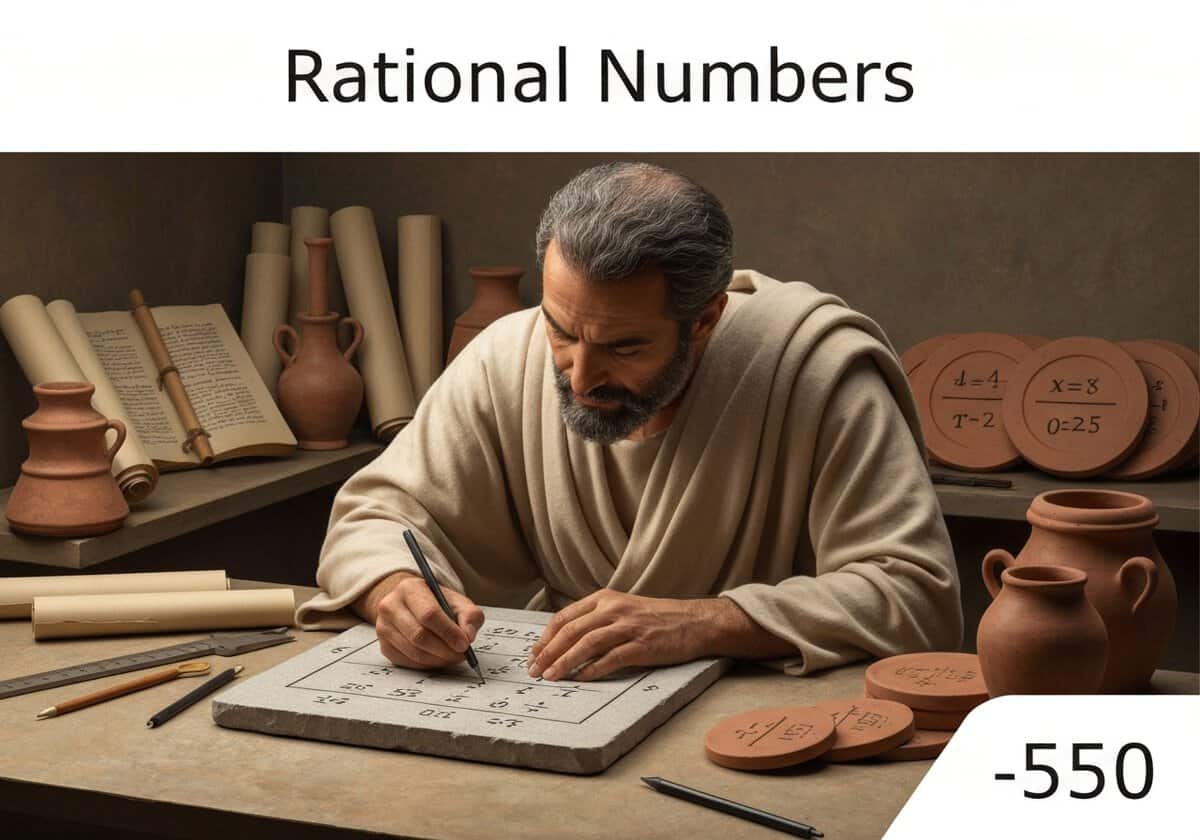
-550
Ancient scholar demonstrating rational numbers on a stone tablet in a historical classroom.

(generated image for illustration only)

A rational number is any number that can be expressed as a fraction or quotient \(p/q\), where \(p\) is an integer and \(q\) is a non-zero integer. The set of all rational numbers is denoted by \(\mathbb{Q}\). This fundamental concept extends the integers to include fractions, allowing for the representation of parts of a whole.
The concept of a rational number arises from the need to measure quantities that are not whole multiples of a unit. In mathematics, it formalizes the idea of a ratio between two integers. A rational number is formally defined as an equivalence class of ordered pairs of integers \((p, q)\) with \(q \neq 0\). The equivalence relation is defined as \((p_1, q_1) \sim (p_2, q_2)\) if and only if \(p_1 q_2 = p_2 q_1\). This means, for example, that the fractions 1/2, 2/4, and -3/-6 all represent the same rational number.

Every integer is a rational number, since any integer \(n\) can be written as the fraction \(n/1\). The set of rational numbers, denoted by \(\mathbb{Q}\) (for ‘quotient’), is therefore a superset of the integers \(\mathbb{Z}\). Unlike integers, rational numbers are not uniquely represented; each rational number has infinitely many fractional forms. The form where \(p\) and \(q\) are coprime (have no common divisors other than 1) and \(q > 0\) is called the canonical or lowest terms representation.

The development of this concept was not immediate. Ancient Egyptians used a system of unit fractions, but the Greeks, particularly the Pythagoreans, were among the first to systematically study ratios of integers. Their worldview was shaken by the discovery of irrational numbers, such as the square root of 2, which could not be expressed as such a ratio. This discovery highlighted the distinction between rational and irrational numbers, a cornerstone of number theory.

UNESCO Nomenclature: 1101
– Algebra, Number theory and Group theory

Type

Abstract System

Disruption

Foundational

Usage

Widespread Use

Precursors

  • concept of integers
  • operation of division
  • ancient egyptian use of unit fractions
  • babylonian sexagesimal system for fractions

Applications

  • measurement and scaling in engineering and science
  • financial calculations involving fractions of units
  • computer programming data types for precise arithmetic
  • music theory for representing intervals and harmonies
  • probability theory for defining event likelihoods

Patents:

NA

Potential Innovations Ideas

  • a cryptographic system based on the difficulty of finding the canonical form of extremely large-numerator/denominator fractions
  • a data compression algorithm that represents floating-point data as rational approximations
  • a financial modeling tool for risk analysis using rational number fields to avoid floating-point errors
  • a programming language with native support for rational arithmetic to enhance precision in scientific computing
  • a musical composition software that uses rational numbers to explore microtonal scales and complex rhythms
  • an AI model for symbolic regression that discovers physical laws in the form of rational functions
  • a digital fabric design tool that uses rational number patterns for creating complex geometric weaves
  • a high-precision robotics control system using rational number kinematics to eliminate cumulative rounding errors
  • a network protocol that uses rational number-based packet division for optimized data routing
  • a medical imaging reconstruction algorithm that uses rational functions for more accurate modeling of tissue densities
Related to: rational number, fraction, integer, quotient, ratio, number theory, mathematics, p/q, set Q, arithmetic.

Historical Context

Rational Numbers

-300
-550
1750
1790
1800
1844
1874
-300
-450
1585
1779
1799
1801
1850
1875

(if date is unknown or not relevant, e.g. "fluid mechanics", a rounded estimation of its notable emergence is provided)

10th year anniversary

Full size images and downloads are only available, 100% free, for registered members.

> Login <