Product Design, Manufacturing & Innovation Resources
Home » Euclid’s Lemma

Euclid’s Lemma

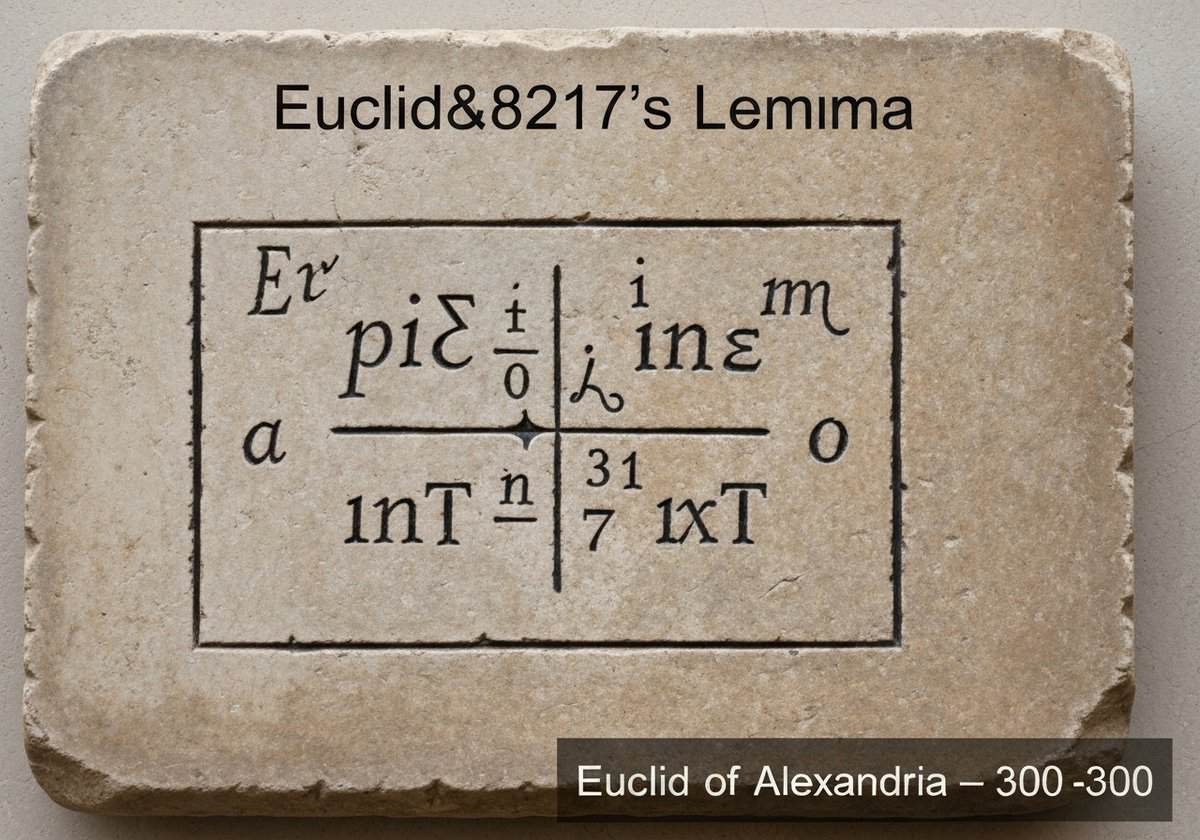
-300
  • Euclid of Alexandria
Stone tablet inscribed with Euclid's Lemma in ancient Greek, number theory concept.

(generated image for illustration only)

A key result in number theory stating that if a prime number \(p\) divides the product of two integers \(a\) and \(b\), then \(p\) must divide at least one of those integers. That is, if \(p | ab\), then \(p | a\) or \(p | b\). This property is essential for proving the uniqueness part of the Fundamental Theorem of Arithmetic.
Euclid’s Lemma is Proposition 30 in Book VII of his *Elements*. Its proof typically relies on another fundamental result, Bézout’s identity, which states that the greatest common divisor (GCD) of two integers `a` and `b` can be expressed as a linear combination `ax + by` for some integers `x` and `y`. The proof of the lemma proceeds as follows: Assume a prime `p` divides `ab`. If `p` does not divide `a`, then `p` and `a` are coprime (their GCD is 1), since the only divisors of `p` are 1 and `p`. By Bézout’s identity, there exist integers `x` and `y` such that `px + ay = 1`. Multiplying this entire equation by `b` gives `pbx + aby = b`. We know that `p` divides `pbx` (trivially) and `p` divides `aby` (by our initial assumption that `p` divides `ab`). Therefore, `p` must divide their sum, which is `b`. This completes the proof.

This lemma is the critical step in establishing the uniqueness of prime factorizations. Without it, one could potentially have two different sets of prime factors for the same number. The lemma ensures that if a prime appears in one factorization, it must also appear in any other factorization of the same number. The property described in the lemma is now used to define the more general concept of a ‘prime element’ in abstract algebra and ring theory, distinguishing it from an ‘irreducible element’.

UNESCO Nomenclature: 1101
– Pure mathematics

Type

Abstract System

Disruption

Foundational

Usage

Widespread Use

Precursors

  • Concept of prime numbers
  • Concept of divisibility
  • Euclidean algorithm for finding the greatest common divisor
  • Bézout’s identity (though often used to prove it, the concepts are deeply intertwined)

Applications

  • proof of the uniqueness of prime factorization
  • development of ring theory (defining prime elements)
  • solving linear diophantine equations
  • modular arithmetic calculations

Patents:

NA

Potential Innovations Ideas

Due to scrapping bot traffic, currently more than 40k per day, this content is reserved to community members.
> Login < or > Register < (100% free) to access this, so as all other restricted content and tools.

Related to: Euclid’s lemma, prime number, divisibility, number theory, Bézout’s identity, coprime, greatest common divisor, fundamental theorem of arithmetic, Euclid’s Elements, proof.

Historical Context

Euclid’s Lemma

-300
-450
1585
1779
1799
1801
1850
1875
-300
-550
1750
1790
1800
1844
1874

(if date is unknown or not relevant, e.g. "fluid mechanics", a rounded estimation of its notable emergence is provided)

Related Invention, Innovation & Technical Principles

Full size images and downloads are only available, 100% free, for registered members.

> Login <