Product Design, Manufacturing & Innovation Resources
Home » Bézout’s Theorem

Bézout’s Theorem

1779
  • Étienne Bézout
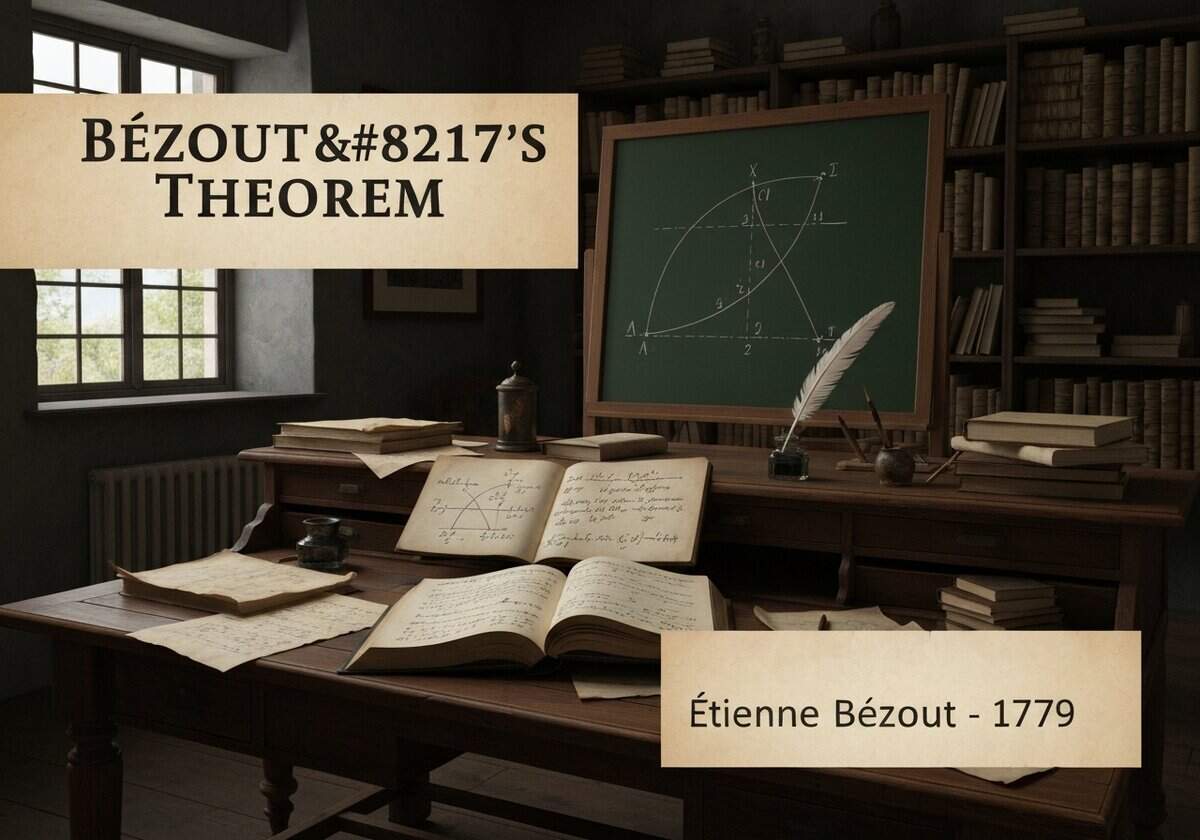
Study room of Étienne Bézout showcasing Bézout's Theorem and algebraic curves.

(generated image for illustration only)

Bézout’s theorem is a fundamental statement in intersection theory. It asserts that the number of intersection points of two plane algebraic curves of degrees \(m\) and \(n\) is exactly \(mn\), provided that one works in a projective plane over an algebraically closed field, counts points with multiplicity, and includes points at infinity where parallel asymptotes meet.
Bézout’s theorem elegantly quantifies the intersection of curves. In the standard affine plane, the number of intersections can be less than \(mn\) for several reasons. First, some solutions might have complex coordinates. Second, lines that are parallel in the affine plane can be thought of as meeting at a ‘point at infinity’; moving to the projective plane \(\mathbb{P}^2\) systematically includes these points. Third, some intersection points might be ‘degenerate’, such as a line being tangent to a circle. In this case, the single point of tangency must be counted with a multiplicity of two for the theorem to hold. The concept of intersection multiplicity is a crucial and subtle part of the theory that makes the count exact.

For example, a parabola (\(y=x^2\), degree 2) and a line (\(y=ax+b\), degree 1) should intersect at \(2 \times 1 = 2\) points. This is clear when the line cuts through the parabola. When the line is tangent, there is one point, but it has multiplicity 2. If the line doesn’t intersect the parabola in the real plane, there are two intersection points with complex coordinates. The theorem generalizes to higher dimensions, stating that \(n\) hypersurfaces of degrees \(d_1, \dots, d_n\) in \(\mathbb{P}^n\) intersect in exactly \(d_1 \cdots d_n\) points, again, when counted properly.

UNESCO Nomenclature: 1105
– Geometry

Type

Abstract System

Disruption

Substantial

Usage

Widespread Use

Precursors

  • coordinate geometry (descartes, fermat)
  • theory of polynomial equations (newton, maclaurin)
  • early concepts of projective geometry (desargues, pascal)
  • cramer’s paradox on the number of points defining a curve

Applications

  • computer graphics (calculating intersections for ray tracing)
  • robotics (solving inverse kinematics for robot arms)
  • computational geometry and cad/cam systems
  • elimination theory for solving polynomial systems
  • celestial mechanics (analyzing orbits)

Patents:

NA

Potential Innovations Ideas

  • collision detection algorithms for autonomous vehicles in complex environments
  • protein folding simulations that predict stable conformations by finding intersections of energy surfaces
  • vulnerability analysis in computer networks by modeling system states as intersecting varieties
  • automated design of mechanical linkages and gears
  • optimal placement of sensors in a wireless network to maximize coverage
  • cryptanalysis techniques for breaking systems based on multivariate polynomials
  • urban planning software for optimizing infrastructure layouts (e.g., roads, pipes)
  • game theory models for finding equilibrium points in multi-player games
Related to: Bézout’s theorem, intersection theory, projective plane, algebraic curve, multiplicity, degree of a curve, polynomial system, points at infinity.

Historical Context

Bézout’s Theorem

-300
-450
1585
1779
1799
1801
1850
1875
-300
-550
1750
1790
1800
1844
1874

(if date is unknown or not relevant, e.g. "fluid mechanics", a rounded estimation of its notable emergence is provided)

10th year anniversary

Full size images and downloads are only available, 100% free, for registered members.

> Login <