Product Design, Manufacturing & Innovation Resources
Home » Transcendental Numbers

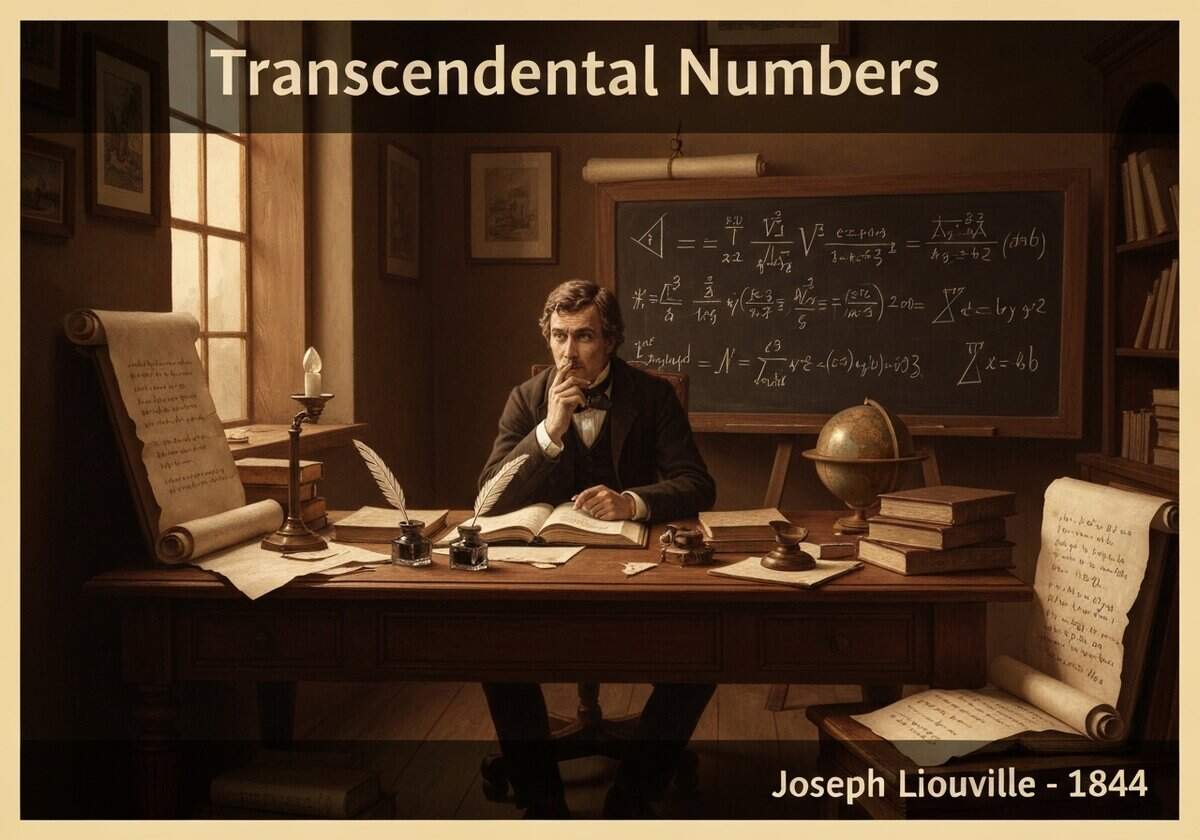
Transcendental Numbers

1844
  • Joseph Liouville
Mathematician studying transcendental numbers in a historical study.

(generated image for illustration only)

A transcendental number is a real or complex number that is not algebraic, meaning it is not a root of any non-zero polynomial equation with integer (or rational) coefficients. All transcendental numbers are irrational, but not all irrational numbers are transcendental (e.g., \(\sqrt{2}\) is irrational but algebraic, as it is a root of \(x^2 – 2 = 0\)).

The concept of transcendental numbers distinguishes a special class within the irrationals. While algebraic numbers are roots of polynomials with integer coefficients, transcendental numbers “transcend” this algebraic description. Joseph Liouville was the first to prove the existence of such numbers in 1844 by constructing a specific class of numbers, now called Liouville numbers, and showing they could not be algebraic. A famous example of a Liouville number is \(\sum_{k=1}^{\infty} 10^{-k!} = 0.11000100…\).

Proving a specific number is transcendental is often extremely difficult. Charles Hermite first proved that *e* (Euler’s number) is transcendental in 1873. Later, in 1882, Ferdinand von Lindemann proved that \(\pi\) is transcendental. The Lindemann–Weierstrass theorem generalizes this result, stating that if \(\alpha_1, …, \alpha_n\) are distinct algebraic numbers, then \(e^{\alpha_1}, …, e^{\alpha_n}\) are linearly independent over the algebraic numbers. Lindemann’s proof for \(\pi\) finally settled the ancient problem of “squaring the circle” with a compass and straightedge, proving it to be impossible because it would require constructing a length of \(\sqrt{\pi}\), which is also transcendental and thus not constructible.

UNESCO Nomenclature: 1101
– Pure mathematics

Type

Abstract System

Disruption

Substantial

Usage

Widespread Use

Precursors

  • development of polynomial algebra
  • concept of algebraic numbers by Euler and Gauss
  • proof of irrationality of *e* and \(\pi\)
  • work on continued fractions

Applications

  • squaring the circle problem (proving its impossibility)
  • diophantine approximation
  • number theory research
  • foundations of mathematics

Patents:

NA

Potential Innovations Ideas

Due to scrapping bot traffic, currently more than 40k per day, this content is reserved to community members.
> Login < or > Register < (100% free) to access this, so as all other restricted content and tools.

Related to: transcendental number, algebraic number, polynomial, integer coefficients, pi, e, Liouville number, number theory, irrational number, squaring the circle.

Historical Context

Transcendental Numbers

1750
1790
1800
1844
1874
1893
1900
1585
1779
1799
1801
1850
1875
1897
1950

(if date is unknown or not relevant, e.g. "fluid mechanics", a rounded estimation of its notable emergence is provided)

Related Invention, Innovation & Technical Principles

Full size images and downloads are only available, 100% free, for registered members.

> Login <