Product Design, Manufacturing & Innovation Resources
Home » Canonical Representation of an Integer

Canonical Representation of an Integer

1850
Desk of a 19th-century mathematician with prime factorization book and tools.

(generated image for illustration only)

The canonical representation, or standard form, of a positive integer \(n\) is its unique prime factorization written as a product of prime powers with the primes in increasing order. For any integer \(n > 1\), it can be written as \(n = p_1^{a_1} p_2^{a_2} \cdots p_k^{a_k}\), where \(p_1 < p_2 < \cdots < p_k\) are prime numbers and the exponents \(a_i\) are positive integers.

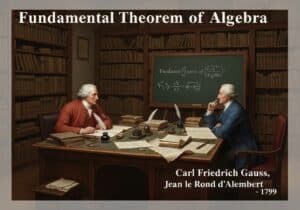
The Fundamental Theorem of Arithmetic guarantees that the set of prime factors for any integer is unique. The canonical representation builds on this by adding a convention for ordering, making the representation itself unique, not just the set of factors. For example, the number 72 can be factored as `2 * 3 * 2 * 3 * 2`. The set of prime factors is {2, 2, 2, 3, 3}. The canonical representation groups these factors and orders the prime bases: `2^3 * 3^2`.

This standardized form is extremely useful in number theory. For instance, given the canonical representations of two numbers, `a` and `b`, their greatest common divisor (GCD) and least common multiple (LCM) can be found easily. If \(a = \prod p_i^{\alpha_i}\) and \(b = \prod p_i^{\beta_i}\) (where some exponents can be zero to include all primes present in either `a` or `b`), then \(\text{gcd}(a, b) = \prod p_i^{\min(\alpha_i, \beta_i)}\) and \(\text{lcm}(a, b) = \prod p_i^{\max(\alpha_i, \beta_i)}\). This provides a powerful computational tool. Furthermore, many important functions in number theory, such as the number of divisors `d(n)` or the sum of divisors `σ(n)`, have simple formulas based on the exponents in the canonical representation. For example, \(d(n) = (a_1+1)(a_2+1)\cdots(a_k+1)\). This form essentially provides a unique ‘fingerprint’ for every integer, encoding its entire multiplicative structure.

UNESCO Nomenclature: 1101
– Pure mathematics

Type

Abstract System

Disruption

Substantial

Usage

Widespread Use

Precursors

  • The Fundamental Theorem of Arithmetic
  • Development of exponential notation
  • Formalization of number theory as a distinct branch of mathematics

Applications

  • calculating the greatest common divisor (GCD) and least common multiple (LCM) of numbers
  • defining number-theoretic functions like the divisor function and Euler’s totient function
  • simplifying fractions
  • analyzing the multiplicative structure of integers

Patents:

NA

Potential Innovations Ideas

  • a database indexing system where keys are integers and their canonical representation determines data locality
  • a file versioning system that uses the canonical representation of a content hash to track changes efficiently
  • a chemical informatics tool that assigns a unique canonical integer to molecules based on their structure
  • a programming language with a native integer type that stores numbers in their canonical prime factorization form for exact rational arithmetic
  • a method for generating unique, human-readable identifiers from large data objects
  • a cryptographic scheme where messages are encoded into the exponents of a canonical representation
  • a bioinformatics algorithm for sequence alignment that uses canonical representations of subsequences
  • a system for procedural generation of game content (e.g., levels, items) based on the canonical factorization of a seed number
  • a distributed ledger technology where transaction validity is tied to the canonical factorization of a hash
  • a formal language theory where strings are mapped to integers and their canonical forms reveal structural properties
Related to: canonical representation, standard form, prime factorization, number theory, greatest common divisor, least common multiple, prime power, integer, exponent, multiplicative function.

Historical Context

Canonical Representation of an Integer

1779
1799
1801
1850
1875
1897
1950
1750
1790
1800
1844
1874
1893
1900

(if date is unknown or not relevant, e.g. "fluid mechanics", a rounded estimation of its notable emergence is provided)

10th year anniversary

Full size images and downloads are only available, 100% free, for registered members.

> Login <