Product Design, Manufacturing & Innovation Resources
بيت » الجذر التربيعي للعدد 2 في أحجام الورق

الجذر التربيعي للعدد 2 في أحجام الورق

1922
  • Walter Porstmann
  • Georg Christoph Lichtenberg
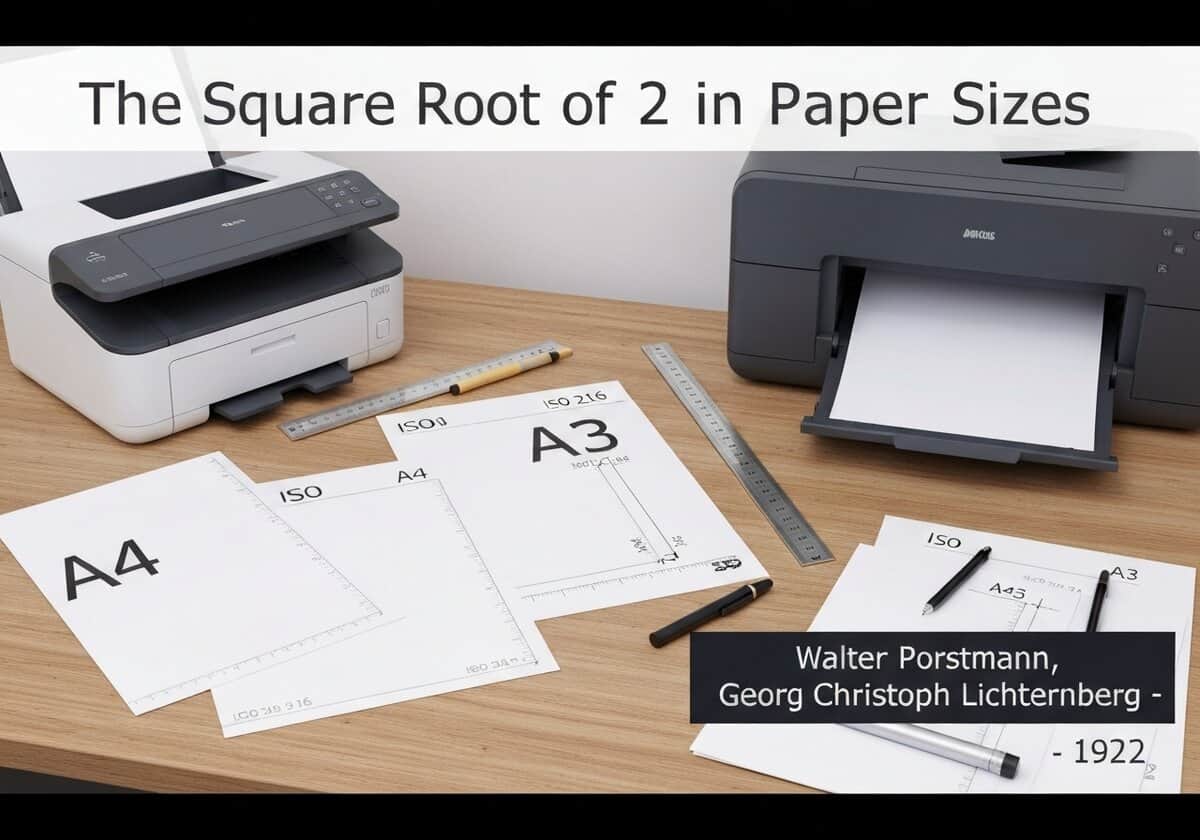
ISO 216 paper sizes A4 and A3 demonstrating the square root of 2 aspect ratio.

(صورة توضيحية فقط)

The international standard for paper sizes, ISO 216 (e.g., A4, A3), is based on the square root of 2. The aspect ratio of every sheet is [latex]1:\sqrt{2}[/latex]. This unique property means that when a sheet is cut or folded in half parallel to its shorter sides, the resulting two smaller sheets have the exact same [latex]1:\sqrt{2}[/latex] aspect ratio as the original.

The system, first proposed by Georg Christoph Lichtenberg in 1786 and later standardized in Germany as DIN 476 in 1922 by Walter Porstmann, is built on two principles: the total area of the base size (A0) is one square meter, and the ratio of the sides is [latex]1:\sqrt{2}[/latex]. Let the sides of an A0 sheet be [latex]x[/latex] and [latex]y[/latex]. We have the system of equations: [latex]y/x = \sqrt{2}[/latex] and [latex]xy = 1[/latex]. Solving this gives the dimensions of A0 as approximately 841 by 1189 millimeters.

Each subsequent size in the A series (A1, A2, A3, A4, etc.) is created by halving the previous size along its longer dimension. For example, cutting an A3 sheet in half produces two A4 sheets. Because of the [latex]\sqrt{2}[/latex] aspect ratio, these new A4 sheets have the same proportions as the original A3 sheet. This elegant mathematical property is incredibly practical. It allows for easy scaling of documents on photocopiers and printers (e.g., enlarging from A4 to A3 is a simple 141% or [latex]\sqrt{2}[/latex] magnification) without cropping or leaving empty margins. This efficiency and simplicity have led to its near-universal adoption worldwide, with the notable exceptions of the United States and Canada.

UNESCO Nomenclature: 3307
– Industrial engineering

يكتب

نظام مجرد

خلل

Substantial

الاستخدام

استخدام واسع النطاق

مقدمات

  • فهم نسب العرض إلى الارتفاع والتشابه الهندسي
  • الخصائص الرياضية للجذر التربيعي لـ 2
  • الحاجة إلى التوحيد القياسي الصناعي خلال أوائل القرن العشرين
  • المقترحات السابقة لتوحيد الورق، مثل تلك التي قدمها جورج كريستوف ليشتنبرج في عام 1786

التطبيقات

  • التوحيد العالمي للورق المستخدم في الطباعة والنسخ
  • قياس حجم المستندات بكفاءة دون تشويه (على سبيل المثال، تكبير حجم A4 إلى A3)
  • الحد من نفايات الورق في صناعة الطباعة
  • تصميم مبسط للمجلدات والمجلدات والمظاريف
  • معايير الرسم المعماري

براءات الاختراع:

NA

أفكار ابتكارية محتملة

  • شاشات إلكترونية معيارية يمكن دمجها بسلاسة مع الحفاظ على نسبة العرض إلى الارتفاع
  • أنظمة التعبئة والتغليف الموحدة التي تقلل من المساحة المهدرة أثناء الشحن
  • واجهات مستخدم رقمية قابلة للتكيف مع إمكانية إعادة القياس بشكل مثالي عبر الأجهزة ذات نسبة العرض إلى الارتفاع \sqrt{2}
  • مواد البناء المعمارية (البلاط والألواح) بهذه النسبة للقطع الخالي من النفايات
  • أنماط النسيج التي يمكن تقسيمها إلى النصف أو مضاعفتها دون الإخلال بالتصميم
  • أحجام حاويات الطعام القياسية للتكديس والتخزين بكفاءة
  • الروبوتات فرز systems optimized for handling iso 216-proportioned objects
  • إعدادات مسبقة للوحات الفنية الرقمية التي تسمح بتغيير الحجم بسهولة للطباعة
  • أثاث معياري يمكن إعادة تشكيله مع الحفاظ على التناغم النسبي
  • ألعاب تعليمية تعتمد على مربعات \sqrt{2} لتعليم الهندسة والكسور
Related to: ISO 216, A4 paper, aspect ratio, paper size, standardization, Walter Porstmann, printing, scaling, document, design.

السياق التاريخي

الجذر التربيعي للعدد 2 في أحجام الورق

1920
1920
1920
1922
1924
1927
1930
1910
1920
1920
1920
1922
1925-01-01
1930
1930

(إذا كان التاريخ غير معروف أو غير ذي صلة، على سبيل المثال "ميكانيكا الموائع"، يتم توفير تقدير تقريبي لظهوره الملحوظ)

أحدث الإضافات

أهم المنشورات والمقالات

أفضل الأدوات الأصلية

السنة العاشرة عيد

الصور والتنزيلات بالحجم الكامل متاحة فقط، ومجانية تمامًا، للأعضاء المسجلين.