Product Design, Manufacturing & Innovation Resources
家 » 有理数

有理数

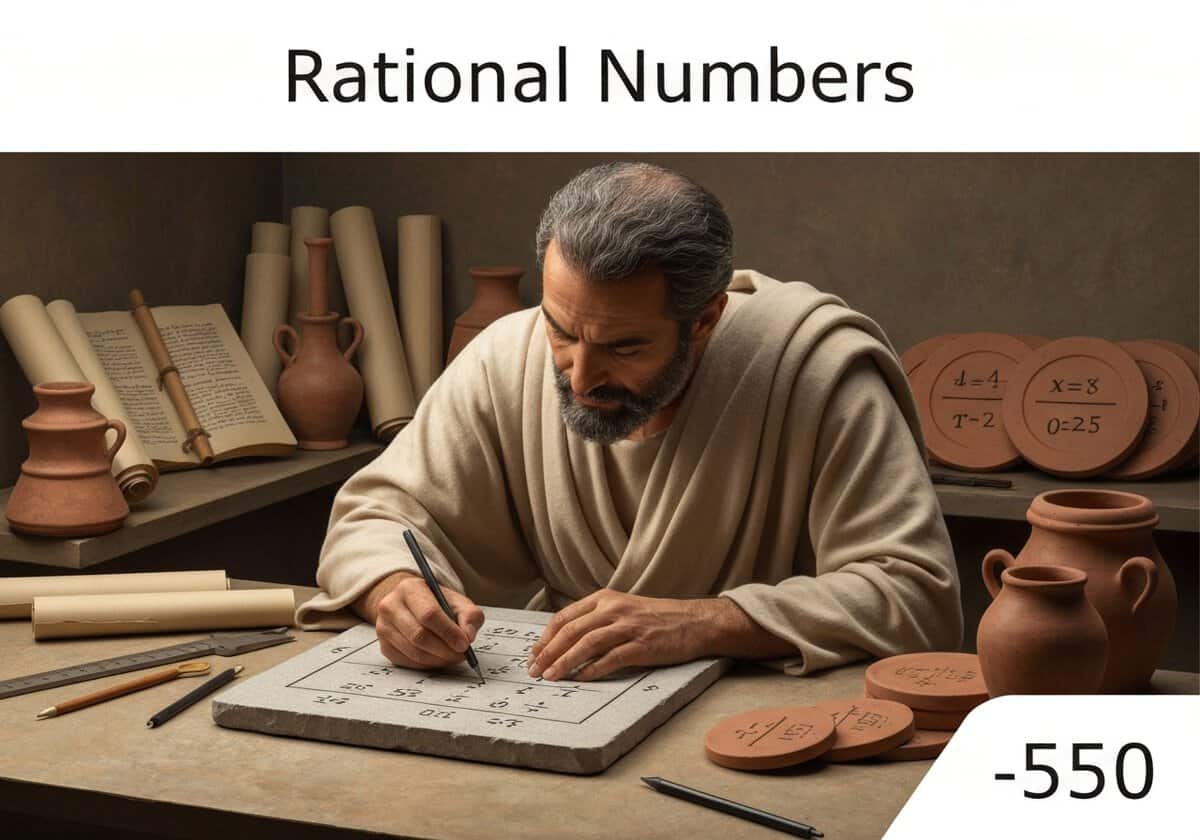
-550
Ancient scholar demonstrating rational numbers on a stone tablet in a historical classroom.

(图片仅供参考)

A rational number is any number that can be expressed as a fraction or quotient [latex]p/q[/latex], where [latex]p[/latex] is an integer and [latex]q[/latex] is a non-zero integer. The set of all rational numbers is denoted by [latex]\mathbb{Q}[/latex]. This fundamental concept extends the integers to include fractions, allowing for the representation of parts of a whole.
The concept of a rational number arises from the need to measure quantities that are not whole multiples of a unit. In mathematics, it formalizes the idea of a ratio between two integers. A rational number is formally defined as an equivalence class of ordered pairs of integers [latex](p, q)[/latex] with [latex]q \neq 0[/latex]. The equivalence relation is defined as [latex](p_1, q_1) \sim (p_2, q_2)[/latex] if and only if [latex]p_1 q_2 = p_2 q_1[/latex]. This means, for example, that the fractions 1/2, 2/4, and -3/-6 all represent the same rational number.

Every integer is a rational number, since any integer [latex]n[/latex] can be written as the fraction [latex]n/1[/latex]. The set of rational numbers, denoted by [latex]\mathbb{Q}[/latex] (for ‘quotient’), is therefore a superset of the integers [latex]\mathbb{Z}[/latex]. Unlike integers, rational numbers are not uniquely represented; each rational number has infinitely many fractional forms. The form where [latex]p[/latex] and [latex]q[/latex] are coprime (have no common divisors other than 1) and [latex]q > 0[/latex] is called the canonical or lowest terms representation.

The development of this concept was not immediate. Ancient Egyptians used a system of unit fractions, but the Greeks, particularly the Pythagoreans, were among the first to systematically study ratios of integers. Their worldview was shaken by the discovery of irrational numbers, such as the square root of 2, which could not be expressed as such a ratio. This discovery highlighted the distinction between rational and irrational numbers, a cornerstone of number theory.

UNESCO Nomenclature: 1101
– Algebra, Number theory and Group theory

类型

抽象系统

中断

Foundational

用法

广泛使用

前体

  • 整数的概念
  • 部门运作
  • 古埃及对单位分数的使用
  • 巴比伦六十进制分数系统

应用程序

  • 工程和科学中的测量和尺度变换
  • 涉及单位分数的财务计算
  • 用于精确算术的计算机编程数据类型
  • 音乐理论中音程和和声的表示
  • 利用概率论定义事件发生的可能性

专利:

NA

潜在创新理念

  • 一种基于寻找分子/分母极大的分数的标准形式的难度而建立的密码系统
  • 一种将浮点数据表示为有理近似值的数据压缩算法
  • 一种利用有理数域避免浮点误差的风险分析金融建模工具
  • 一个 编程语言 with native support for rational arithmetic to enhance precision in scientific computing
  • 一款利用有理数来探索微音阶和复杂节奏的音乐创作软件
  • 一种用于符号回归的人工智能模型,能够以有理函数的形式发现物理定律。
  • 一种利用有理数模式创建复杂几何图案的数字面料设计工具
  • 一种采用有理数运动学的高精度机器人控制系统,可消除累积舍入误差
  • 一种使用基于有理数的分组划分来优化数据路由的网络协议
  • 一个 医学成像 reconstruction algorithm that uses rational functions for more accurate modeling of tissue densities
Related to: rational number, fraction, integer, quotient, ratio, number theory, mathematics, p/q, set Q, arithmetic.

历史背景

有理数

-300
-550
1750
1790
1800
1844
1874
-300
-450
1585
1779
1799
1801
1850
1875

(如果日期未知或不相关,例如“流体力学”,则提供其显著出现的近似估计)

第十年 周年纪念日

只有注册会员才能免费获取完整尺寸的图片和下载内容。

> 登录 <