Product Design, Manufacturing & Innovation Resources
Home » Cauchy-Kowalevski Theorem

Cauchy-Kowalevski Theorem

1875
  • Augustin-Louis Cauchy
  • Sofya Kovalevskaya
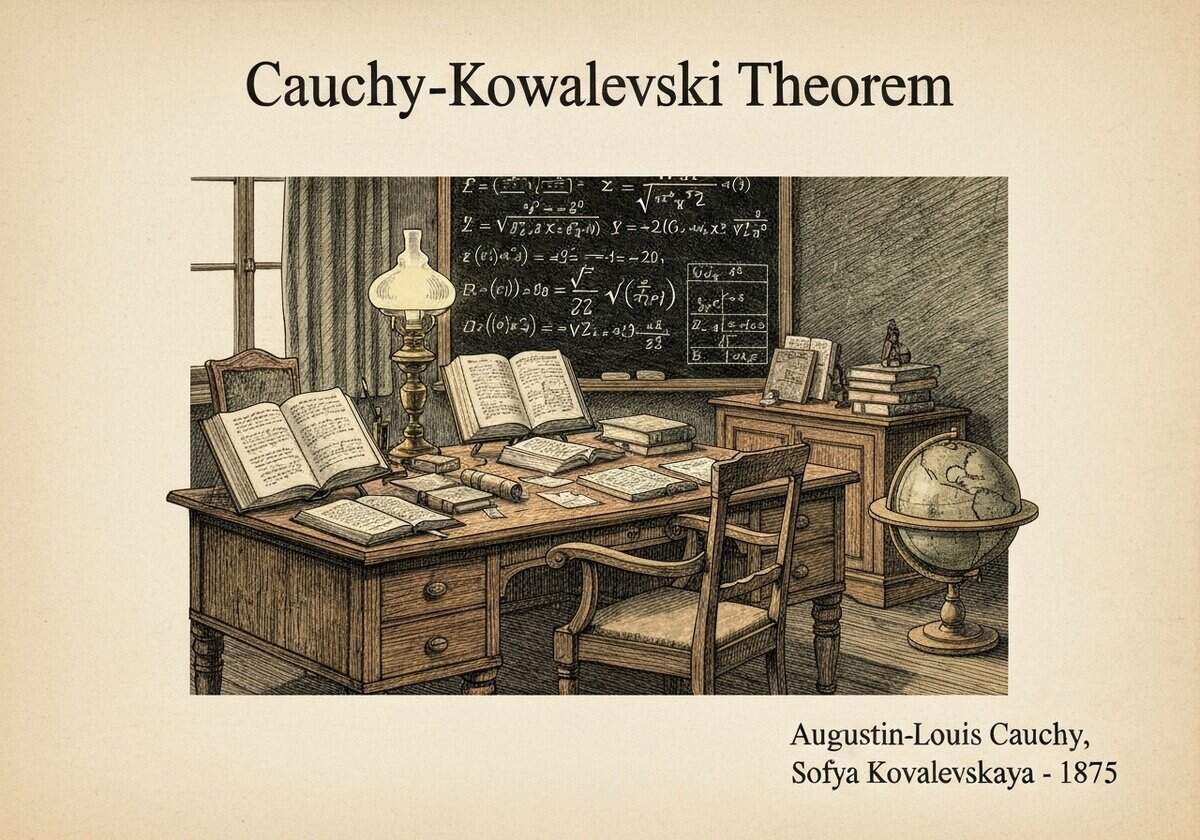
Study room of mathematicians Cauchy and Kovalevski with analysis books and equations.

(generated image for illustration only)

A fundamental existence and uniqueness theorem for partial differential equations associated with Cauchy initial value problems. It states that if the PDE and the initial conditions are ‘analytic’ (can be represented by convergent power series), then a unique analytic solution exists in a neighborhood of the initial surface. It provides a local existence guarantee but does not address global behavior or well-posedness.

The Cauchy-Kowalevski theorem is a powerful theoretical tool, though its practical applicability is limited by the strict requirement of analyticity. An analytic function is infinitely differentiable and can be locally represented by its Taylor series. Many physical problems involve functions or boundaries that are not analytic, so the theorem does not apply.

The theorem considers a system of PDEs where the highest-order time derivative of each unknown function is expressed in terms of lower-order time derivatives and spatial derivatives. The initial data is specified on a non-characteristic surface (a surface where the initial value problem can be uniquely solved for the highest derivatives). For a PDE of order \(k\), this typically involves specifying the function and its first \(k-1\) time derivatives at \(t=0\).

The proof of the theorem is constructive, based on finding the coefficients of the power series expansion of the solution. It demonstrates that under the analytic assumption, these coefficients can be uniquely determined from the PDE and the initial data, and that the resulting series converges in some small neighborhood. However, the theorem gives no information about the size of this neighborhood of existence, nor does it guarantee that the solution depends continuously on the initial data (a key component of well-posedness). Hans Lewy’s famous 1957 example showed a simple linear PDE with smooth (but non-analytic) coefficients that has no solutions at all, highlighting the theorem’s limitations.

UNESCO Nomenclature: 1102
– Analysis

Type

Abstract System

Disruption

Substantial

Usage

Niche/Specialized

Precursors

  • cauchy’s work on complex analysis and power series
  • theory of analytic functions by weierstrass
  • formulation of initial value problems for odes and pdes
  • method of majorants (a key technique in the proof)

Applications

  • providing a theoretical foundation for the existence of solutions in mathematical physics
  • guiding the development of numerical methods based on series expansions
  • theoretical analysis in general relativity
  • proving the existence of local solutions to certain nonlinear pdes

Patents:

NA

Potential Innovations Ideas

  • automated theorem provers that verify the analyticity conditions for complex pde systems
  • symbolic computation software that generates local power series solutions to pdes
  • development of ‘weak solution’ theories (e.g., sobolev spaces) to handle non-analytic cases
  • numerical methods that use local analytic approximations to improve accuracy
  • ai-driven discovery of physical laws by searching for pdes with local analytic solutions matching data
  • control theory for systems where local predictability is guaranteed by the theorem
  • foundational work for theories of quantum fields where local analyticity is a key assumption
  • algorithms for detecting the formation of singularities by observing the breakdown of local analytic solutions
Related to: cauchy-kowalevski theorem, existence theorem, uniqueness theorem, analytic function, cauchy problem, initial value problem, power series, pde theory.

Historical Context

Cauchy-Kowalevski Theorem

1799
1801
1850
1875
1897
1950
1790
1800
1844
1874
1893
1900

(if date is unknown or not relevant, e.g. "fluid mechanics", a rounded estimation of its notable emergence is provided)

10th year anniversary

Full size images and downloads are only available, 100% free, for registered members.

> Login <