Product Design, Manufacturing & Innovation Resources
Home » Process Capability Index (Cpk)

Process Capability Index (Cpk)

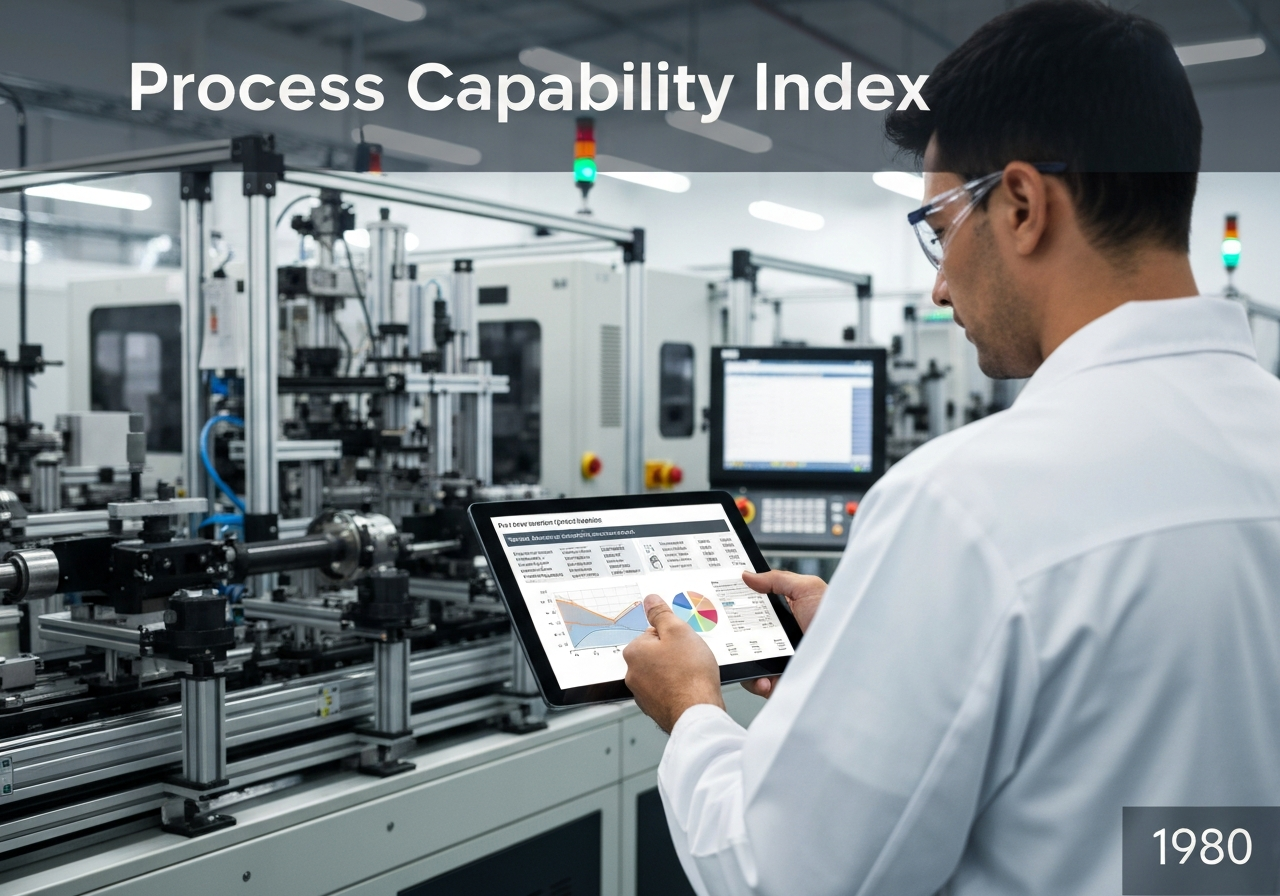
1980
Quality control engineer analyzing process capability index in manufacturing.

(generated image for illustration only)

A statistical measure of a process’s ability to produce output within customer-defined specification limits. Unlike control charts, which track stability, Cpk quantifies capability. It measures how centered the process is between the specification limits and accounts for process variation. A higher Cpk value indicates a more capable process. The formula is [latex]C_{pk} = \min\left[\frac{USL – \mu}{3\sigma}, \frac{\mu – LSL}{3\sigma}\right][/latex].


While control charts tell you if a process is stable and predictable, they do not indicate if the process is actually meeting customer requirements. This is the role of process capability indices, with Cpk being one of the most widely used. Cpk bridges the gap between the “voice of the process” (its mean [latex]\mu[/latex] and standard deviation [latex]\sigma[/latex]) and the “voice of the customer” (the Upper Specification Limit, USL, and Lower Specification Limit, LSL). The index is calculated by finding the distance from the process mean to the nearest specification limit and dividing it by three times the process standard deviation (representing half the natural process spread).

The ‘k’ in Cpk specifically addresses how well the process mean is centered relative to the specification limits. A perfectly centered process would have its mean exactly halfway between the USL and LSL. If the process mean shifts closer to one of the limits, the Cpk value will decrease, even if the overall process spread (variation) remains the same. This is because the risk of producing a defect increases as the process average approaches a specification boundary. A Cpk value of 1.0 implies the process is just capable of meeting specifications (assuming a normal distribution, a small percentage of defects would still be expected). Many industries, particularly automotive, require a Cpk of 1.33 or even 1.67 to ensure a high level of quality and provide a buffer for any potential process shifts.

UNESCO Nomenclature: 1209
– Statistics

Type

Abstract System

Disruption

Substantial

Usage

Widespread Use

Precursors

  • statistical process control (spc)
  • concept of specification limits in engineering
  • normal distribution theory
  • standard deviation as a measure of dispersion

Applications

  • supplier quality assurance programs
  • product design and tolerance setting
  • process improvement project selection (six sigma)
  • manufacturing performance benchmarking
  • validation of process changes

Patents:

NA

Potential Innovations Ideas

Due to scrapping bot traffic, currently more than 40k per day, this content is reserved to community members.
> Login < or > Register < (100% free) to access this, so as all other restricted content and tools.

Related to: cpk, process capability, specification limits, usl, lsl, six sigma, quality metric, process performance, centering, variation.

Historical Context

Process Capability Index (Cpk)

1980
1980
1980
1980
1986-01-01
1990
1990
1975-06-01
1980
1980
1980
1982-07-01
1988-06-01
1990
1993

(if date is unknown or not relevant, e.g. "fluid mechanics", a rounded estimation of its notable emergence is provided)

Full size images and downloads are only available, 100% free, for registered members.

> Login <