
In innovation, we are conditioned to celebrate the pioneer—the visionary who stands alone with a groundbreaking idea. This romantic image, however, overlooks a more critical catalyst for change. As illustrated by the “Lone Nut” theory, an innovator is merely an outlier until the arrival of the first follower. This crucial second actor provides the social proof that transforms a strange, individual act into the beginning of a movement. It is their public courage that lowers the barrier for others, validates the new idea, and shifts the dynamic from solitary eccentricity to collective action, proving that true leadership lies not just in starting something new, but in empowering others to join.
This principle of second-mover power extends directly from social dynamics into the corporate boardroom through the “Fast Follower” business strategy. Here, the logic is not about joining a movement, but about strategically capturing a market. A fast follower deliberately allows a pioneer to bear the immense costs and risks of educating consumers and proving a new concept. By observing the first mover’s successes and, more importantly, their failures, the follower can enter the now-validated market with a superior, more refined product. This approach challenges the “first-mover advantage” myth, demonstrating that in both social movements and market competition, the most enduring success often belongs not to the one who starts the race, but to the one who learns from it and runs it better.
“Lone Nut” and his “First Follower” ≠ “Fast Follower”
(these are 2 different strategies)
Key Takeaways
- An innovator is an anomaly; the first follower is the start of a trend.
- The first follower isn’t just joining; they are a form of leadership, showing others how to participate.
- For a movement to start, the initial act must be both visible and simple to replicate.
- Pioneering is expensive. The first mover pays the “market education tax” and bears the full cost of initial failures.
- The goal is not to clone the first product, but to launch the version 2.0 that customers wanted all along.
- Both strategies weaponize the act of waiting. The first follower waits for a signal to reduce social risk; the fast follower waits for data to reduce market risk.
- A pioneer’s best defense is entrenchment through patents, brand loyalty, or network effects, which can make a follower’s superior product irrelevant.
- Growth reaches a tipping point when the fear of being left out surpasses the initial fear of standing out.
The “Lone Nut” and his First Follower
In his influential TED talk “How to Start a Movement“, Derek Sivers presents a counterintuitive and powerful tactic for innovation and marketing centered on the crucial role of the “first follower“. Using footage of a lone man dancing ecstatically at a music festival, Sivers breaks down the social dynamics of how a new idea transforms from a strange, individual act into a collective movement. The core of his argument is that the first follower’s courage is just as, if not more, important than the innovator’s initial idea.
The Innovator as the “Lone Nut”

Sivers begins by highlighting the innovator—the person with the new idea or behavior. This individual needs the “guts to stand alone and look ridiculous”. Initially, this person is a “lone nut”, an outlier whose actions are not yet understood or accepted. For this innovator to succeed in starting a movement, Sivers emphasizes two key points:
- Public visibility: the act must be public. An innovation hidden from view can never gather followers.
- Simplicity: the idea must be easy to understand and, crucially, easy to follow. Complex actions create a barrier to entry for potential followers.
Tip: stop thinking of yourself as a performer and start acting like an experience designer by meticulously engineering the on-ramp for your first follower. Instead of just publicly demonstrating your full, complex vision, deconstruct it to its simplest possible component and make that one, low-friction action the most visible and repeatable part of your display. This goes beyond merely being “easy to follow”; it’s about making the initial act of joining irresistibly simple and psychologically safe. Project approachability over intimidating perfection, because your immediate goal isn’t to showcase your own mastery, but to lower the social barrier so much that taking that first step feels like a small, easy, and natural thing for someone else to do.
The Transformative Power of the First Follower
The pivotal moment in the creation of a movement is the arrival of the first follower. According to Sivers, this person performs an under-appreciated form of leadership. The first follower’s actions are what “transforms a lone nut into a leader”. Without this first public endorsement, the innovator remains an isolated individual.

Here are the critical functions of the first follower:
- Legitimization and Social Proof: the first follower’s act of joining in signals to the crowd that the innovator’s idea might not be so crazy after all. It provides social proof and legitimizes the new behavior.
- Reducing Risk for Others: it takes immense courage to be the first follower, as you risk ridicule just like the leader. However, by joining, you significantly lower the social risk for the next person. The second follower is no longer joining a “lone nut” but is now part of a small group.
- Publicly Demonstrating How to Follow: the first follower plays a crucial instructional role by showing others how to participate. This simplifies the process for subsequent followers who might have been interested but unsure of how to join.
- Shifting the Focus from the Individual to the Group: a key observation Sivers makes is that a good leader embraces the first follower as an equal. This act immediately shifts the focus from the leader to the collective “them”. The movement becomes about the shared idea, not the glorification of a single person.
Tip: to consciously act as both a translator and an amplifier, not just a participant. While the innovator provides the raw, often strange, new idea, your critical role is to reframe it for the mainstream, making it understandable, relatable, and safe for others to join. Don’t just mimic the leader’s actions; demonstrate a slightly more accessible version of them and use your own social capital to publicly signal why this movement is important and how others can easily participate. You are the crucial bridge between the “lone nut” and the crowd, and your job is to turn their strange signal into a clear, compelling invitation that is too good to refuse.
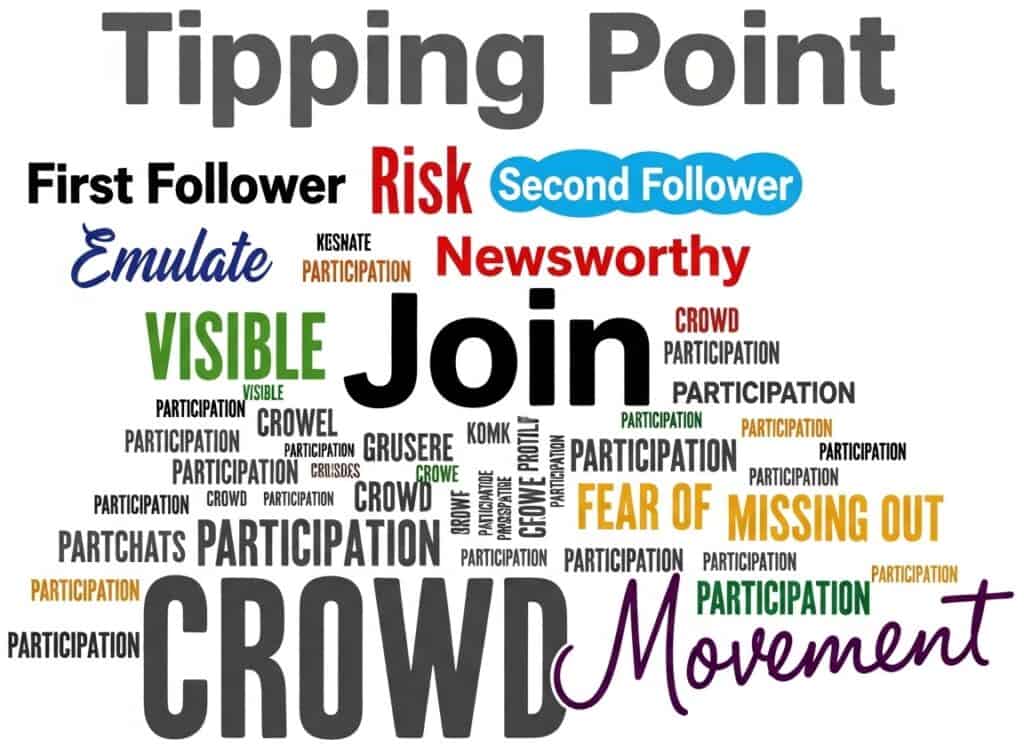
From Two to a Crowd: The Tipping Point
Once the first follower has joined, the dynamic changes rapidly:
- The Second Follower: the arrival of a second follower is a key turning point. As Sivers notes, “it’s proof the first has done well”. Three people constitute a “crowd”, and a crowd is newsworthy.
- Followers Emulate Followers: a crucial insight is that new followers primarily emulate other followers, not the leader. This is why it’s vital for the movement to be public and for the followers to be visible.
- Reaching the tipping point: as more people join, a tipping point is reached where it becomes riskier not to join. The fear of being left out or ridiculed for not participating surpasses the initial fear of standing out.
Key Lessons for Innovation and Marketing
Sivers’ “first follower” tactic offers profound lessons for anyone trying to launch a new product, service, or idea:
- Leadership is over-glorified: the success of a new idea is not solely dependent on the brilliance of the innovator. It is equally, if not more, dependent on the courage and actions of the first few adopters.
- Nurture your first followers: innovators and marketers must actively seek out and empower their first followers. This means treating early adopters as equals, celebrating their participation, and making them visible to others. The movement should be about “us”, not “me”.
- Have the courage to follow: Sivers’ ultimate message is a call to action for everyone else. If you see a “lone nut” with a great idea, have the courage to be the first to stand up and join in. Being a first follower is a powerful way to make a difference and is a distinct form of leadership.
The “first follower” tactic reframes the launch of an innovation not as a top-down broadcast from a leader, but as a collaborative dance that begins when one brave person decides to join the “lone nut” on the dance floor.
First Follower Fictional Full Example
The Technology and “The Lone Nut”
The fictional product is the “Chroma-Ink“, a revolutionary bio-safe ink for tattoos that can change color and display simple animations based on real-time biometric data. Its creator, the brilliant but introverted bio-hacker Arthur Finch, is the “lone nut”. For weeks, he works from a popular co-working space, his forearm covered in a complex mandala tattoo that subtly shifts from blue (focus) to gold (sunlight) or ripples with light when he gets a message.
He’s a public curiosity, ignored by most and quietly mocked by others as “#GlowTattGuy”. He doesn’t sell his idea; he simply lives it, making his innovation visible but strange.
The First Follower and the Tipping Point
Maya, a user-interface designer, watches him for weeks. While others see a weirdo, she sees a beautiful, human-centered new language. In a pivotal and public act, she walks directly to Arthur’s table and praises his work, asking to collaborate. This moment transforms him from a lone nut into a leader. He embraces her as an equal, and a week later, Maya returns to the café with her own elegant Chroma-Ink tattoo—a simple line around her wrist. Now there are two of them.
The effect is immediate: the idea is legitimized, and the social risk vanishes. A tech blogger who had previously ignored Arthur writes a viral article about them, inquiries flood in, and a movement begins, all because one person had the courage to be the first to follow.
The rest of this article is reserved for members
To limit scraping bots (currently 40,000 hits per day!),
we had to restrict access to full articles and tools to registered members only.
to access all the rest.