Product Design, Manufacturing & Innovation Resources
Home » SWOT Matrix Framework

SWOT Matrix Framework

1960
  • Albert Humphrey
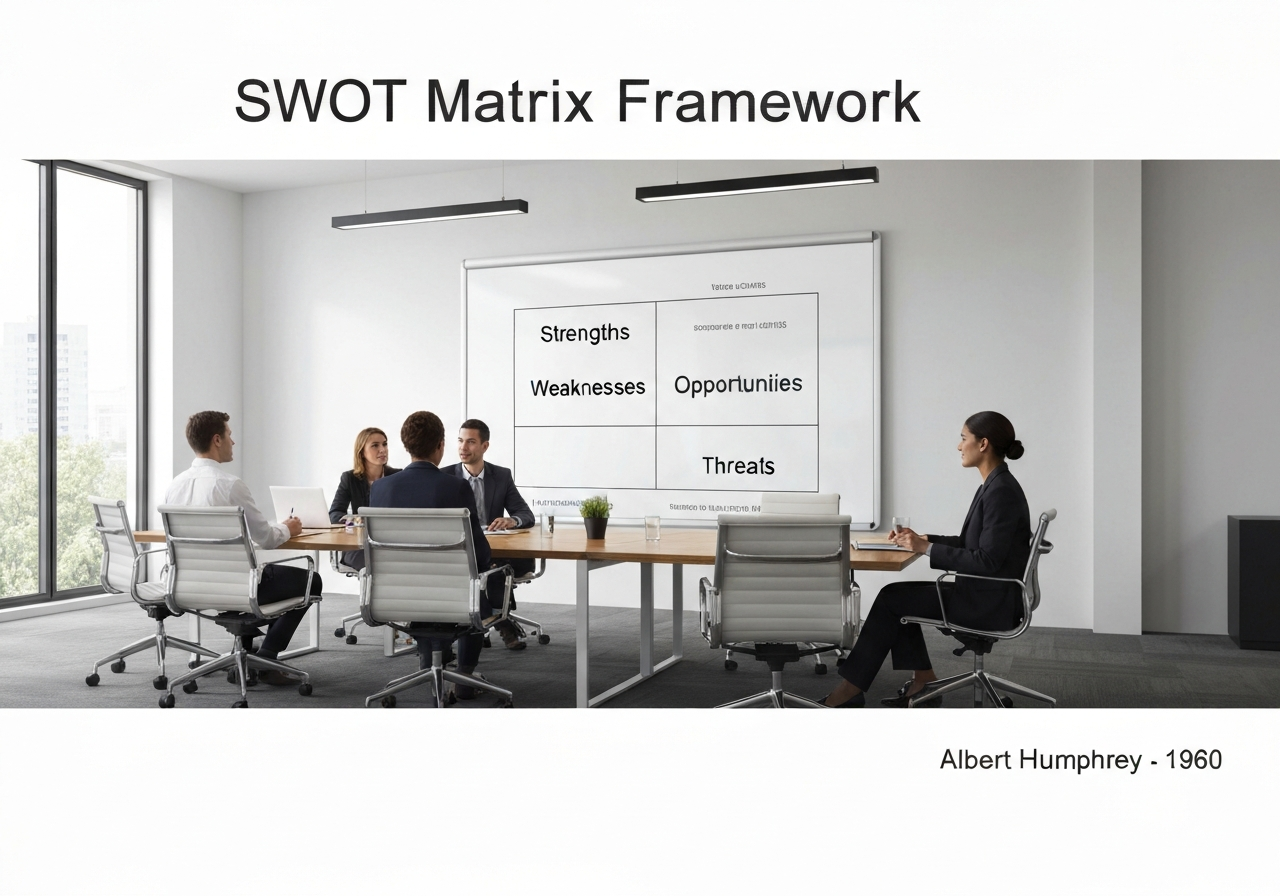
SWOT Matrix Framework in a professional office for strategic planning.

(generated image for illustration only)

SWOT analysis is a strategic planning technique structured as a 2×2 matrix. It evaluates four elements: Strengths (internal, helpful), Weaknesses (internal, harmful), Opportunities (external, helpful), and Threats (external, harmful). The framework aims to identify these internal and external factors to facilitate the development of a strategic plan that aligns an organization’s capabilities with its environment. Its opportunities and threats are easier to list after a competitor analysis Porter style, which reviews the forces acting on the industry.


The SWOT analysis framework is a foundational tool in strategic management. Its power lies in its simplicity and visual representation of complex situations. The four quadrants prompt users to systematically consider different facets of their subject. ‘Strengths’ are the attributes of the organization that are helpful to achieving the objective, such as a strong brand, loyal customer base, or unique technology. ‘Weaknesses’ are attributes that are harmful to achieving the objective, like high debt, an outdated supply chain, or lack of a strong R&D department. These are internal factors, meaning the organization has a degree of control over them.

Conversely, ‘Opportunities’ are external conditions that could be exploited to the organization’s advantage, such as a new market opening, a competitor’s failure, or favorable government regulations. ‘Threats’ are external conditions that could do damage to the organization’s performance, like an economic downturn, new competition, or changing consumer tastes. The goal is not just to list these items but to use the completed matrix as a basis for strategic thinking. By understanding these four aspects, an organization can better formulate a strategy that leverages its strengths, mitigates its weaknesses, capitalizes on opportunities, and defends against threats.

UNESCO Nomenclature: 5312
– Organization and management

Type

Abstract System

Disruption

Substantial

Usage

Widespread Use

Precursors

  • military strategy concepts (e.g., Sun Tzu’s the art of war)
  • early business management theories
  • systems thinking principles
  • decision theory frameworks

Applications

  • business strategy development
  • marketing plan creation
  • personal career planning
  • non-profit organizational assessment
  • product launch analysis
  • competitive analysis

Patents:

NA

Potential Innovations Ideas

  • ai-powered swot analysis for real-time market data integration
  • dynamic swot dashboards for continuous strategic monitoring
  • collaborative online swot platforms with voting and prioritization features
  • swot analysis for personal ai assistants to provide career advice
  • automated swot generation from corporate annual reports
  • gamified swot training modules for business students
  • integrating swot with project management software for risk assessment
  • swot analysis for smart city planning initiatives
  • using swot to evaluate the ethical implications of new technologies
  • a swot-based algorithm for investment portfolio risk analysis
Related to: SWOT analysis, strategic planning, business matrix, strengths, weaknesses, opportunities, threats, internal factors, external factors, management tool.

Historical Context

SWOT Matrix Framework

1957
1957
1960
1960
1970
1980
1980
1957
1957
1960
1960
1965
1970
1980
1980

(if date is unknown or not relevant, e.g. "fluid mechanics", a rounded estimation of its notable emergence is provided)

10th year anniversary

Full size images and downloads are only available, 100% free, for registered members.

> Login <