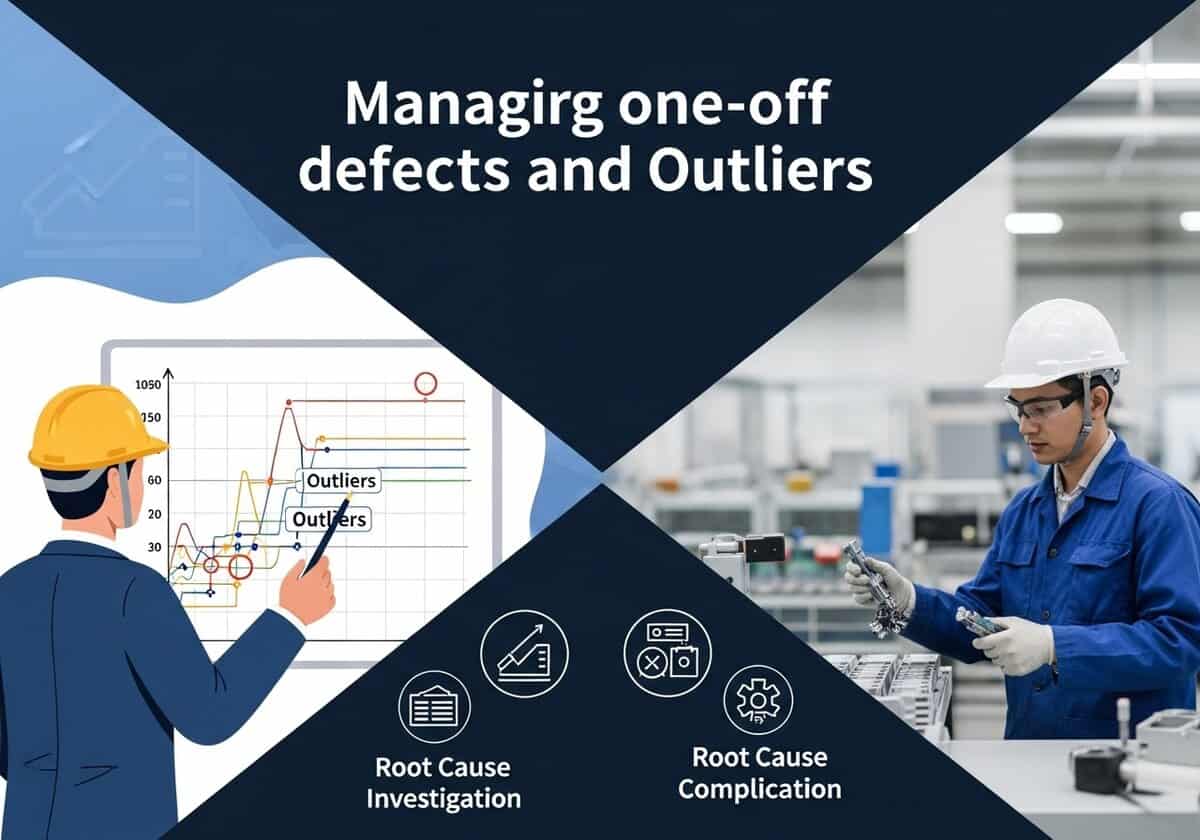
A plane suddenly pointing down, a part of a car flying away on the highway, a blade braking in a kitchen home-appliance … bad luck, normal wearing, default, rare statistics or more complicated R&D, Quality or manufacturing event?

The rigorous identification and analysis of one-off defect events and outliers are critical across Research and Development (R&D), Verification and Validation (V&V), and manufacturing, as they directly impact product quality and end-user safety. One-off defect events—rare, isolated failures or deviations—and outliers—data points that fall significantly outside expected process distributions—may serve as early indicators of latent process weaknesses, measurement inaccuracies, or emerging risks. In R&D, systematic detection of these anomalies informs design robustness and risk assessment, guiding iterative improvements before transfer to production. During V&V, their correct evaluation is essential for validating product performance, confirming compliance with specifications, and ensuring that rare failure modes are not overlooked. In manufacturing, prompt recognition and investigation of such events enable targeted root cause analysis and corrective actions, preventing recurrence and systemic propagation.
Effective management of one-off defects and outliers is integral to maintaining process control, product conformity, and regulatory compliance. It underpins continuous improvement initiatives and safeguards both organizational reputation and user safety. In industries with stringent quality and traceability requirements, the disciplined handling of these anomalies is a foundational element of a mature quality management system, ensuring that potential threats to product integrity are systematically addressed before they can impact the final user.
Key Takeaways
- Outliers and one-off defect events are distinct: outliers are statistically anomalous data points, while one-off defect events are rare, non-recurring process or product failures; both require different detection and response strategies.
- Statistical rigor: use appropriate statistical methods, ensuring methods match data characteristics and industry requirements.
- Control charts are foundational: Implement X-bar, R, S, or individuals control charts to monitor process stability and detect both outliers and one-off defect events in real time.
- Root cause analysis is mandatory: every confirmed outlier or one-off defect event must trigger structured root cause analysis to prevent recurrence and eliminate underlying process weaknesses.
- Industry risk profile dictates response: high-risk sectors require immediate investigation, batch quarantine, and regulatory notification for any one-off defect or critical outlier, regardless of statistical frequency.
- Process capability analysis integrity: Exclude assignable-cause outliers from Cp/Cpk calculations only when justified and documented; otherwise, include them to reflect true process performance.
- Trend monitoring and escalation: use run charts and event logs to track one-off defect and outlier frequency over time; escalate to process review if patterns or increasing trends emerge.
An “event”, despite being identified as a one-off defect or as an outlier, internal company rules & regulatory compliance is non-negotiable.
Adhere to industry-specific standards (IATF 16949, AS9100, ISO 13485, GMP, HACCP, IRIS, IEC 61508 …) for anomaly handling, reporting, and corrective action.
Definitions
In quality and manufacturing, these two terms are among the ones used to describe defects, errors, or issues that affect product quality:
Among others: single occurrence defect, isolated defect, unique defect, rare defect, sporadic defect, random defect, exceptional defect, anomaly, aberration, deviation, irregularity, singular defect, non-recurring defect, exceptional case, outlier, special cause variation, one-time error, unique event, chance cause, ad hoc defect …
One-off Defect
Meaning: a “one-off defect” or issue (more rarely “One Time Off” or OTO) refers to a problem that occurs only once and is not expected to recur. It is often considered an isolated incident and as such, root cause is difficult to analyse and identify.
Example: a machine might produce one defective part due to a temporary glitch, but once fixed, the problem does not happen again.
Importance: identifying one-off defect issues helps differentiate between systemic problems and random, isolated defects. Is there any true random ?
Outlier
Meaning: an outlier is a data point or measurement that is significantly different from other observations. In manufacturing, it could be a product measurement or defect rate that deviates markedly from the norm.
Example: if most parts have a dimension of 10 mm ± 0.1 mm, but one part measures 12 mm, that part is an outlier.
Importance: outliers can indicate special causes of variation or errors in measurement, and they often need investigation to determine if they represent a real problem or a measurement anomaly or part of the long tail in a normal distribution.
The rest of this article is reserved for members
To limit scraping bots (currently 40,000 hits per day!),
we had to restrict access to full articles and tools to registered members only.
to access all the rest.
FAQ
What is a One Time Off (one-off defect) event in manufacturing?
An one-off defect event is a rare, isolated process or product failure that does not recur and may indicate a special cause or unique disturbance.
How is an outlier defined in quality control?
An outlier is a data point that deviates significantly from the rest of the dataset, often identified using statistical methods such as Z-score, IQR, or Grubbs’ test.
Why must one-off defect events be investigated even if they are rare?
one-off defect events can signal latent process weaknesses or risks that, if unaddressed, may lead to more frequent or severe failures.
What statistical methods are used to detect outliers?
Common methods include Z-score analysis, interquartile range (IQR), and Grubbs’ test for small samples.
How should outliers be handled in process capability analysis?
Outliers with assignable causes may be excluded with justification; otherwise, they must be included to reflect true process performance.
What is the regulatory expectation for handling one-off defect events in high-risk industries?
Immediate investigation, documentation, root cause analysis, and notification to authorities or customers if safety or compliance is impacted.
How does an one-off defect event differ from common cause variation?
one-off defect events are special cause variations, not inherent to the process, and require targeted corrective action.
When can an outlier be ignored in quality data?
Only when a clear, documented assignable cause (e.g., measurement error) is confirmed; otherwise, it must be investigated and addressed.
What role do control charts play in detecting one-off defects and outliers?
Control charts provide real-time monitoring and highlight points outside control limits, signaling the need for investigation.
How are one-off defect events modeled statistically?
The Poisson distribution is used to estimate the expected frequency of rare events in a defined interval or sample size.
What documentation is required for one-off defect and outlier events?
Detailed records of detection, investigation, root cause, corrective actions, and communication are required for compliance and traceability.
How should one-off defect and outlier events be integrated into FMEA?
Update failure modes, occurrence ratings, and controls to reflect new risks and ensure ongoing risk mitigation.
What is the impact of recurring one-off defect events?
Recurrence indicates a systemic issue, requiring escalation, process review, and potentially redesign or retraining.
How should customer communication be managed for critical one-off defect or outlier events?
Promptly inform customers of the event, investigation results, and corrective actions, especially if product safety or compliance is affected.
Related Readings
- Measurement System Analysis (MSA): evaluating the accuracy and precision of measurement tools to ensure data reliability.
- Statistical Process Control (SPC): using statistical methods to monitor and control manufacturing processes.
- Process Capability Indices (Cp, Cpk): quantifying how well a process can produce output within specification limits.
- Design of Experiments (DOE): systematically planning tests to understand process variables and optimize performance.
- Gage Repeatability and Reproducibility (Gage R&R): assessing measurement variation from equipment and operators.
- Corrective and Preventive Action (CAPA): systematic approach to eliminate causes of nonconformities and prevent recurrence.
- Nonconformance management: procedures for identifying, documenting, and resolving deviations from requirements.
- Root cause analysis tools: techniques such as 5 Whys and Fishbone diagrams for identifying underlying causes of defects.
- Mistake-proofing (Poka-Yoke): implementing mechanisms to prevent errors in manufacturing processes.
- Batch release and disposition: decision-making process for accepting, reworking, or rejecting production lots.
- Statistical sampling plans: designing sampling strategies for inspection and quality control.
- Change control management: managing process or product changes to maintain quality and compliance.
External Links on One Time Off (one-off defect) in Quality
International Standards
(hover the link to see our description of the content)
Glossary of Terms Used
Corrective Action and Preventative Action (CAPA): a systematic approach to identifying, investigating, and addressing nonconformities and potential issues to prevent recurrence and ensure compliance with regulatory standards in quality management systems.
Critical Control Points (CCP): specific stages in a process where control can be applied to prevent, eliminate, or reduce food safety hazards to acceptable levels. Identifying these points is essential for effective hazard analysis and critical control management in food production systems.
Define Measure Analyze Improve Control (DMAIC): a data-driven quality strategy used in Six Sigma for process improvement, consisting of five phases: identifying the problem, measuring current performance, analyzing data to identify causes, improving processes based on findings, and controlling future performance to sustain improvements.
Design of Experiment (DOE): a systematic method for planning, conducting, and analyzing controlled tests to evaluate the effects of multiple variables on a response variable, facilitating the identification of optimal conditions and interactions among factors.
Failure Mode and Effects Analysis (FMEA): a systematic method for evaluating potential failure modes within a system, process, or product, assessing their effects on performance, and prioritizing risks to improve reliability and safety through corrective actions.
Food and Drug Administration (FDA): a federal agency of the United States Department of Health and Human Services responsible for regulating food safety, pharmaceuticals, medical devices, cosmetics, and tobacco products to ensure public health and safety through scientific evaluation and enforcement of compliance standards.
Good Manufacturing Practice (GMP): a system ensuring products are consistently produced and controlled according to quality standards, minimizing risks involved in pharmaceutical production and related industries. It encompasses guidelines for manufacturing processes, facility conditions, personnel qualifications, and documentation practices to ensure product safety and efficacy.
Hazard Analysis and Critical Control Points (HACCP): a systematic approach to food safety that identifies, evaluates, and controls hazards at critical points in the production process to prevent foodborne illnesses and ensure product safety.
Installation Qualification (IQ): a documented process to verify that equipment or systems are installed according to specifications, including assessment of utilities, environmental conditions, and compliance with design requirements, ensuring readiness for operational qualification.
International Electrotechnical Commission (IEC): a global organization that develops and publishes international standards for electrical, electronic, and related technologies, facilitating international trade and ensuring safety, efficiency, and interoperability of electrical devices and systems.
International Organization for Standardization (ISO): a non-governmental international body that develops and publishes standards to ensure quality, safety, efficiency, and interoperability across various industries and sectors, facilitating global trade and cooperation. Established in 1947, it comprises national standardization organizations from member countries.
Interquartile Range (IQR): a statistical measure representing the difference between the third quartile (Q3) and the first quartile (Q1) in a data set, indicating the range within which the central 50% of values lie, thus providing insight into data dispersion.
Measurement System Analysis (MSA): a statistical method used to evaluate the accuracy, precision, and reliability of measurement processes and instruments, ensuring that data collected is valid and consistent for decision-making in quality control and process improvement.
Non-Destructive Testing (NDT): a method used to evaluate material properties, integrity, or structure without causing damage, employing techniques such as ultrasonic, radiographic, magnetic particle, and dye penetrant testing to detect flaws or discontinuities.
One Time Off (OTO): a marketing strategy offering a single, limited-time product or service to customers, typically at a discounted rate, aimed at increasing sales and customer engagement during a specific promotional period. In production, can also be a unique manufacturing batch. Rarely: a Quality or manufacturing isolated incident, sometimes used instead of "One-off Defect".
Process Capability Index (Cpk): a statistical measure that quantifies how well a process can produce output within specified limits, indicating the relationship between the process mean and the nearest specification limit, adjusted for process variability.
Quality Management System (QMS): a structured system of processes, procedures, and responsibilities aimed at ensuring consistent quality in products and services, facilitating continuous improvement, and meeting customer and regulatory requirements.
Radiology Information System (RIS): a software system for managing medical imaging data, facilitating scheduling, tracking, and reporting of radiological procedures, and integrating with other healthcare systems to enhance workflow and patient care.
Repeatability and Reproducibility (R&R): a measurement system's ability to produce consistent results under the same conditions (repeatability) and across different conditions or operators (reproducibility), often evaluated through statistical methods to assess variability and reliability in data collection processes.
Statistical Process Control (SPC): a method of quality control that employs statistical techniques to monitor and control a process, ensuring it operates at its full potential by identifying variations and maintaining consistent output within specified limits.
Verification and Validation (V&V): a process to ensure a system meets specifications and fulfills its intended purpose, involving two distinct activities: verification checks if the product meets design specifications, while validation assesses if it satisfies user needs and requirements.