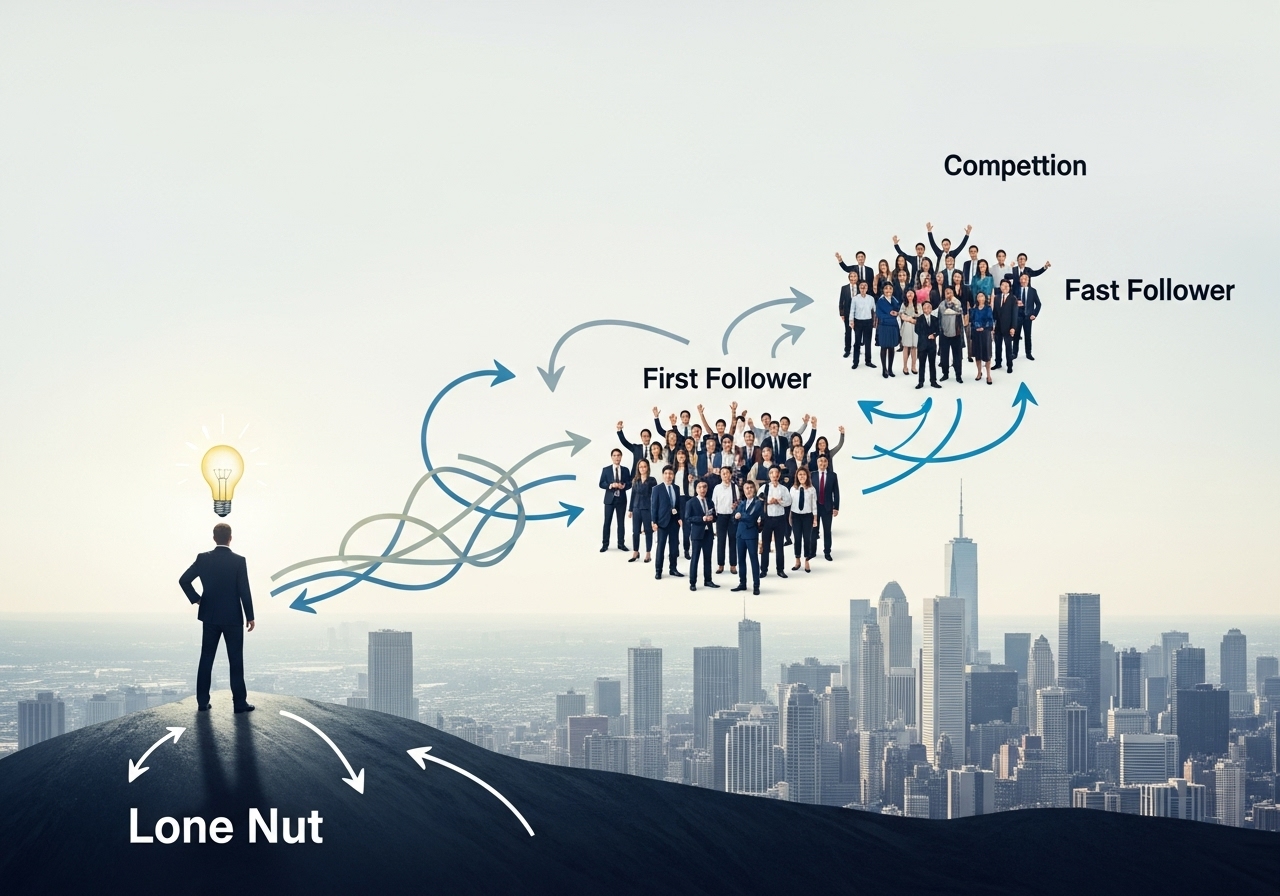
Na área da inovação, somos condicionados a celebrar o pioneiro — o visionário que se destaca sozinho com uma ideia revolucionária. Essa imagem romântica, no entanto, ignora um catalisador de mudança ainda mais crucial. Como ilustrado pelo exemplo do £8220Noz SolitáriaNa teoria, um inovador é meramente um valor atípico até a chegada do primeiro seguidor. Esse segundo ator crucial fornece a prova social que transforma um ato estranho e individual no início de um movimento. É a sua coragem pública que diminui a barreira para os outros, valida a nova ideia e muda a dinâmica da excentricidade solitária para a ação coletiva, provando que a verdadeira liderança reside não apenas em começar algo novo, mas em capacitar outros a se juntarem a ele.
Este princípio do poder do segundo a agir estende-se diretamente da dinâmica social para a sala de reuniões corporativa através do £8220Seguidor RápidoEstratégia de negócios. Aqui, a lógica não é aderir a um movimento, mas sim conquistar um mercado estrategicamente. Um seguidor rápido permite deliberadamente que um pioneiro arque com os imensos custos e riscos de educar os consumidores e comprovar um novo conceito. Ao observar os sucessos do pioneiro e, mais importante, seus fracassos, o seguidor pode entrar no mercado agora validado com um produto superior e mais refinado. Essa abordagem desafia o mito da "vantagem do pioneiro", demonstrando que, tanto em movimentos sociais quanto na competição de mercado, o sucesso mais duradouro muitas vezes não pertence a quem inicia a corrida, mas a quem aprende com ela e a conduz melhor.
'Lone Nut' e seu 'Primeiro Seguidor' ≠ “Seguidor Rápido”
(Estas são duas estratégias diferentes)
Principais conclusões

- Um inovador é uma anomalia; o primeiro seguidor é o início de uma tendência.
- O primeiro seguidor não está apenas se juntando a um grupo; ele representa uma forma de liderança, mostrando aos outros como participar.
- Para que um movimento comece, o ato inicial deve ser visível e simples de replicar.
- Ser pioneiro é caro. O primeiro a agir paga o "imposto da educação de mercado" e arca com o custo total das falhas iniciais.
- O objetivo não é clonar o primeiro produto, mas lançar a versão 2.0 que os clientes sempre quiseram.
- Ambas as estratégias instrumentalizam o ato de esperar. O seguidor inicial aguarda um sinal para reduzir o risco social; o seguidor rápido aguarda dados para reduzir o risco de mercado.
- A melhor defesa de um pioneiro é o fortalecimento da posição por meio de patentes, fidelidade à marca ou efeitos de rede, o que pode tornar irrelevante o produto superior de um seguidor.
- O crescimento atinge um ponto de inflexão Quando o medo de ser excluído supera o medo inicial de se destacar.
O "Lone Nut" e seu primeiro seguidor
Em sua influente palestra TED †Como iniciar um movimentoDerek Sivers apresenta uma tática contraintuitiva e poderosa para inovação e marketing centrado no papel crucial do primeiro seguidorUtilizando imagens de um homem solitário dançando extasiado em um festival de música, Sivers analisa a dinâmica social de como uma nova ideia se transforma de um ato estranho e individual em um movimento coletivo. O cerne de seu argumento é que a coragem do primeiro seguidor é tão importante quanto, ou até mais, do que a ideia inicial do inovador.
O Inovador como o 'Louco Solitário'

Sivers começa destacando o inovador — a pessoa com a nova ideia ou comportamento. Esse indivíduo precisa da “coragem de ficar sozinho e parecer ridículo”. Inicialmente, essa pessoa é um “maluco solitário”, um dissidente cujas ações ainda não são compreendidas ou aceitas. Para que esse inovador tenha sucesso em iniciar um movimento, Sivers enfatiza dois pontos-chave:
- Visibilidade pública: O ato deve ser público. Uma inovação escondida jamais conseguirá adeptos.
- Simplicidade: A ideia deve ser fácil de entender e, crucialmente, fácil de seguir. Ações complexas criam uma barreira de entrada para potenciais seguidores.
Dica: Pare de se ver como um artista e comece a agir como uma experiência. designer Planeje meticulosamente o caminho para o seu primeiro seguidor. Em vez de simplesmente demonstrar publicamente sua visão completa e complexa, desconstrua-a em seu componente mais simples possível e faça dessa ação única e descomplicada a parte mais visível e repetível da sua apresentação. Isso vai além de ser apenas "fácil de seguir"; trata-se de tornar o ato inicial de se juntar à sua comunidade irresistivelmente simples e psicologicamente seguro. Transmita acessibilidade em vez de uma perfeição intimidante, porque seu objetivo imediato não é exibir sua própria maestria, mas sim reduzir a barreira social a tal ponto que dar o primeiro passo pareça algo pequeno, fácil e natural para outra pessoa.
O Poder Transformador do Primeiro Seguidor
O momento crucial na criação de um movimento é a chegada do primeiro seguidor. Segundo Sivers, essa pessoa exerce uma forma de liderança subestimada. As ações do primeiro seguidor são o que “transforma um lunático solitário em um líder”. Sem esse primeiro endosso público, o inovador permanece um indivíduo isolado.

Eis as funções essenciais do primeiro seguidor:
- Legitimização e Prova Social: O ato do primeiro seguidor de aderir sinaliza para a multidão que a ideia do inovador pode não ser tão maluca assim. Isso fornece prova social e legitima o novo comportamento.
- Reduzindo o risco para os outros: é preciso muita coragem para ser o primeiro a seguir, pois você corre o risco de ser ridicularizado assim como o líder. No entanto, ao se juntar ao grupo, você reduz significativamente o risco social para a próxima pessoa. O segundo seguidor não está mais se juntando a um "maluco solitário", mas agora faz parte de um pequeno grupo.acima.
- Demonstração pública de como participar: o primeiro seguidor desempenha um papel instrutivo crucial, mostrando aos outros como participar. Isso simplifica o processo para os seguidores subsequentes que possam estar interessados, mas não tenham certeza de como participar.
- Mudar o foco do indivíduo para o grupo: Uma observação fundamental feita por Sivers é que um bom líder acolhe o primeiro seguidor como um igual. Esse ato imediatamente desloca o foco do líder para o coletivo – o “eles”. O movimento passa a ser sobre a ideia compartilhada, e não sobre a glorificação de uma única pessoa.
Dica: Atuar conscientemente como tradutor e amplificador, não apenas como participante. Enquanto o inovador fornece a ideia nova, muitas vezes estranha, seu papel crucial é reformulá-la para o público em geral, tornando-a compreensível, acessível e segura para que outros participem. Não imite as ações do líder; demonstre uma versão um pouco mais acessível delas e use seu próprio capital social para sinalizar publicamente por que esse movimento é importante e como outros podem participar facilmente. Você é a ponte crucial entre o "maluco solitário" e a multidão, e seu trabalho O objetivo é transformar esse sinal estranho em um convite claro e irresistível.
De Dois a Multidão: O Ponto de Virada
Assim que o primeiro seguidor entra, a dinâmica muda rapidamente:
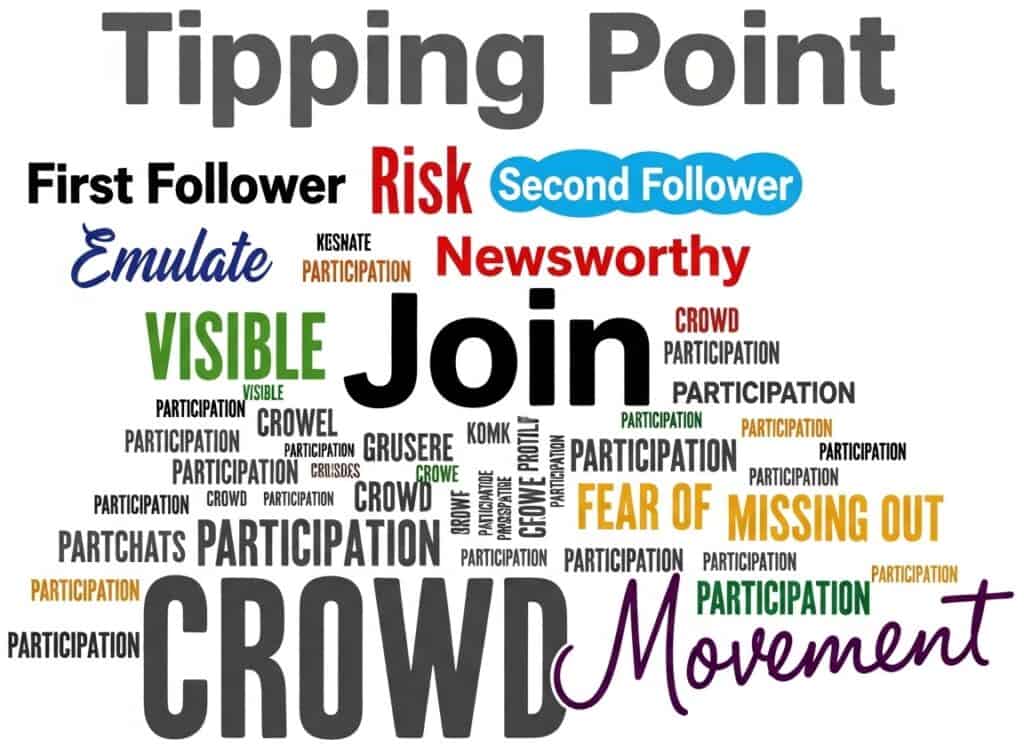
- O segundo seguidor: A chegada de um segundo seguidor é um ponto de virada crucial. Como Sivers observa, “é a prova de que o primeiro se saiu bem”. Três pessoas constituem uma “multidão”, e uma multidão é notícia.
- Seguidores imitam seguidores: Uma constatação crucial é que os novos seguidores imitam principalmente outros seguidores, não o líder. É por isso que é vital que o movimento seja público e que os seguidores sejam visíveis.
- Chegando ao ponto de inflexão: Com a entrada de mais pessoas, chega-se a um ponto crítico em que se torna mais arriscado. não para participar. O medo de ser deixado de fora ou ridicularizado por não Participar supera o medo inicial de se destacar.
Principais lições para inovação e marketing
A tática do "primeiro seguidor" de Sivers oferece lições profundas para qualquer pessoa que esteja tentando lançar um novo produto, serviço ou ideia:
- A liderança é supervalorizada: O sucesso de uma nova ideia não depende apenas da genialidade do inovador. Depende igualmente, ou até mais, da coragem e das ações dos primeiros a adotá-la.
- Cultive seus primeiros seguidores: Inovadores e profissionais de marketing devem buscar ativamente e capacitar seus primeiros seguidores. Isso significa tratar os primeiros usuários como iguais, celebrar sua participação e dar-lhes visibilidade. O movimento deve ser sobre "nós", não sobre "eu".
- Tenha a coragem de seguir em frente: A mensagem final de Sivers é um chamado à ação para todos. Se você vir um "maluco solitário" com uma ótima ideia, tenha a coragem de ser o primeiro a se levantar e participar. Ser um dos primeiros a seguir é uma maneira poderosa de fazer a diferença e é uma forma singular de liderança.
A tática do "primeiro seguidor" reformula o lançamento de uma inovação, não como uma transmissão de cima para baixo de um líder, mas como uma dança colaborativa que começa quando uma pessoa corajosa decide se juntar ao "solitário" na pista de dança.
Primeiro exemplo fictício completo de seguidor
A Tecnologia e 'O Solitário'
O produto fictício é o £8220Tinta Chroma', uma tinta revolucionária e biosegura para tatuagens que pode mudar de cor e exibir animações simples com base em dados biométricos em tempo real. Seu criador, o brilhante, porém introvertido, biohacker Arthur Finch, é o "maluco solitário". Por semanas, ele trabalha em um popular espaço de coworking, com o antebraço coberto por uma complexa mandala. tatuagem que muda sutilmente de azul (foco) para dourado (luz solar) ou ondula com a luz quando ele recebe uma mensagem.
Ele é uma curiosidade pública, ignorado pela maioria e discretamente ridicularizado por outros como o "#CaraDaTatuagemBrilhante". Ele não vende sua ideia; ele simplesmente a vive, tornando sua inovação visível, porém peculiar.
O Primeiro Seguidor e o Ponto de Virada
Maya, uma designer de interface de usuário, o observa por semanas. Enquanto outros veem um excêntrico, ela enxerga uma nova linguagem bela e centrada no ser humano. Num ato crucial e público, ela caminha diretamente até a mesa de Arthur e elogia seu trabalho, pedindo para colaborar. Esse momento o transforma de um lunático solitário em um líder. Ele a acolhe como igual e, uma semana depois, Maya retorna ao café com sua própria tatuagem elegante de Chroma-Ink — uma linha simples em volta do pulso. Agora são duas.
O efeito é imediato: a ideia é legitimada e o risco social desaparece. Um blogueiro de tecnologia que antes ignorava Arthur escreve um artigo viral sobre eles, as perguntas chegam aos montes e um movimento começa, tudo porque uma pessoa teve a coragem de ser a primeira a seguir o exemplo.
The “Fast Follower” Business Strategy
The “Fast Follower” or the “Second-Mover Advantage” business strategy.
This strategy is a calculated and deliberate approach to market entry where a company chooses not to be the first to introduce a new product or service category. Instead, it allows a pioneer (the “first mover”) to bear the costs and risks of creating and educating a new market. The fast follower then enters the now-validated market with a refined, improved, or better-marketed product, aiming to capture a significant market share from the original innovator.
It is not simply about copying; it is a strategy of innovation through iteration.
https://www.youtube.com/watch?v=E0Z0ByCVhDg
The Strategic Logic: Why Be a Follower?

The first mover faces immense challenges:
- High R&D Costs: they must invent the technology from scratch.
- Market Education: they have to teach consumers what the product is, why they need it, and how to use it. This is incredibly expensive.
- Technological Uncertainty: the first version of a product is often buggy, flawed, and based on unproven technology.
- Não Roteiro: they are guessing at the right features, the right price point, and the right marketing strategy.
The fast follower watches the pioneer navigate this minefield and uses their journey as a roadmap of what to do and, more importantly, what não to do.
Key Advantages of the Fast Follower Strategy

- Dramatically reduced costs: the pioneer pays the “education tax” for the market. The fast follower’s research and development is not focused on pure invention but on refinement, which is significantly cheaper. They can reverse-engineer the pioneer’s product to understand its strengths and weaknesses without the initial investment.
- Learning from the pioneer’s mistakes: this is the most significant advantage. The fast follower gets a free masterclass in market entry. They can analyze:
- Product flaws: did the first product have poor battery life? A confusing interface do usuário? Was it made of cheap materials? The follower can design their product to fix these specific issues.
- Marketing missteps: did the pioneer target the wrong audience? Was their messaging unclear? The follower can craft a more precise and effective marketing campaign.
- Pricing errors: was the initial product too expensive for the mass market or too cheap to be profitable? The follower can enter with an optimized price point.
- A validated market: the pioneer has already proven that demand exists for this type of product. The fast follower doesn’t have to gamble on whether an audience exists; they only need to focus on capturing that pre-existing audience.
- Superior proposta de valor: by combining all these learnings, the fast follower can enter the market with what is effectively a “Version 2.0” product as their initial offering. They can offer a superior design, more of the features customers actually want, better quality, and a more competitive price, creating a compelling reason for consumers to switch.
- Capitalizing on new technology: the pioneer is often locked into their initial technology choices. The fast follower can leverage newer, cheaper, or more efficient tecnologias that have emerged in the time since the initial launch.
Execution: Key Tactics for a Successful Fast Follower
To succeed, a fast follower must be more than a copycat. They must be agile, intelligent, and aggressive:
| Intense market intelligence: the company must obsessively monitor the pioneer. This includes analyzing customer reviews, tracking sales data, monitoring online forums, and conducting deep competitive analysis. | Rapid and Focused Development: the window of opportunity is often short. The follower must be able to develop and launch their improved product quickly before the pioneer can build an insurmountable lead or release their own “Version 2.0”. |
| Clear and compelling differentiation: the marketing message must be sharp and focused on the points of improvement. It’s not “we have one too”, but “we have the one that works better”, “the one that’s easier to use”, or “the one that you can actually afford”. | ![]() |
| Leveraging existing strengths: successful fast followers often use a pre-existing advantage. This could be a stronger brand name, a massive distribution network, superior fabricação capabilities, or a large existing customer base they can market to directly. | Aggressive marketing and distribution: the follower must be prepared to out-spend or out-maneuver the pioneer in marketing to overcome their head start in brand recognition. |
Tip: obsess over the pioneer’s customers, not their product. While amateurs focus on reverse-engineering features and competing on a spec sheet, the master fast follower relentlessly studies the first mover’s user base to find the deep, unmet psychological need or the core frustration that the pioneer has misunderstood. Your goal is not to launch a “Version 2.0” of their product, but to launch a “Version 1.0” of the product the market actually wanted all along. By solving the problem behind the problem, you don’t just iterate, but you invalidate their entire approach and capture the heart of the market they created.
Risks associated with the Fast Follower strategy
While the Fast Follower strategy can be highly effective, it is fraught with significant risks. Success is not guaranteed, and a miscalculation can be just as costly as pioneering a failed product:
1. The Pioneer Builds an Insurmountable Lead

This is the most significant risk. If the first mover executes well, they can build a lead that is nearly impossible to overcome through:
- Strong brand loyalty: the pioneer’s brand can become synonymous with the product category itself (e.g., “Google” for search, “Xerox” for copying).
- High switching costs: customers may be locked into the pioneer’s ecossistema due to data, learned habits, or integration with other services, making it difficult and costly for them to switch even to a superior product.
- The network effect: for products like social media or comunicação platforms, the value comes from the number of users. A follower’s technically superior platform is useless if no one else is on it.
Exemplo: eBay’s network effect. In the late 1990s and early 2000s, numerous companies, including Yahoo Auctions and Amazon Auctions, launched online auction sites to compete with eBay. Some of these fast followers offered lower fees and arguably better features. However, they failed to gain significant traction due to eBay’s powerful network effect. Sellers went to eBay because that’s where the most buyers were, and buyers went there because it had the most sellers. This self-reinforcing loop created an insurmountable lead, making the follower’s superior features irrelevant.
2. The Pioneer is a “Moving Target”
The first mover is not static. They are also learning from their initial launch, gathering customer feedback, and working on their own Version 2.0. A fast follower might spend a year developing a product that leapfrogs the pioneer’s first version, only to launch at the same time the pioneer releases an even better second version, making the follower’s product obsolete on day one.
Example: the iPhone 3G and the App Store. When the first iPhone launched in 2007, competitors began working to create “iPhone killers” that would match its touchscreen and basic internet capabilities. However, just as they were catching up, Maçã released the iPhone 3G in 2008, which was not just an incremental hardware update. It launched with the App Store, which fundamentally changed the definition of a smartphone from a device into a platform. Competitors who were busy cloning the first iPhone’s hardware suddenly found themselves competing against an entire ecosystem of software, making their products seem obsolete the moment they launched.
3. Patent and Intellectual Property (IP) Infringement

The pioneer has likely protected their innovation with a wall of patents, trademarks, and copyrights. A fast follower must navigate a legal minefield to create a product that is different enough to avoid costly lawsuits, which can drain resources and halt a launch indefinitely.
Example: Apple versus Samsung. Starting in 2011, Apple engaged in a massive, worldwide legal battle with Samsung, accusing the fast follower of slavishly copying the design and functionality of the iPhone and iPad in its Galaxy line of products. The lawsuits centered on patents for features like “slide-to-unlock”, “pinch-to-zoom”, and the basic grid layout of icons. While Samsung ultimately became also a big player, the litigation cost both companies hundreds of millions of dollars in legal fees and resulted in court-ordered damages against Samsung.
4. The “Copycat” Stigma

Even if the follower’s product is superior, the market may perceive it as a cheap imitation or a “clone”. This can permanently damage brand equity, making it difficult to command a premium price or be seen as an innovative company in the future.
Example: Microsoft Zune versus Apple iPod. Microsoft launched the Zune in 2006 as a direct competitor to the dominant iPod. The Zune was a competent device and even had features the iPod lacked, such as a built-in FM radio and wireless song sharing between devices. Despite this, it could never shake the public perception that it was simply a “me-too” product or an uncool iPod copycat. The iPod was a cultural phenomenon, and the Zune’s identity was so tied to being “not an iPod” that it failed to build its own brand loyalty and was eventually discontinued.
5. Misreading the Market
The follower might misinterpret why the pioneer’s product is successful. They might “fix” problems that users don’t care about or copy features that were not the core reason for the product’s appeal. This leads to a differentiated but ultimately undesirable product.
Example: Google+ versus Facebook. Google launched Google+ in 2011 to compete with Facebook. It was designed to be a “better” social network, fixing perceived flaws in Facebook with features like “Circles” for more granularly organizing friends. Google believed users wanted more control and a more logically structured network. However, they misread the market entirely. Users didn’t want a better-engineered social network; they wanted to be where their friends and family already were. Google+ failed because it solved problems most users didn’t care about, while failing to solve the main one: an empty room is no diversão. Many may argue that there was also in this case a strong “The Pioneer Builds an Insurmountable Lead” (point #1) effect.
6. Following a False Positive
Sometimes, a first mover’s initial success is a short-lived fad, not a sustainable market. The fast follower might invest heavily to enter a market that is already collapsing by the time their product is ready, having chased a fleeting trend.

Example: the 3D Television market collapse. Following the massive box office success of the filme 8220;Avatar” in 2009, pioneers like Samsung, Panasonic, and LG invested heavily in 3D television technology. Seeing the initial hype and high sales figures, dozens of other fast-follower manufacturers rushed to release their own 3D TV models. However, the initial success was a false positive. Consumers quickly grew tired of the expensive, clunky glasses, a lack of 3D content, and a subpar viewing experience. The entire market collapsed, and by 2017, virtually all major manufacturers had stopped producing 3D TVs, leaving the followers with significant losses on a product category that turned out to be a fad.
7. Underestimating Costs and Execution Challenges
The assumption that a follower can build a better product more cheaply and quickly is not always true. They may underestimate the complexity of the technology or the marketing budget required to challenge an incumbent. A failure in execution can negate all the strategic advantages of following.
Example: Webvan’s logistical failure. In the late 1990s, Webvan was a fast follower in the online grocery delivery space, aiming to perfect the model pioneered by smaller services like Peapod. Their plan was ambitious: build massive, highly automated warehouses and operate a huge fleet of delivery trucks to offer unparalleled service. However, they catastrophically underestimated the logistical complexity and capital required. They spent over $1 billion building infrastructure before their business model was proven, leading to immense operational costs they couldn’t sustain. Webvan went bankrupt in 2001, becoming a poster child for underestimating the challenges of execution at scale.
8. Market Anchoring
The pioneer’s design and experiência do usuário can become the de facto standard in the minds of consumers. Even if a follower creates a demonstrably better or more efficient interface, users may reject it simply because it is unfamiliar and requires them to unlearn their established habits.
Exemplo: the Dvorak keyboard versus QWERTY. The Dvorak keyboard layout, patented in 1936, is demonstrably superior to the standard QWERTY layout. It is designed to be more ergonomic, increase typing speed, and reduce errors by placing the most commonly used letters on the home row. Despite being a better “product”, it has never achieved mainstream adoption. The reason is market anchoring: the entire world learned to type on the QWERTY layout established by early typewriters almost 60 years before. The cost and effort for millions of people to unlearn this deeply ingrained habit far outweighs the benefits of switching, even to a superior system.
Fast Follower Examples
| Google versus early Search Engines (AltaVista, Lycos): search engines existed, but they were cluttered and their results were often irrelevant. Google followed with a superior PageRank algorithm that delivered better results and a radically simple user interface. They didn’t invent search; they perfected it. | Apple’s iPad versus BlackBerry and Nokia: smartphones with email and clunky browsers existed. Apple followed by completely reimagining the user experience with a multi-touch screen, a full-featured web browser, and later, the App Store. They didn’t invent the smartphone; they redefined what a smartphone should be. |
| Facebook versus MySpace: MySpace pioneered mass-market social networking but became known for its chaotic, customizable profiles and spam issues. Facebook followed with a clean, uniform design and an initial focus on exclusivity (college networks), which created a perception of quality and safety. They improved the user experience and trust. | Apple’s iPhone versus BlackBerry and Nokia: smartphones with email and clunky browsers existed. Apple followed by completely reimagining the user experience with a multi-touch screen, a full-featured web browser, and later, the App Store. They didn’t invent the smartphone; they redefined what a smartphone should be. |
Conclusão

Both the first follower and the fast follower dismantle the myth that success belongs only to the first to act. One validates a social risk, the other exploits a market risk. The first follower is the one who turns the lone innovator into a leader, providing the crucial public endorsement that makes it safe for a crowd to form. Similarly, the fast follower lets the pioneer absorb the financial and educational costs of breaking new ground, then enters the now-proven market with a product refined by that expensive data.
These two strategies reveal that the most powerful position is often not the lonely vanguard, but the intelligent second who turns observation into decisive advantage.
The initial idea is less important than its adoption. Timing and intelligent iteration often beat pure invention.
Related Readings
- Diffusion of innovations theory: the classic academic estrutura by Everett Rogers that categorizes adopters into Innovators, Early Adopters, Early Majority, Late Majority, and Laggards. The “First Follower” is a quintessential Early Adopter.
- Crossing the chasm: a concept by Geoffrey Moore that focuses on the critical gap between the early adopters (visionaries) and the early majority (pragmatists), a crucial step that happens after the first follower has succeeded.
- The innovator’s dilemma: Clayton Christensen’s theory explaining how market leaders (pioneers) can fail by focusing too much on their existing customers, which opens the door for disruptive fast followers to serve an overlooked segment.
- Produto Mínimo Viável (MVP): the practice of launching a new product with just enough features to satisfy early adopters. The “Lone Nut’s” simple, imitable action described above, is a form of social MVP, and a fast follower often improves on a pioneer’s MVP.
- First-mover advantage: the direct counter-argument to the Fast Follower strategy, focusing on the benefits of being first to market, such as establishing brand recognition, capturing market share, and setting industry padrões.
- Blue ocean strategy: a strategy that bypasses the pioneer/follower dynamic entirely by creating a completely new, uncontested market space (“blue ocean”) rather than competing in an existing one (“red ocean”).
- Disruptive versus sustaining innovation: a framework for categorizing innovation. Fast followers often envolver in sustaining innovation (making a good product better), but sometimes they are the ones who introduce the truly disruptive version that changes the market’s foundation.
- Jogo theory in competitive strategy: the application of mathematical models to analyze competitive situations, where the success of one’s choice (e.g., entering a market now versus later) depends on the choices of others (the pioneer).
- Social proof and herd mentality: the core psychological principles that explain why the first follower is so effective. People assume the actions of others are the correct behavior in a given situation, especially in moments of uncertainty.
- Network effects: the phenomenon where a product or service becomes more valuable as more people use it. This is often the strongest defense a pioneer has against a fast follower (e.g., Facebook versus a new social network).
- Barriers to adoption & innovation resistance: The flip side of the coin—studying the specific psychological, social, and practical reasons why consumers actively resist new ideas, even if they are superior.
- In-group/out-group dynamics: how the first few followers create an exclusive “in-group” that is attractive to outsiders, leveraging a sense of identity and belonging to fuel a movement’s growth.
- Strategic timing and market entry: the broader business discipline of deciding when to enter a market, analyzing the trade-offs between being first, second, or even a late entrant.
- Punctuated equilibrium in technology: a theory that industries experience long periods of stability (equilibrium) that are suddenly disrupted by a new technology, creating a chaotic window of opportunity for both pioneers and followers.
- The red queen effect: an evolutionary hypothesis that states organisms must constantly adapt and evolve not just to gain an advantage, but simply to survive against ever-evolving opposing organisms. In business, this describes the relentless race between pioneers and fast followers, where each improvement by one forces the other to respond in kind.
Glossário de termos utilizados
Minimum Viable Product (MVP): Uma versão básica de um produto que inclui apenas os recursos essenciais necessários para satisfazer os primeiros usuários e coletar feedback para o desenvolvimento futuro. Seu objetivo é validar hipóteses sobre as necessidades do cliente com o mínimo de recursos e tempo investidos.
Rolled Throughput Yield (RTY): Uma medida da eficiência de um processo de fabricação, calculada como o produto dos rendimentos de cada etapa individual do processo, refletindo a probabilidade de um produto passar por todas as etapas sem defeitos.
User experience (UX): the overall satisfaction and perception of a user when interacting with a product, system, or service, encompassing usability, accessibility, design, and emotional response throughout the entire interaction process.
User Interface (UI): a system that enables interaction between users and software applications, encompassing visual elements, controls, and overall layout to facilitate user tasks and enhance experience.