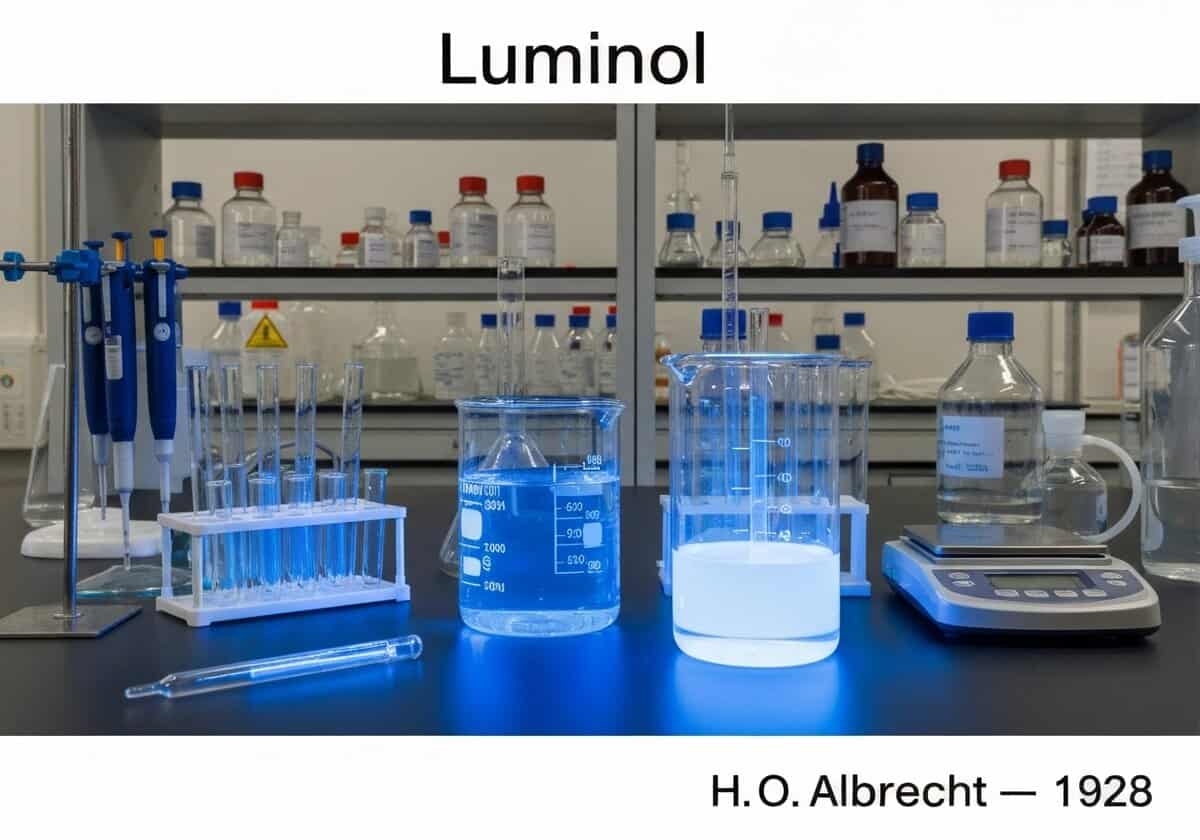
The luminol reaction is a classic example of liquid-phase 化学发光. The process begins with the deprotonation of luminol in a basic solution (e.g., sodium hydroxide). The resulting dianion then reacts with an oxidant, typically 氢 peroxide. This reaction is slow but is dramatically accelerated by a 催化剂. In forensic applications, the iron(II) ion in the heme group of hemoglobin acts as the catalyst. The reaction proceeds through a cyclic peroxide intermediate, which is highly unstable. This intermediate collapses, releasing nitrogen gas and forming 3-aminophthalate in an excited singlet state. The subsequent relaxation of this excited state to the ground state results in the emission of a photon, producing a characteristic blue glow around 425 nm. The sensitivity of this reaction is remarkable, allowing for the detection of blood dilutions as low as one part in a million. However, it is not specific to blood, as other substances like copper salts, horseradish peroxidase, and even some bleaches can catalyze the reaction, potentially leading to false positives in a forensic context.