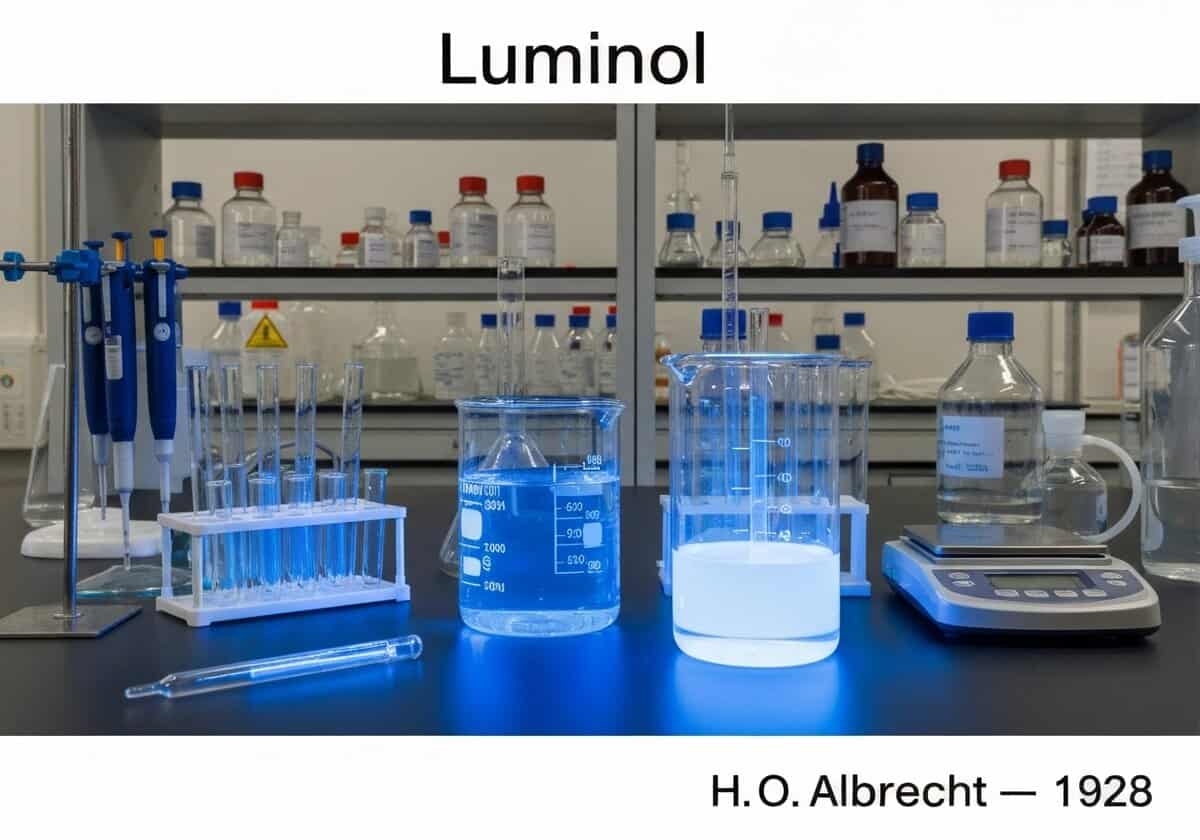
ルミノール(C8H7N3O2)は、塩基性溶液中で酸化剤と混合すると、強い青色の化学発光を示します。触媒、多くの場合、ヘモグロビン中のヘムのような鉄化合物が必要です。この反応によりルミノールが酸化され、不安定な過酸化物が生成されます。この過酸化物は、電子励起状態の3-アミノフタル酸に分解します。その後、この励起状態が崩壊し、青色の光子を放出します。
(画像はイメージです)
ルミノール(C8H7N3O2)は、塩基性溶液中で酸化剤と混合すると、強い青色の化学発光を示します。触媒、多くの場合、ヘモグロビン中のヘムのような鉄化合物が必要です。この反応によりルミノールが酸化され、不安定な過酸化物が生成されます。この過酸化物は、電子励起状態の3-アミノフタル酸に分解します。その後、この励起状態が崩壊し、青色の光子を放出します。
The luminol reaction is a classic example of liquid-phase 化学発光. The process begins with the deprotonation of luminol in a basic solution (e.g., sodium hydroxide). The resulting dianion then reacts with an oxidant, typically 水素 peroxide. This reaction is slow but is dramatically accelerated by a 触媒. In forensic applications, the iron(II) ion in the heme group of hemoglobin acts as the catalyst. The reaction proceeds through a cyclic peroxide intermediate, which is highly unstable. This intermediate collapses, releasing nitrogen gas and forming 3-aminophthalate in an excited singlet state. The subsequent relaxation of this excited state to the ground state results in the emission of a photon, producing a characteristic blue glow around 425 nm. The sensitivity of this reaction is remarkable, allowing for the detection of blood dilutions as low as one part in a million. However, it is not specific to blood, as other substances like copper salts, horseradish peroxidase, and even some bleaches can catalyze the reaction, potentially leading to false positives in a forensic context.
ルミノール
(日付が不明または関連性がない場合、例えば「流体力学」などでは、その注目すべき出現時期の概算値が提示されます。)

フルサイズの画像とダウンロードは、登録会員のみが100%無料で利用できます。
> ログイン <