Product Design, Manufacturing & Innovation Resources
Heim » Luminol

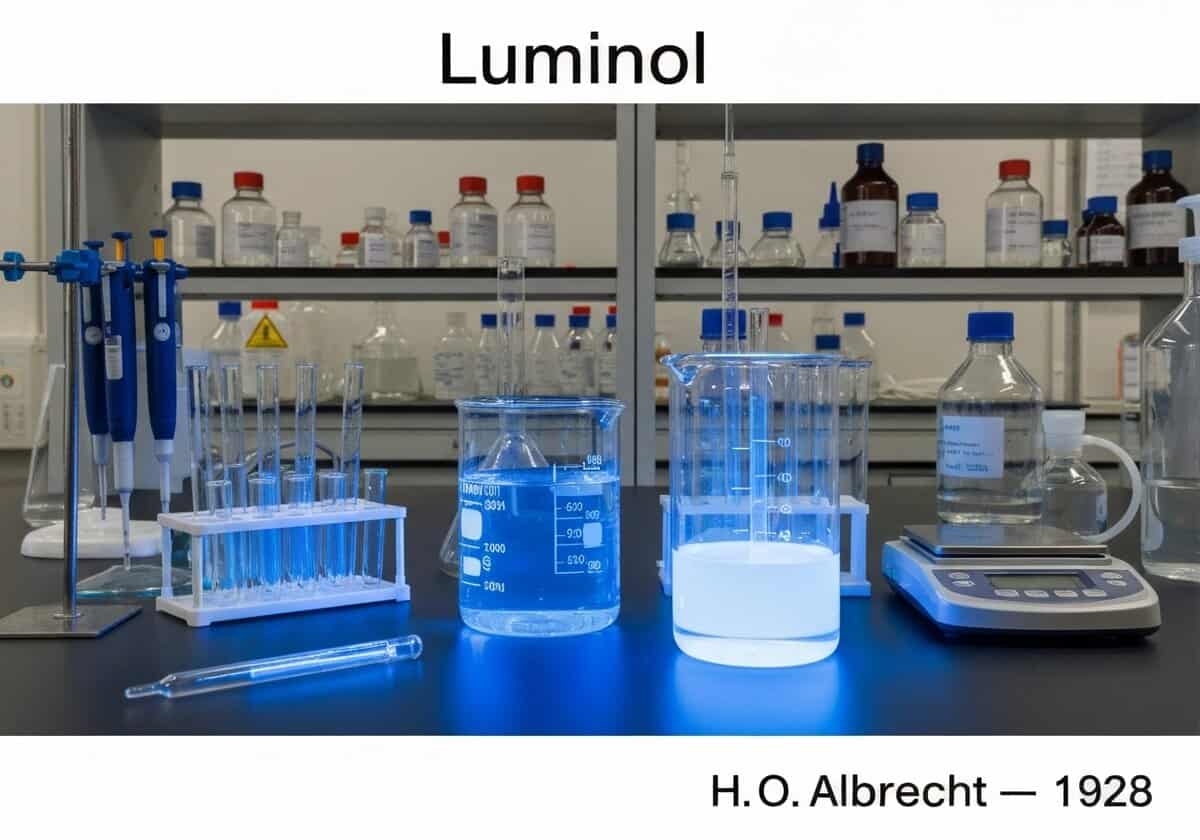
Luminol

1928
  • H. O. Albrecht
Chemilumineszenz-Experiment mit Luminol in der analytischen Chemie.

(Abbildung dient nur zur Veranschaulichung)

Luminol (C8H7N3O2) exhibits strong blue Chemilumineszenz when mixed with an oxidizing agent in a basic solution. A Katalysator, often an iron compound like the heme in hemoglobin, is required. The reaction oxidizes luminol, forming an unstable peroxide which decomposes into 3-aminophthalate in an electronically excited state. This excited state then decays, emitting a blue photon.
The luminol reaction is a classic example of liquid-phase Chemilumineszenz. The process begins with the deprotonation of luminol in a basic solution (e.g., sodium hydroxide). The resulting dianion then reacts with an oxidant, typically hydrogen peroxide. This reaction is slow but is dramatically accelerated by a Katalysator. In forensic applications, the iron(II) ion in the heme group of hemoglobin acts as the catalyst. The reaction proceeds through a cyclic peroxide intermediate, which is highly unstable. This intermediate collapses, releasing nitrogen gas and forming 3-aminophthalate in an excited singlet state. The subsequent relaxation of this excited state to the ground state results in the emission of a photon, producing a characteristic blue glow around 425 nm. The sensitivity of this reaction is remarkable, allowing for the detection of blood dilutions as low as one part in a million. However, it is not specific to blood, as other substances like copper salts, horseradish peroxidase, and even some bleaches can catalyze the reaction, potentially leading to false positives in a forensic context.

UNESCO Nomenclature: 2401
– Analytische Chemie

Typ

Chemischer Prozess

Störung

Inkremental

Verwendung

Weitverbreitete Verwendung

Vorläufer

  • Synthese von Luminol (1902)
  • Entdeckung der Chemilumineszenz in Lophin (1877)
  • Verständnis von Katalyse and oxidation-reduction reactions
  • Entwicklung grundlegender Techniken der analytischen Chemie

Anwendungen

  • Forensische Wissenschaft zum Nachweis von Blutspuren
  • biochemische Tests zum Nachweis von Kupfer, Eisen und Cyaniden
  • Enzymimmunoassays (ELISA)
  • Western Blotting zur Proteinerkennung

Patente:

NA

Potenzielle Innovationsideen

  • Luminol-basierte Sprays zum Nachweis von Pestizidrückständen auf Produkten
  • tragbar sensors that use luminol to detect airborne oxidizing pollutants
  • Diagnosekits für den Heimgebrauch zum Nachweis von Blut in Stuhlproben
  • Mikrofluidische Chips mit Luminol für das Hochdurchsatz-Screening von Enzyminhibitoren
  • selbststerilisierende Oberflächen, die leuchten, um anzuzeigen, dass der Sterilisationsprozess aktiv ist
  • Kunstinstallationen, die den langsamen, katalysierten Zerfall von Luminol für visuelle Effekte nutzen
  • educational tools to visualize catalytic activity in real-time
  • Umweltüberwachungssysteme zum Nachweis von Schwermetallverunreinigungen im Wasser
  • Luminol-basierte Tests zur Messung von zellulärem oxidativem Stress
  • Neuheiten wie leuchtende Getränke (zur Schau, nicht zum Verzehr)
Verwandt mit: Luminol, Chemilumineszenz, Forensik, Blutnachweis, Katalysator, Hämoglobin, Oxidation, 3-Aminophthalat, analytische Chemie, Wasserstoffperoxid.

Historischer Kontext

Luminol

1880
1902
1920
1928
1930
1940
1950
1880
1900
1910
1921
1930
1930
1940
1950

(wenn das Datum unbekannt oder nicht relevant ist, z. B. „Strömungsmechanik“, wird eine gerundete Schätzung seines bemerkenswerten Auftretens bereitgestellt)

10. Jahr Jubiläum

Bilder in voller Größe und Downloads sind ausschließlich für registrierte Mitglieder kostenlos verfügbar.

> Login <