Product Design, Manufacturing & Innovation Resources
Home » Luminol

Luminol

1928
  • H. O. Albrecht
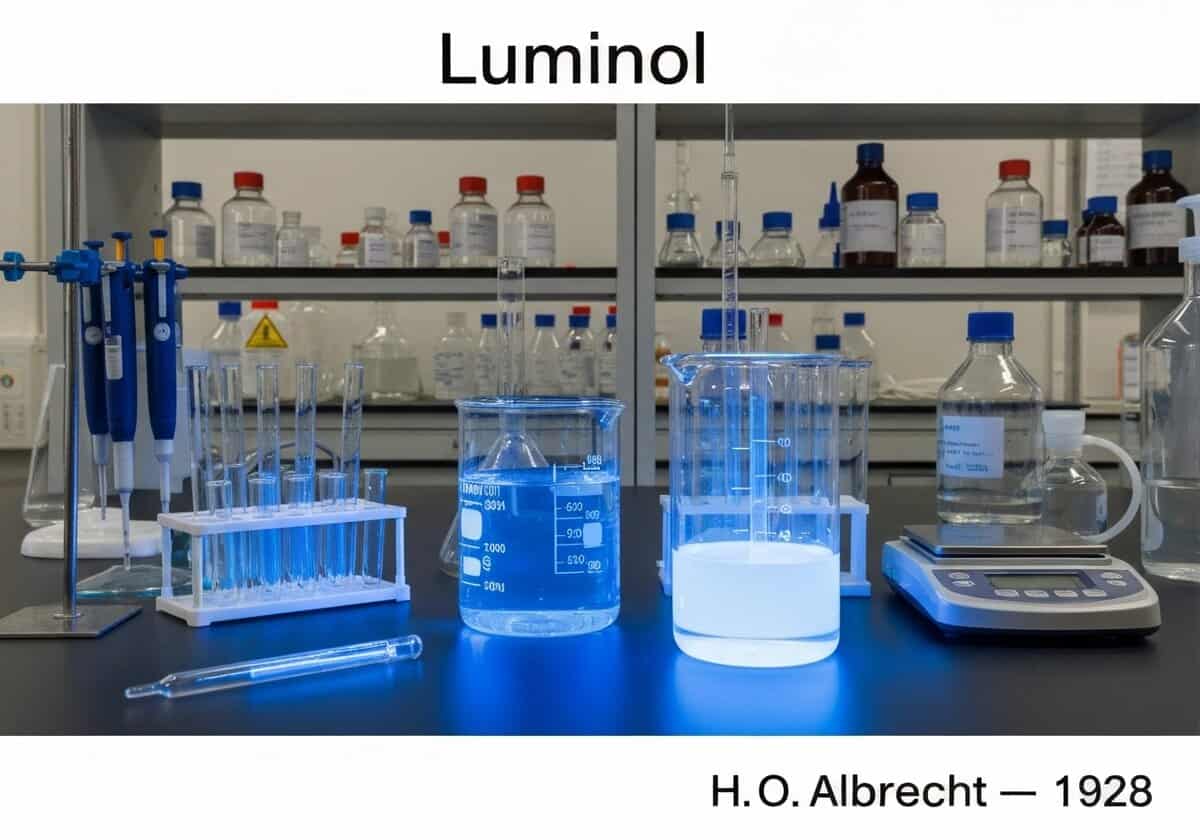
Chemiluminescence experiment with luminol in analytical chemistry.

(generated image for illustration only)

Luminol (C8H7N3O2) exhibits strong blue chemiluminescence when mixed with an oxidizing agent in a basic solution. A catalyst, often an iron compound like the heme in hemoglobin, is required. The reaction oxidizes luminol, forming an unstable peroxide which decomposes into 3-aminophthalate in an electronically excited state. This excited state then decays, emitting a blue photon.
The luminol reaction is a classic example of liquid-phase chemiluminescence. The process begins with the deprotonation of luminol in a basic solution (e.g., sodium hydroxide). The resulting dianion then reacts with an oxidant, typically hydrogen peroxide. This reaction is slow but is dramatically accelerated by a catalyst. In forensic applications, the iron(II) ion in the heme group of hemoglobin acts as the catalyst. The reaction proceeds through a cyclic peroxide intermediate, which is highly unstable. This intermediate collapses, releasing nitrogen gas and forming 3-aminophthalate in an excited singlet state. The subsequent relaxation of this excited state to the ground state results in the emission of a photon, producing a characteristic blue glow around 425 nm. The sensitivity of this reaction is remarkable, allowing for the detection of blood dilutions as low as one part in a million. However, it is not specific to blood, as other substances like copper salts, horseradish peroxidase, and even some bleaches can catalyze the reaction, potentially leading to false positives in a forensic context.

UNESCO Nomenclature: 2401
– Analytical chemistry

Type

Chemical Process

Disruption

Incremental

Usage

Widespread Use

Precursors

  • synthesis of luminol (1902)
  • discovery of chemiluminescence in lophine (1877)
  • understanding of catalysis and oxidation-reduction reactions
  • development of basic analytical chemistry techniques

Applications

  • forensic science for detecting trace amounts of blood
  • biochemical assays for detecting copper, iron, and cyanides
  • enzyme-linked immunosorbent assays (ELISA)
  • western blotting for protein detection

Patents:

NA

Potential Innovations Ideas

Due to scrapping bot traffic, currently more than 40k per day, this content is reserved to community members.
> Login < or > Register < (100% free) to access this, so as all other restricted content and tools.

Related to: luminol, chemiluminescence, forensic science, blood detection, catalyst, hemoglobin, oxidation, 3-aminophthalate, analytical chemistry, hydrogen peroxide.

Historical Context

Luminol

1880
1902
1920
1928
1930
1940
1950
1880
1900
1910
1921
1930
1930
1940
1950

(if date is unknown or not relevant, e.g. "fluid mechanics", a rounded estimation of its notable emergence is provided)

Full size images and downloads are only available, 100% free, for registered members.

> Login <