Product Design, Manufacturing & Innovation Resources
家 » 胰岛素的发现和分离

胰岛素的发现和分离

1921
  • Frederick Banting
  • Charles Best
  • John Macleod
  • James Collip
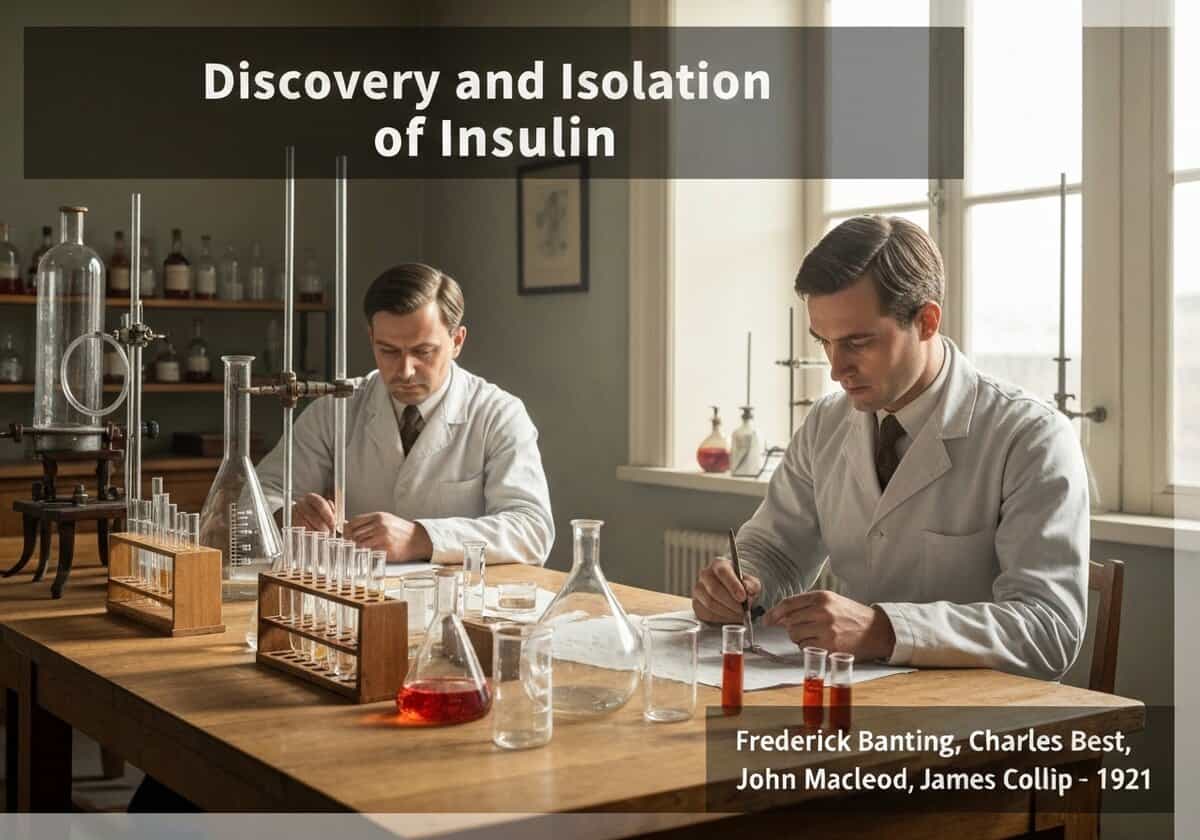
班廷和贝斯特分离胰岛素的实验室场景,1921 年,内分泌学研究。.

(图片仅供参考)

In 1921, Frederick Banting and Charles Best, under John Macleod’s direction at the University of Toronto, isolated insulin from canine pancreatic extracts. Biochemist James Collip then developed a purification process, making the extract safe for human use. This discovery transformed type 1 diabetes from a fatal disease into a manageable condition, earning Banting and Macleod the 1923 诺贝尔奖 奖。
Before 1921, a diagnosis of type 1 diabetes was a death sentence, often within months. The prevailing theory, proposed by researchers like Oskar Minkowski and Joseph von Mering in 1889, linked the pancreas to diabetes by showing that its removal in dogs induced the disease. The challenge was to isolate the specific anti-diabetic substance from the pancreas without it being destroyed by the organ’s own digestive enzymes. Frederick Banting, a young surgeon, hypothesized that ligating the pancreatic ducts would cause the enzyme-producing acinar cells to atrophy, leaving the islets of Langerhans, which he believed produced the sought-after secretion, intact. He proposed this idea to John Macleod, a prominent physiologist at the University of Toronto. Macleod was initially skeptical but provided Banting with lab space, ten dogs, and the assistance of a medical student, Charles Best. Over the summer of 1921, they successfully induced diabetes in dogs by removing their pancreas and then treated them with an extract from the degenerated pancreases of duct-ligated dogs. The extract, which they called “isletin,” effectively lowered blood glucose levels. The next crucial step was purification. Biochemist James Collip joined the team and developed a method using alcohol extraction to produce a purer, less toxic form of the extract suitable for human trials. The first human patient, 14-year-old Leonard Thompson, was successfully treated in January 1922, marking a turning point in medical history.

UNESCO Nomenclature: 2408
人类生物学

类型

医疗程序

中断

革命

用法

广泛使用

前体

  • 奥斯卡·明可夫斯基和约瑟夫·冯·梅林发现胰腺切除术会导致糖尿病(1889 年)
  • 保罗·兰格汉斯 (Paul Langerhans) 发现胰岛 (1869)
  • 爱德华·阿尔伯特·夏佩-沙弗 (Edward Albert Sharpey-Schafer) 提出,胰腺分泌的一种化学物质(他将其命名为“胰岛素”)负责控制血糖(1916 年)。
  • 乔治·路德维希·祖尔泽 (Georg Ludwig Zuelzer) 等人尝试制作胰腺提取物,但未能成功

应用程序

  • 1型糖尿病的治疗
  • 开发各种胰岛素制剂(短效、长效)
  • 2型糖尿病高血糖的管理
  • 高钾血症的治疗
  • 内分泌学基础研究

专利:

  • US1469994

潜在创新理念

  • implantable insulin pumps with 闭环 glucose monitoring
  • 口服或吸入胰岛素输送系统
  • 用于移植的基因工程β细胞
  • 仅在高血糖水平下激活的智能胰岛素
  • 基于基因标记的个性化胰岛素治疗
  • insulin-based therapies for neurodegenerative diseases like alzheimer’s
  • 与胰岛素输送相结合的非侵入性血糖监测技术
  • 由干细胞培养的胰岛素分泌类器官
  • 针对特定组织输送胰岛素以减少副作用
  • 胰岛素模拟物(激活胰岛素受体的小分子)的开发
相关内容:胰岛素的发现、班廷、麦克劳德、J.科利普、糖尿病、胰腺、内分泌学、诺贝尔奖。

历史背景

胰岛素的发现和分离

1880
1900
1910
1921
1930
1930
1940
1834-01-01
1880
1902
1920
1928
1930
1940
1950

(如果日期未知或不相关,例如“流体力学”,则提供其显著出现的近似估计)

第十年 周年纪念日

只有注册会员才能免费获得 100% 的全尺寸图片和下载。.

> 登录 <