Product Design, Manufacturing & Innovation Resources
Lar » Luminol

Luminol

1928
  • H. O. Albrecht
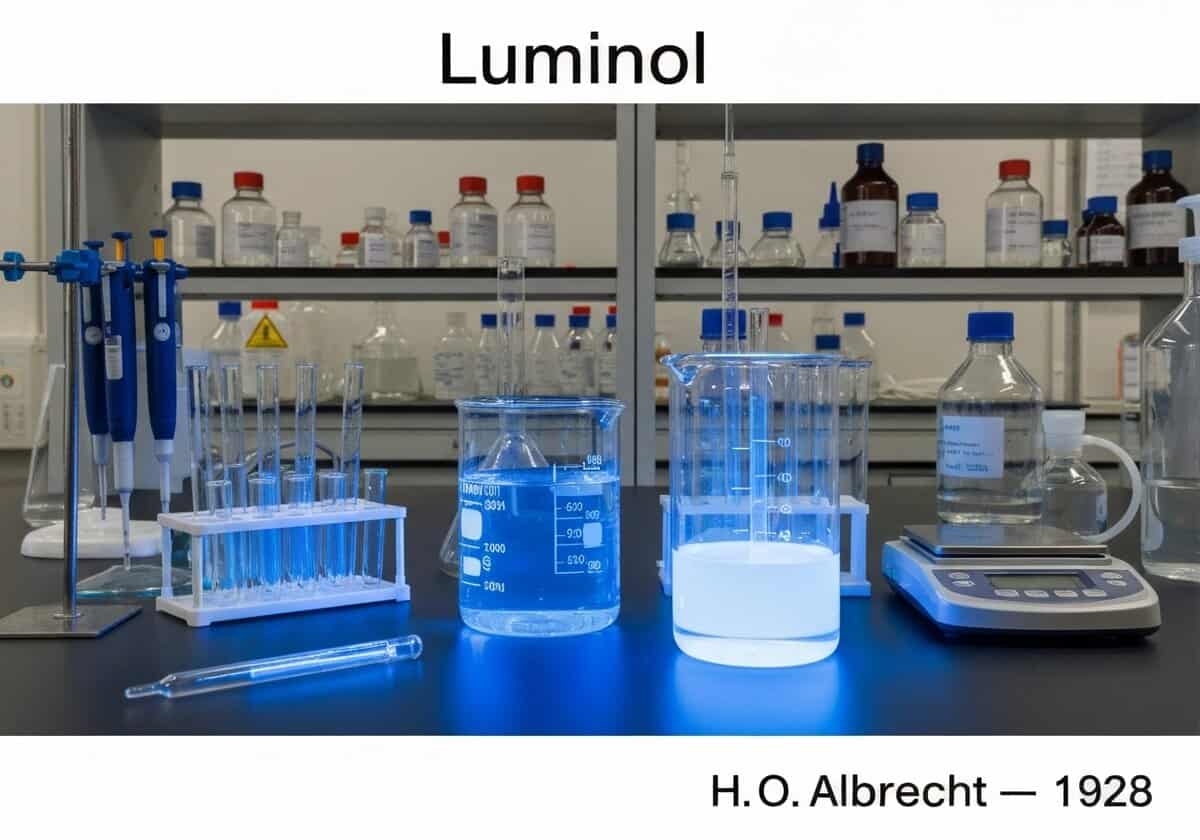
Experimento de quimiluminescência com luminol em química analítica.

(Imagem gerada apenas para fins ilustrativos)

Luminol (C8H7N3O2) exhibits strong blue quimioluminescência when mixed with an oxidizing agent in a basic solution. A catalisador, often an iron compound like the heme in hemoglobin, is required. The reaction oxidizes luminol, forming an unstable peroxide which decomposes into 3-aminophthalate in an electronically excited state. This excited state then decays, emitting a blue photon.
The luminol reaction is a classic example of liquid-phase quimioluminescência. The process begins with the deprotonation of luminol in a basic solution (e.g., sodium hydroxide). The resulting dianion then reacts with an oxidant, typically hydrogen peroxide. This reaction is slow but is dramatically accelerated by a catalisador. In forensic applications, the iron(II) ion in the heme group of hemoglobin acts as the catalyst. The reaction proceeds through a cyclic peroxide intermediate, which is highly unstable. This intermediate collapses, releasing nitrogen gas and forming 3-aminophthalate in an excited singlet state. The subsequent relaxation of this excited state to the ground state results in the emission of a photon, producing a characteristic blue glow around 425 nm. The sensitivity of this reaction is remarkable, allowing for the detection of blood dilutions as low as one part in a million. However, it is not specific to blood, as other substances like copper salts, horseradish peroxidase, and even some bleaches can catalyze the reaction, potentially leading to false positives in a forensic context.

UNESCO Nomenclature: 2401
Química analítica

Tipo

Processo Químico

Interrupção

Incremental

Uso

Uso generalizado

Precursores

  • síntese de luminol (1902)
  • descoberta da quimioluminescência na lofina (1877)
  • compreensão de catálise and oxidation-reduction reactions
  • desenvolvimento de técnicas básicas de química analítica

Aplicações

  • ciência forense para detecção de vestígios de sangue
  • Ensaios bioquímicos para detecção de cobre, ferro e cianetos.
  • Ensaios imunoenzimáticos (ELISA)
  • Western blotting para detecção de proteínas

Patentes:

NA

Ideias de Inovação Potencial

  • luminol-based sprays for detecting pesticide residue on produce
  • vestível sensors that use luminol to detect airborne oxidizing pollutants
  • diagnostic kits for home use to detect blood in stool samples
  • microfluidic chips incorporating luminol for high-throughput screening of enzyme inhibitors
  • self-sterilizing surfaces that glow to indicate the sterilization process is active
  • art installations using the slow, catalyzed decay of luminol for visual effects
  • educational tools to visualize catalytic activity in real-time
  • environmental monitoring systems for detecting heavy metal contamination in water
  • luminol-based assays to measure cellular oxidative stress
  • novelty items like glowing beverages (for display, not consumption)
Relacionado a: luminol, quimioluminescência, ciência forense, detecção de sangue, catalisador, hemoglobina, oxidação, 3-aminofitalato, química analítica, peróxido de hidrogênio.

Contexto histórico

Luminol

1880
1902
1920
1928
1930
1940
1950
1880
1900
1910
1921
1930
1930
1940
1950

(Caso a data seja desconhecida ou irrelevante, por exemplo, "mecânica dos fluidos", é fornecida uma estimativa aproximada de seu surgimento notável)

10º ano aniversário

Imagens em tamanho real e downloads estão disponíveis apenas, 100% gratuitos, para membros registrados.