Product Design, Manufacturing & Innovation Resources
घर » ल्यूमिनोल

ल्यूमिनोल

1928
  • H. O. Albrecht
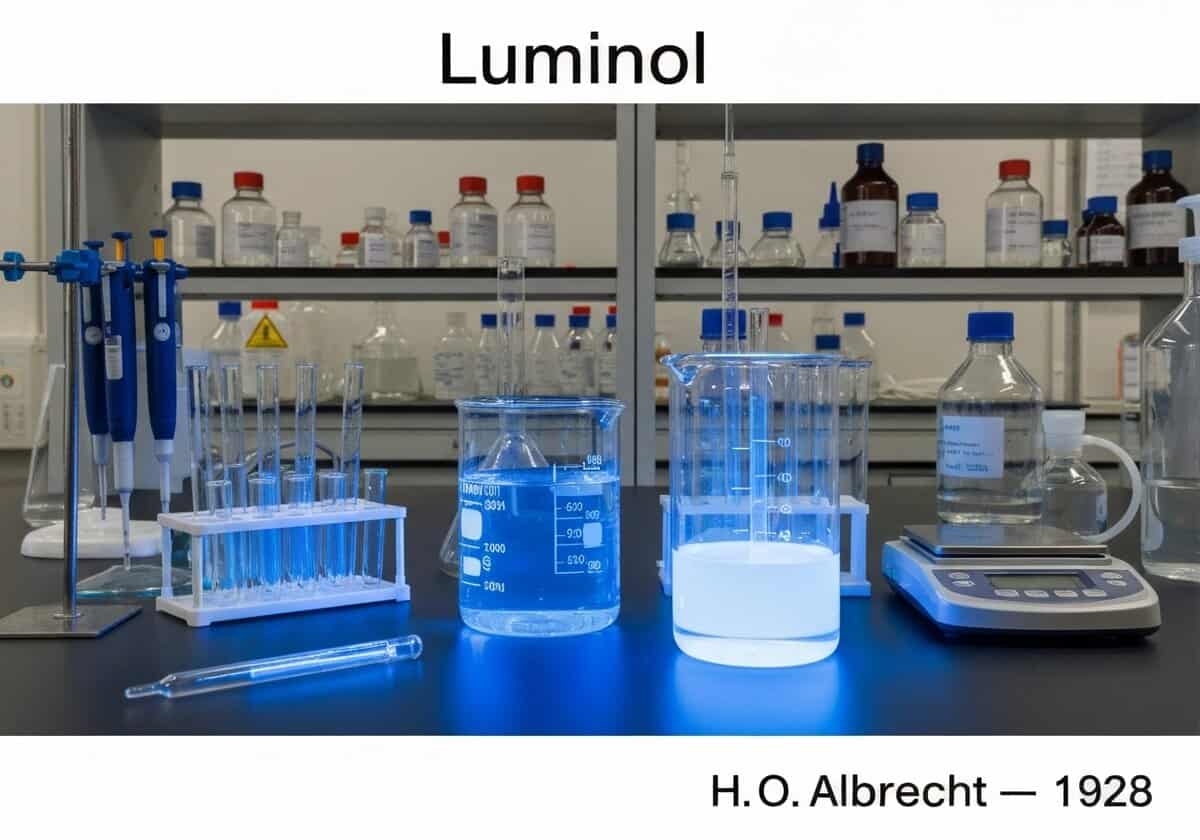
Chemiluminescence experiment with luminol in analytical chemistry.

(यह छवि केवल उदाहरण के लिए बनाई गई है)

Luminol (C8H7N3O2) exhibits strong blue chemiluminescence when mixed with an oxidizing agent in a basic solution. A उत्प्रेरक, often an iron compound like the heme in hemoglobin, is required. The reaction oxidizes luminol, forming an unstable peroxide which decomposes into 3-aminophthalate in an electronically excited state. This excited state then decays, emitting a blue photon.
The luminol reaction is a classic example of liquid-phase chemiluminescence. The process begins with the deprotonation of luminol in a basic solution (e.g., sodium hydroxide). The resulting dianion then reacts with an oxidant, typically hydrogen peroxide. This reaction is slow but is dramatically accelerated by a उत्प्रेरक. In forensic applications, the iron(II) ion in the heme group of hemoglobin acts as the catalyst. The reaction proceeds through a cyclic peroxide intermediate, which is highly unstable. This intermediate collapses, releasing nitrogen gas and forming 3-aminophthalate in an excited singlet state. The subsequent relaxation of this excited state to the ground state results in the emission of a photon, producing a characteristic blue glow around 425 nm. The sensitivity of this reaction is remarkable, allowing for the detection of blood dilutions as low as one part in a million. However, it is not specific to blood, as other substances like copper salts, horseradish peroxidase, and even some bleaches can catalyze the reaction, potentially leading to false positives in a forensic context.

UNESCO Nomenclature: 2401
विश्लेषणात्मक रसायन विज्ञान

Type

रासायनिक प्रक्रिया

व्यवधान

इंक्रीमेंटल

उपयोग

व्यापक उपयोग

शगुन

  • ल्यूमिनोल का संश्लेषण (1902)
  • लोफीन में रासायनिक प्रकाश की खोज (1877)
  • की समझना catalysis and oxidation-reduction reactions
  • बुनियादी विश्लेषणात्मक रसायन विज्ञान तकनीकों का विकास

आवेदन

  • रक्त की थोड़ी मात्रा का पता लगाने के लिए फोरेंसिक विज्ञान
  • तांबा, लोहा और साइनाइड का पता लगाने के लिए जैव रासायनिक परीक्षण
  • एंजाइम-लिंक्ड इम्यूनोसोरबेंट परख (ईएलआईएसए)
  • प्रोटीन का पता लगाने के लिए वेस्टर्न ब्लॉटिंग

पेटेंट:

NA

संभावित नवाचार विचार

  • खाद्य पदार्थों पर कीटनाशक अवशेषों का पता लगाने के लिए ल्यूमिनोल-आधारित स्प्रे
  • पहनने योग्य sensors that use luminol to detect airborne oxidizing pollutants
  • मल के नमूनों में रक्त का पता लगाने के लिए घरेलू उपयोग हेतु निदान किट
  • एंजाइम अवरोधकों की उच्च-थ्रूपुट स्क्रीनिंग के लिए ल्यूमिनॉल युक्त माइक्रोफ्लुइडिक चिप्स
  • स्व-कीटाणुरहित सतहें जो चमकती हैं और कीटाणुशोधन प्रक्रिया के सक्रिय होने का संकेत देती हैं।
  • दृश्य प्रभावों के लिए ल्यूमिनोल के धीमे, उत्प्रेरित क्षय का उपयोग करने वाली कलाकृतियाँ
  • educational tools to visualize catalytic activity in real-time
  • पानी में भारी धातु प्रदूषण का पता लगाने के लिए पर्यावरण निगरानी प्रणाली
  • कोशिकीय ऑक्सीडेटिव तनाव को मापने के लिए ल्यूमिनॉल-आधारित परीक्षण
  • चमकने वाले पेय पदार्थों जैसी नवीन वस्तुएं (प्रदर्शन के लिए, उपभोग के लिए नहीं)
संबंधित विषय: ल्यूमिनॉल, केमिल्यूमिनेसेंस, फोरेंसिक विज्ञान, रक्त का पता लगाना, उत्प्रेरक, हीमोग्लोबिन, ऑक्सीकरण, 3-एमिनोफ्थालेट, विश्लेषणात्मक रसायन विज्ञान, हाइड्रोजन पेरोक्साइड।

ऐतिहासिक संदर्भ

ल्यूमिनोल

1880
1902
1920
1928
1930
1940
1950
1880
1900
1910
1921
1930
1930
1940
1950

(यदि तिथि अज्ञात है या प्रासंगिक नहीं है, उदाहरण के लिए "द्रव यांत्रिकी", तो इसके उल्लेखनीय उद्भव का एक अनुमानित आंकड़ा प्रदान किया गया है)

नवीनतम परिवर्धन

शीर्ष पोस्ट और लेख

शीर्ष मूल उपकरण

10वां वर्ष सालगिरह

पंजीकृत सदस्यों के लिए पूर्ण आकार की छवियाँ और डाउनलोड 100% निःशुल्क उपलब्ध हैं।