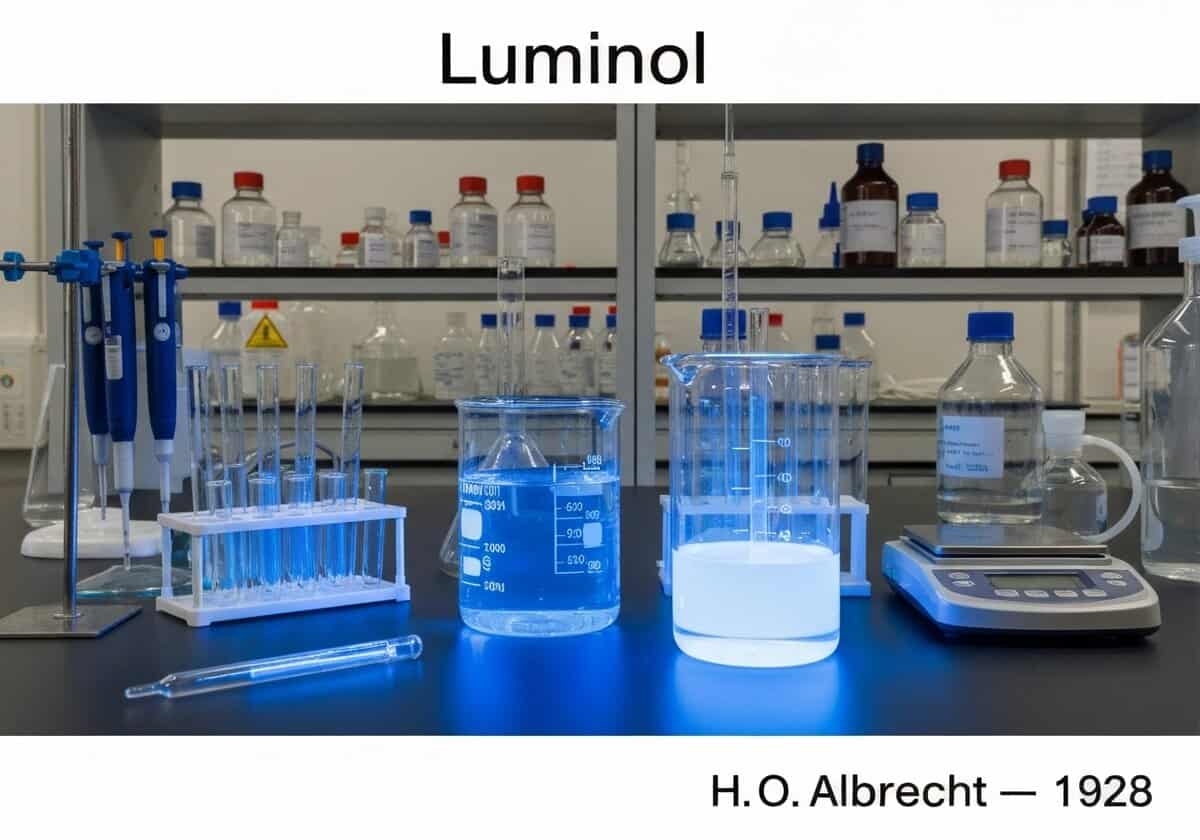
루미놀(C8H7N3O2)은 염기성 용액에서 산화제와 혼합될 때 강한 청색 화학발광을 나타냅니다. 이 반응에는 촉매, 흔히 헤모글로빈의 헴과 같은 철 화합물이 필요합니다. 반응은 루미놀을 산화시켜 불안정한 과산화물을 생성하고, 이 과산화물은 분해되어 전자적으로 들뜬 상태의 3-아미노프탈레이트를 생성합니다. 이 들뜬 상태는 붕괴되면서 청색 광자를 방출합니다.
(설명을 위한 생성된 이미지입니다)
루미놀(C8H7N3O2)은 염기성 용액에서 산화제와 혼합될 때 강한 청색 화학발광을 나타냅니다. 이 반응에는 촉매, 흔히 헤모글로빈의 헴과 같은 철 화합물이 필요합니다. 반응은 루미놀을 산화시켜 불안정한 과산화물을 생성하고, 이 과산화물은 분해되어 전자적으로 들뜬 상태의 3-아미노프탈레이트를 생성합니다. 이 들뜬 상태는 붕괴되면서 청색 광자를 방출합니다.
The luminol reaction is a classic example of liquid-phase 화학 발광. The process begins with the deprotonation of luminol in a basic solution (e.g., sodium hydroxide). The resulting dianion then reacts with an oxidant, typically 수소 peroxide. This reaction is slow but is dramatically accelerated by a 촉매. In forensic applications, the iron(II) ion in the heme group of hemoglobin acts as the catalyst. The reaction proceeds through a cyclic peroxide intermediate, which is highly unstable. This intermediate collapses, releasing nitrogen gas and forming 3-aminophthalate in an excited singlet state. The subsequent relaxation of this excited state to the ground state results in the emission of a photon, producing a characteristic blue glow around 425 nm. The sensitivity of this reaction is remarkable, allowing for the detection of blood dilutions as low as one part in a million. However, it is not specific to blood, as other substances like copper salts, horseradish peroxidase, and even some bleaches can catalyze the reaction, potentially leading to false positives in a forensic context.
루미놀
(날짜를 알 수 없거나 관련이 없는 경우, 예를 들어 "유체역학"의 경우, 주목할 만한 등장 시기를 대략적으로 추정하여 제공합니다.)

고화질 이미지 및 다운로드는 등록된 회원에게만 100% 무료로 제공됩니다.
> 로그인 <