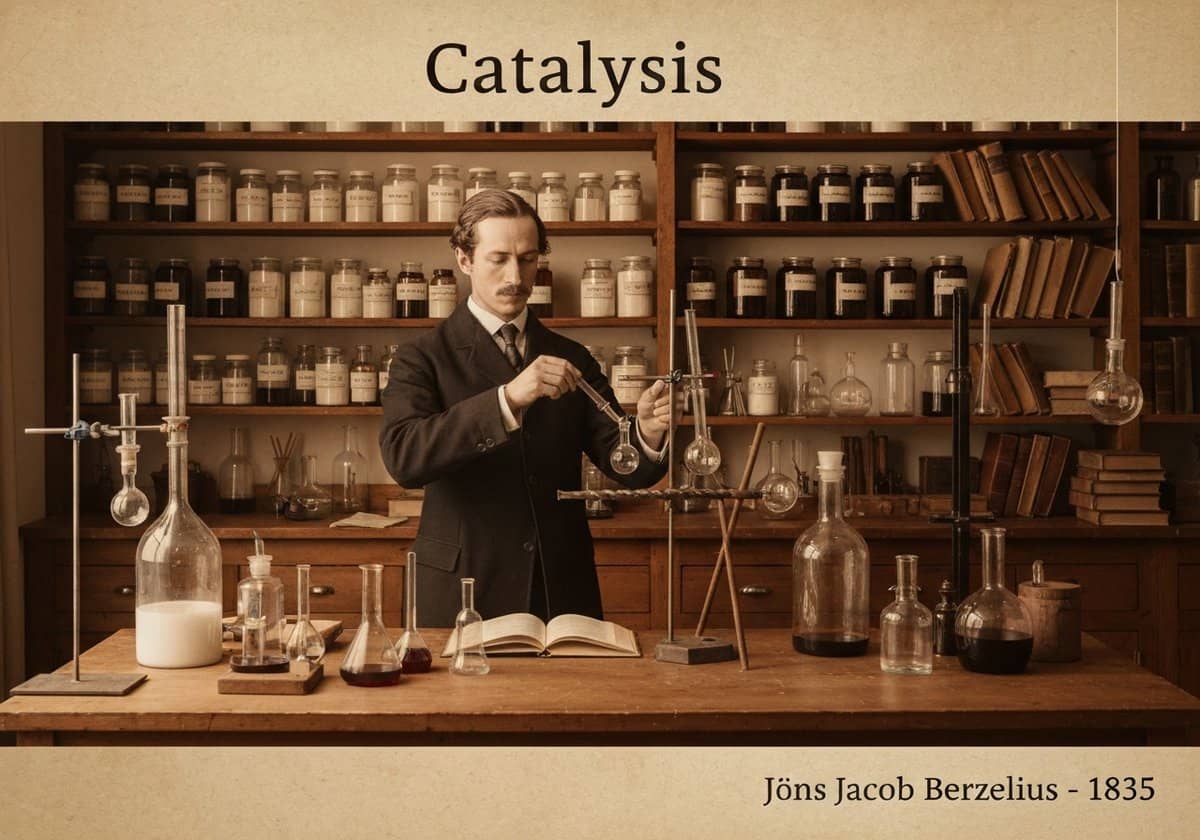
The fundamental principle of catalysis lies in its ability to alter the kinetics of a chemical reaction without affecting its thermodynamics. A 催化剂 introduces a new reaction mechanism, often involving one or more intermediate steps. For a reaction A + B → C, a catalyst C’ might participate as follows: A + C’ → AC’ and then AC’ + B → C + C’. The catalyst C’ is regenerated at the end of the process. This alternative pathway has a lower transition state energy compared to the uncatalyzed reaction. The Arrhenius equation, [latex]k = Ae^{-E_a/(RT)}[/latex], shows that a lower activation energy ([latex]E_a[/latex]) leads to an exponential increase in the reaction rate constant (k). Importantly, the catalyst does not change the Gibbs free energy change ([latex]\Delta G[/latex]) or the equilibrium constant ([latex]K_{eq}[/latex]) of the reaction. It only affects the speed at which equilibrium is reached. This concept was first formally described by Jöns Jacob Berzelius in 1835, who observed that certain substances could accelerate reactions without being consumed, coining the term “catalysis” from Greek words meaning “to dissolve” or “to break down”.