Product Design, Manufacturing & Innovation Resources
家 » 紫外线杀菌照射(UVGI)

紫外线杀菌照射(UVGI)

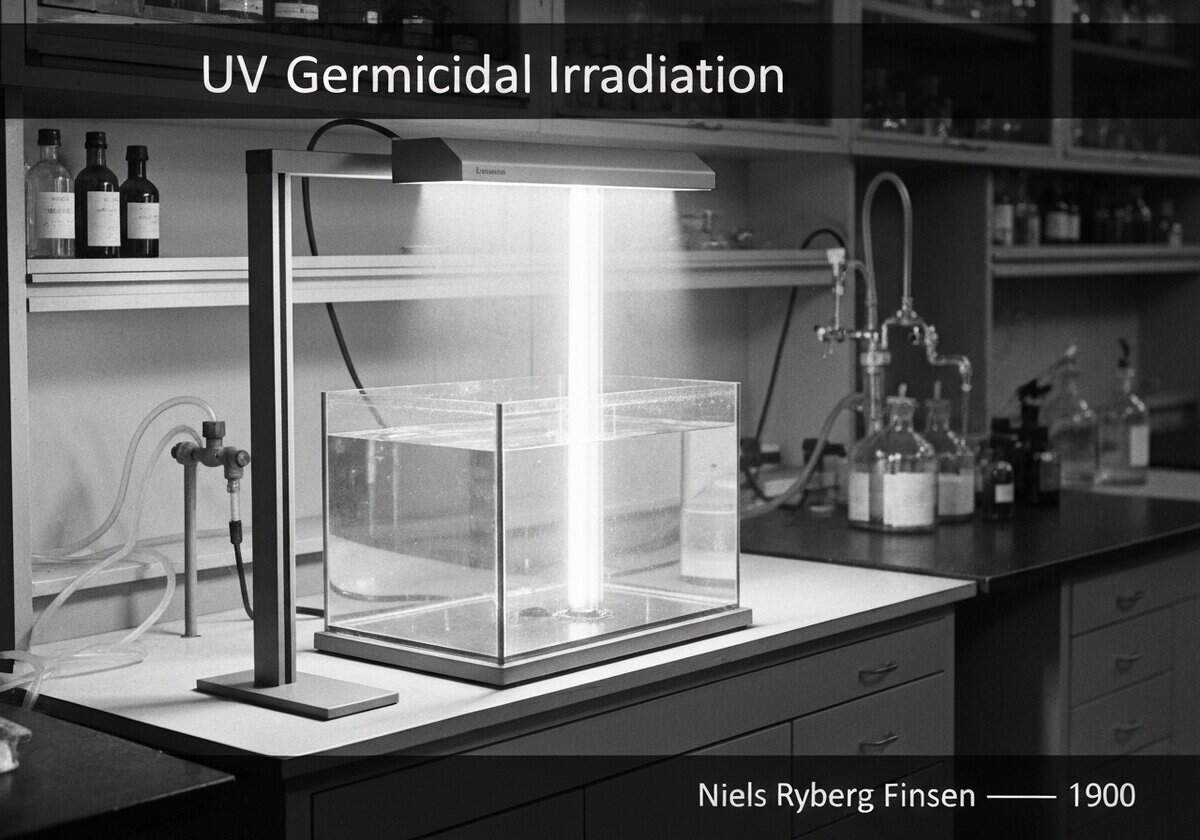
1900
  • Niels Ryberg Finsen
UV Germicidal Irradiation system in a laboratory for microbial disinfection.

(图片仅供参考)

紫外线杀菌照射(UVGI)利用短波长紫外线 紫外线 C (UVC) radiation, typically at 254 nm, to kill or inactivate microorganisms. UVC light disrupts the nucleic acids (DNA and RNA) of bacteria, viruses, and other pathogens, destroying their ability to replicate and cause disease. This non-chemical disinfection method is used for air, water, and surface sterilization.
The germicidal properties of UVC radiation are centered around its ability to be absorbed by the nucleic acids of microorganisms. The peak germicidal effectiveness occurs at a wavelength of approximately 265 nm, which corresponds to the peak absorption wavelength of DNA. Commercially available low-pressure mercury vapor lamps, which are the most common source for UVGI, emit monochromatically at 253.7 nm, which is very close to this peak and highly effective. When a UVC photon is absorbed by a DNA or RNA molecule, it can induce the formation of pyrimidine dimers, most commonly thymine dimers. These dimers are covalent bonds between adjacent pyrimidine bases (thymine or cytosine) on the same DNA strand. This structural damage prevents the DNA from being correctly read during replication or transcription, effectively rendering the microorganism sterile and unable to reproduce. While microorganisms have cellular mechanisms to repair such DNA damage, the high intensity of UVGI overwhelms these repair systems. UVGI is a physical process, not a chemical one, meaning it does not introduce toxins or residues. Its effectiveness depends on the UV dose, which is a product of intensity and exposure time, as well as factors like humidity, temperature, and the microorganism’s susceptibility. Its primary limitation is that it is a line-of-sight technology; UV light cannot disinfect areas in shadow.

UNESCO Nomenclature: 2415
– Microbiology

类型

Physical Process

中断

重大的

用法

广泛使用

前体

  • 路易·巴斯德的疾病细菌理论
  • 发现 UVC 辐射是紫外线光谱的一部分
  • 汞灯的开发
  • Downes 和 Blunt (1877) 的研究表明,阳光可以抑制细菌生长

应用程序

  • 医院空气和表面消毒
  • 市政水处理
  • 暖通空调空气净化系统
  • 食品和饮料加工
  • 实验室灭菌
  • 废水处理

专利:

NA

潜在创新理念

  • 便携式电池供电 UVC 消毒棒,用于对手机和键盘等个人物品进行消毒
  • 集成到自动扶梯扶手的 UVC-LED 可持续消毒
  • 自主机器人可在夜间绘制医院和机场房间地图并进行消毒
  • 配备 UVC 的暖通空调系统,可在空气循环通过建筑物时主动对其进行消毒
  • 船舶压载水紫外线处理系统,防止入侵水生物种的扩散
  • 瓶盖内置 UVC LED 的智能水瓶,可净化任何水源
  • 具有自消毒功能的 UVC 涂层高频接触表面(例如门把手)
  • integration of uvc emitters into 3d printers to sterilize 医疗植入物 during fabrication
  • 用于大型户外公共场所或农田消毒的 UVC 无人机
  • 公共卫生间 UVC 灯具,当房间无人时启动
相关术语:紫外线杀菌、紫外线、杀菌、消毒、灭菌、DNA损伤、胸腺嘧啶二聚体、微生物学、水处理、空气净化。

历史背景

紫外线杀菌照射(UVGI)

1800
1800-05-02
1880
1900
1910
1921
1930
1930
1800
1834-01-01
1880
1902
1920
1928
1930

(如果日期未知或不相关,例如“流体力学”,则提供其显著出现的近似估计)

第十年 周年纪念日

只有注册会员才能免费获取完整尺寸的图片和下载内容。

> 登录 <