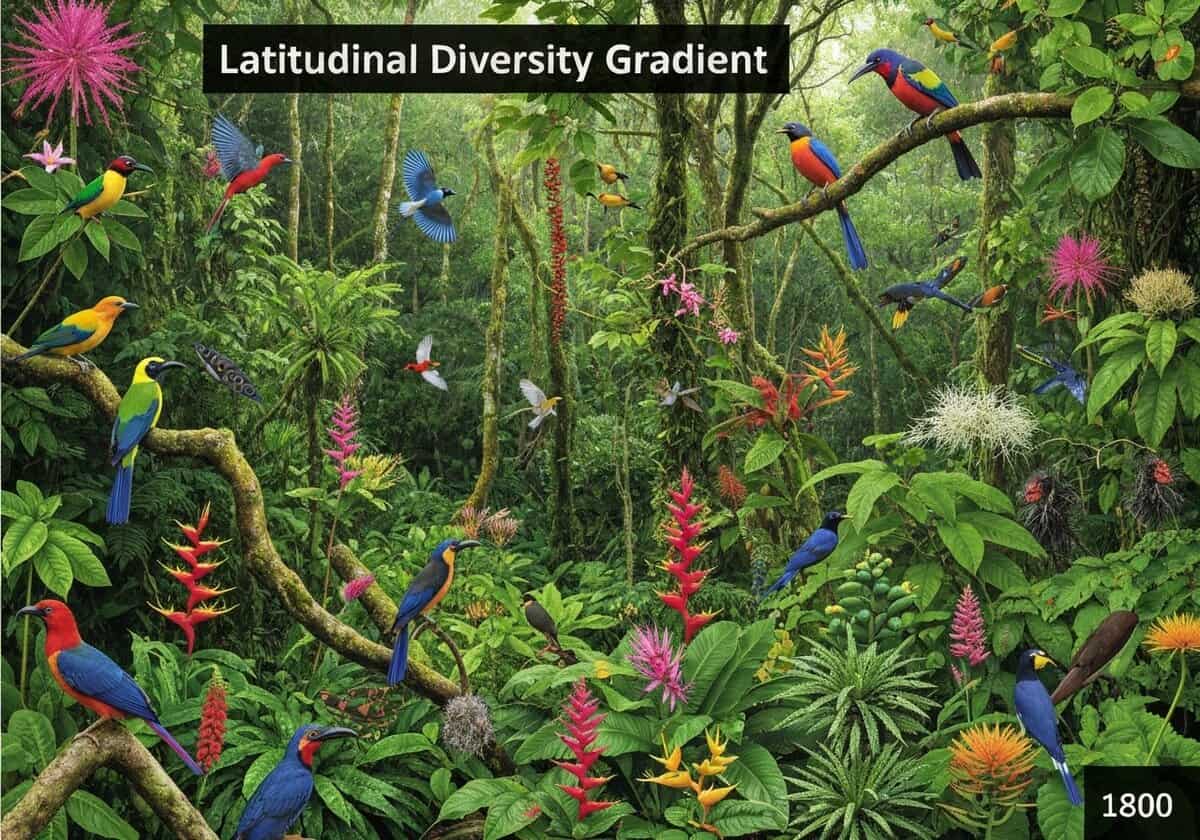
These hypotheses can be broadly grouped into several categories. Historical hypotheses suggest the tropics are older and have been more climatically stable over geological time, allowing more time for speciation to occur and less extinction to interrupt it (the ‘tropics as cradle and museum’ idea). Ecological hypotheses focus on current environmental conditions. For instance, the tropics receive more 太阳 energy, which increases productivity at the base of the food web, potentially supporting more species. The ‘climatic harshness’ hypothesis suggests that the stable, favorable conditions of the tropics allow for finer niche specialization, enabling more species to coexist. Evolutionary hypotheses propose that speciation rates are intrinsically higher in the tropics, perhaps due to faster metabolic rates driven by higher temperatures, leading to shorter generation times and more rapid genetic divergence.
Understanding the mechanisms behind the LDG is a central goal of ecology and biogeography. It is not merely an academic puzzle; it has profound implications for conservation. The gradient means that a disproportionate amount of Earth’s 生物多样性 is concentrated in tropical countries, many of which are developing nations facing significant economic and social pressures that can lead to habitat destruction. Furthermore, 气候变化 is predicted to disrupt this pattern, potentially pushing species’ ranges poleward and altering the very structure of global biodiversity.
using the ldg pattern to forecast ‘biodiversity velocity’ under climate change
创建基于 ldg 的模型来预测入侵物种或疾病的传播
通过重点关注高度多样化的热带地区的生物勘探来开发仿生材料和药物
设计利用热带农业生物多样性保障粮食安全的全球农业政策
establishing a ‘longitudinal diversity gradient’ research program to study east-west patterns
使用古气候数据来模拟 ldg 在地质时期的变化
将ldg纳入全球经济模型,以更好地评估热带地区的生态系统服务
开发教育性虚拟现实体验,让用户可以从两极旅行到赤道,亲眼目睹 ldg
applying ldg principles to the design of large-scale 生物反应器 or artificial ecosystems
研究 ldg 的例外情况(例如企鹅、姬蜂),以深入了解其驱动因素
Related to: latitudinal gradient, biodiversity, species richness, tropics, macroecology, biogeography, 生态, alexander von humboldt, climate, speciation.