Product Design, Manufacturing & Innovation Resources
집 » 위도별 생물다양성 기울기(LDG)

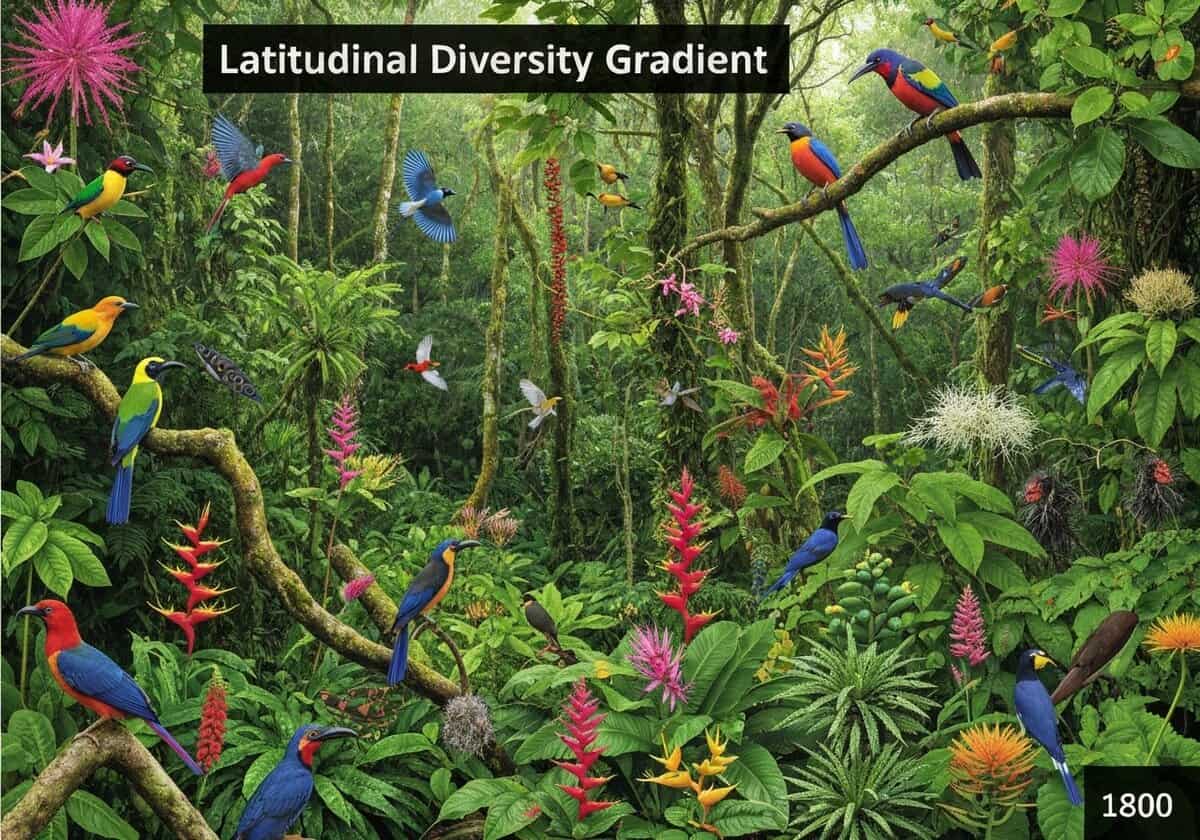
위도별 생물다양성 기울기(LDG)

1800
생물 다양성이 풍부한 열대 우림으로, 생물지리학 연구에 있어 핵심적인 역할을 한다.

(설명을 위한 생성된 이미지입니다)

위도별 생물다양성 기울기는 생태학에서 가장 잘 알려진 지구적 패턴 중 하나입니다. 이는 종 풍부도로 측정되는 생물다양성이 고위도 극지방에서 저위도 열대 지방으로 갈수록 전반적으로 증가하는 현상을 설명합니다. 이러한 패턴은 육상 및 해양 환경 모두에서 포유류, 조류, 곤충, 식물을 포함한 광범위한 분류군에 걸쳐 관찰됩니다.


열대 지역이 극지방에 비해 생명체가 풍부하다는 관찰은 오래전부터 있었지만, 18세기와 19세기에 활동한 알렉산더 폰 훔볼트와 앨프레드 러셀 월리스 같은 박물학자들이 탐험을 통해 이를 체계적으로 기록했습니다. 이러한 현상, 즉 위도별 생물 다양성 기울기(LDG)는 이후 거의 모든 주요 생물군에서 확인되었습니다. 예를 들어 열대 국가인 콜롬비아에는 약 1,900종의 조류가 서식하는 반면, 북극 지역 전체에는 100종도 채 되지 않습니다. 이러한 기울기는 설명이 필요한 근본적인 거시생태학적 패턴이며, 수십 가지 가설이 제시되었지만 아직까지 보편적으로 받아들여지는 가설은 없습니다.

These hypotheses can be broadly grouped into several categories. Historical hypotheses suggest the tropics are older and have been more climatically stable over geological time, allowing more time for speciation to occur and less extinction to interrupt it (the ‘tropics as cradle and museum’ idea). Ecological hypotheses focus on current environmental conditions. For instance, the tropics receive more 태양광 energy, which increases productivity at the base of the food web, potentially supporting more species. The ‘climatic harshness’ hypothesis suggests that the stable, favorable conditions of the tropics allow for finer niche specialization, enabling more species to coexist. Evolutionary hypotheses propose that speciation rates are intrinsically higher in the tropics, perhaps due to faster metabolic rates driven by higher temperatures, leading to shorter generation times and more rapid genetic divergence.

Understanding the mechanisms behind the LDG is a central goal of ecology and biogeography. It is not merely an academic puzzle; it has profound implications for conservation. The gradient means that a disproportionate amount of Earth’s 생물다양성 is concentrated in tropical countries, many of which are developing nations facing significant economic and social pressures that can lead to habitat destruction. Furthermore, 기후 변화 이는 이러한 패턴을 교란시켜 종의 서식 범위를 극지방으로 밀어내고 전 세계 생물 다양성의 구조 자체를 변화시킬 가능성이 있다고 예측됩니다.

UNESCO Nomenclature: 2407
생태학

유형

추상 시스템

분열

상당한

용법

널리 사용됨

전구체

  • 린네 분류법은 종을 분류하고 세는 데 사용된다.
  • 탐험과 박물학자 탐험의 시대 (예: 훔볼트, 월리스)
  • 다윈의 자연선택에 의한 진화론
  • 생물군계와 생태계 개념의 발전

응용 프로그램

  • 지구 온난화가 종 분포에 미칠 수 있는 잠재적 영향 예측
  • 열대 지역에 초점을 맞춘 글로벌 보존 전략을 수립합니다.
  • 생물지리학 및 거시생태학 연구의 기준선 역할을 함
  • 생물다양성을 생성하고 유지하는 메커니즘에 대한 이론을 제시합니다.
  • 서로 다른 계통군의 진화 역사를 이해하는 것

특허:

NA

잠재적 혁신 아이디어

  • using the ldg pattern to forecast ‘biodiversity velocity’ under climate change
  • creating ldg-informed models for predicting the spread of invasive species or diseases
  • developing bio-inspired materials and medicines by focusing bioprospecting on hyperdiverse tropical regions
  • designing global agricultural policies that leverage tropical agrobiodiversity for food security
  • establishing a ‘longitudinal diversity gradient’ research program to study east-west patterns
  • using paleoclimatic data to model how the ldg has changed through geological time
  • integrating the ldg into global economic models to better value ecosystem services from the tropics
  • developing educational virtual reality experiences that allow users to travel from the poles to the equator and see the ldg firsthand
  • applying ldg principles to the design of large-scale 생물반응기 or artificial ecosystems
  • studying exceptions to the ldg (e.g., penguins, ichneumonid wasps) to gain deeper insights into its drivers
Related to: latitudinal gradient, biodiversity, species richness, tropics, macroecology, biogeography, 생태학, alexander von humboldt, climate, speciation.

역사적 맥락

위도별 생물다양성 기울기(LDG)

1800
1834-01-01
1880
1902
1920
1928
1930
1800
1800-05-02
1880
1900
1910
1921
1930
1930

(날짜를 알 수 없거나 관련이 없는 경우, 예를 들어 "유체역학"의 경우, 주목할 만한 등장 시기를 대략적으로 추정하여 제공합니다.)

10년차 기념일

고화질 이미지 및 다운로드는 등록된 회원에게만 100% 무료로 제공됩니다.

> 로그인 <