Product Design, Manufacturing & Innovation Resources
Casa » Gradiente di diversità latitudinale (LDG)

Gradiente di diversità latitudinale (LDG)

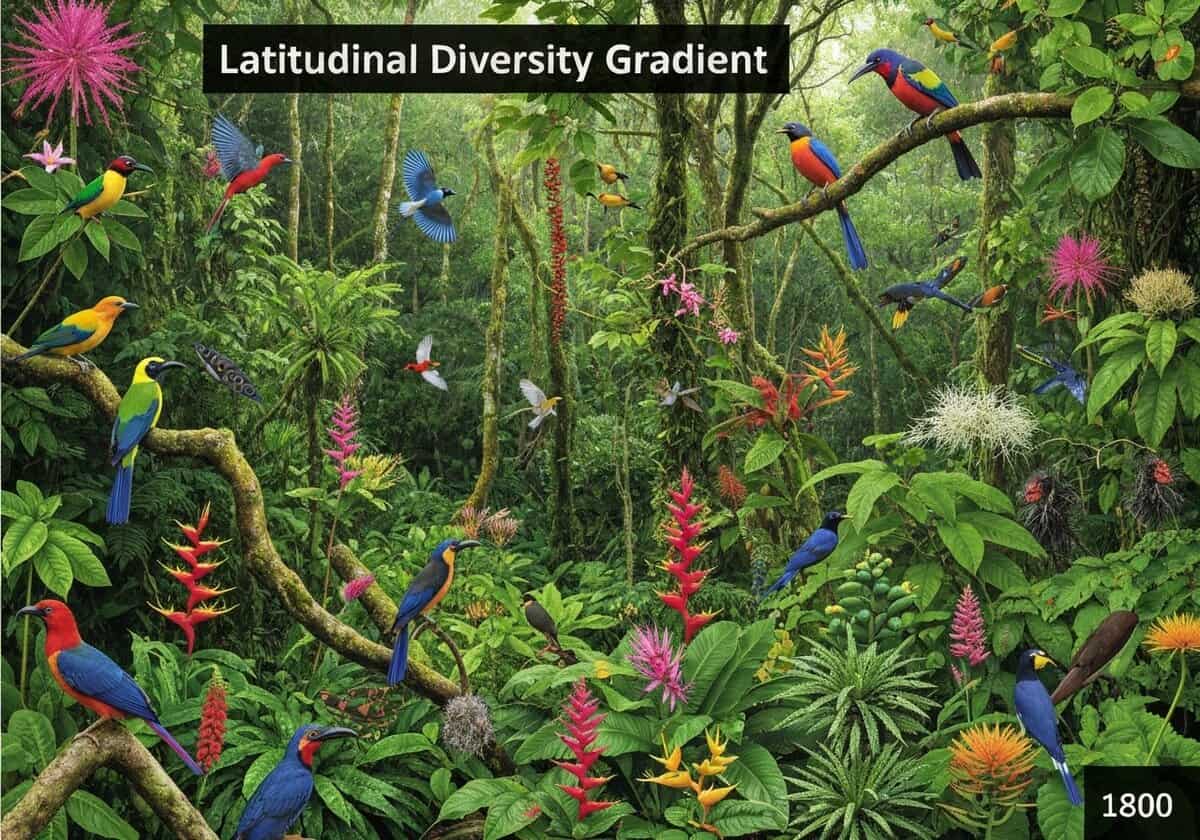
1800
Foresta pluviale tropicale ad alta biodiversità, fondamentale per gli studi di biogeografia.

(Immagine generata a solo scopo illustrativo)

Il gradiente di diversità latitudinale è uno dei modelli globali più riconosciuti in ecologia. Descrive l'aumento generale della biodiversità, misurata come ricchezza di specie, dalle regioni polari ad alta latitudine ai tropici a bassa latitudine. Questo modello è osservato in un'ampia gamma di gruppi tassonomici, tra cui mammiferi, uccelli, insetti e piante, sia in ambienti terrestri che marini.


The observation that the tropics are teeming with life compared to the poles is ancient, but it was systematically documented by 18th and 19th-century naturalists like Alexander von Humboldt and Alfred Russel Wallace during their expeditions. This pattern, the Latitudinal Diversity Gradient (LDG), has since been confirmed for nearly every major group of organisms. For example, Colombia, a tropical country, has around 1,900 bird species, while the entire Arctic region has fewer than 100. The gradient is a fundamental macroecological pattern that demands an explanation, and dozens of hypotheses have been proposed, though no single one is universally accepted.

These hypotheses can be broadly grouped into several categories. Historical hypotheses suggest the tropics are older and have been more climatically stable over geological time, allowing more time for speciation to occur and less extinction to interrupt it (the ‘tropics as cradle and museum’ idea). Ecological hypotheses focus on current environmental conditions. For instance, the tropics receive more solare energy, which increases productivity at the base of the food web, potentially supporting more species. The ‘climatic harshness’ hypothesis suggests that the stable, favorable conditions of the tropics allow for finer niche specialization, enabling more species to coexist. Evolutionary hypotheses propose that speciation rates are intrinsically higher in the tropics, perhaps due to faster metabolic rates driven by higher temperatures, leading to shorter generation times and more rapid genetic divergence.

Understanding the mechanisms behind the LDG is a central goal of ecology and biogeography. It is not merely an academic puzzle; it has profound implications for conservation. The gradient means that a disproportionate amount of Earth’s biodiversità is concentrated in tropical countries, many of which are developing nations facing significant economic and social pressures that can lead to habitat destruction. Furthermore, cambiamento climatico si prevede che interromperà questo schema, spingendo potenzialmente gli areali delle specie verso i poli e alterando la struttura stessa della biodiversità globale.

UNESCO Nomenclature: 2407
- Ecologia

Tipo

Sistema astratto

Interruzione

Sostanziale

Utilizzo

Uso diffuso

Precursori

  • Linnaean taxonomy for classifying and counting species
  • age of exploration and naturalist expeditions (e.g., by Humboldt, Wallace)
  • La teoria dell'evoluzione per selezione naturale di Darwin
  • development of the concept of biomes and ecosystems

Applicazioni

  • predicting the potential impacts of global warming on species distributions
  • guiding global conservation strategies to focus on tropical regions
  • serving as a baseline for biogeographical and macroecological research
  • informing theories about the mechanisms that generate and maintain biodiversity
  • understanding the evolutionary history of different clades

Brevetti:

NA

Idee e potenziali innovazioni

  • using the ldg pattern to forecast ‘biodiversity velocity’ under climate change
  • creating ldg-informed models for predicting the spread of invasive species or diseases
  • developing bio-inspired materials and medicines by focusing bioprospecting on hyperdiverse tropical regions
  • designing global agricultural policies that leverage tropical agrobiodiversity for food security
  • establishing a ‘longitudinal diversity gradient’ research program to study east-west patterns
  • using paleoclimatic data to model how the ldg has changed through geological time
  • integrating the ldg into global economic models to better value ecosystem services from the tropics
  • developing educational virtual reality experiences that allow users to travel from the poles to the equator and see the ldg firsthand
  • applying ldg principles to the design of large-scale bioreattori or artificial ecosystems
  • studying exceptions to the ldg (e.g., penguins, ichneumonid wasps) to gain deeper insights into its drivers
Related to: latitudinal gradient, biodiversity, species richness, tropics, macroecology, biogeography, ecologia, alexander von humboldt, climate, speciation.

Contesto storico

Gradiente di diversità latitudinale (LDG)

1800
1834-01-01
1880
1902
1920
1928
1930
1800
1800-05-02
1880
1900
1910
1921
1930
1930

(se la data è sconosciuta o non rilevante, ad esempio "meccanica dei fluidi", viene fornita una stima approssimativa della sua notevole comparsa)

decimo anno anniversario

Le immagini a grandezza naturale e i download sono disponibili, gratuitamente al 100%, solo per gli utenti registrati.

> Login <