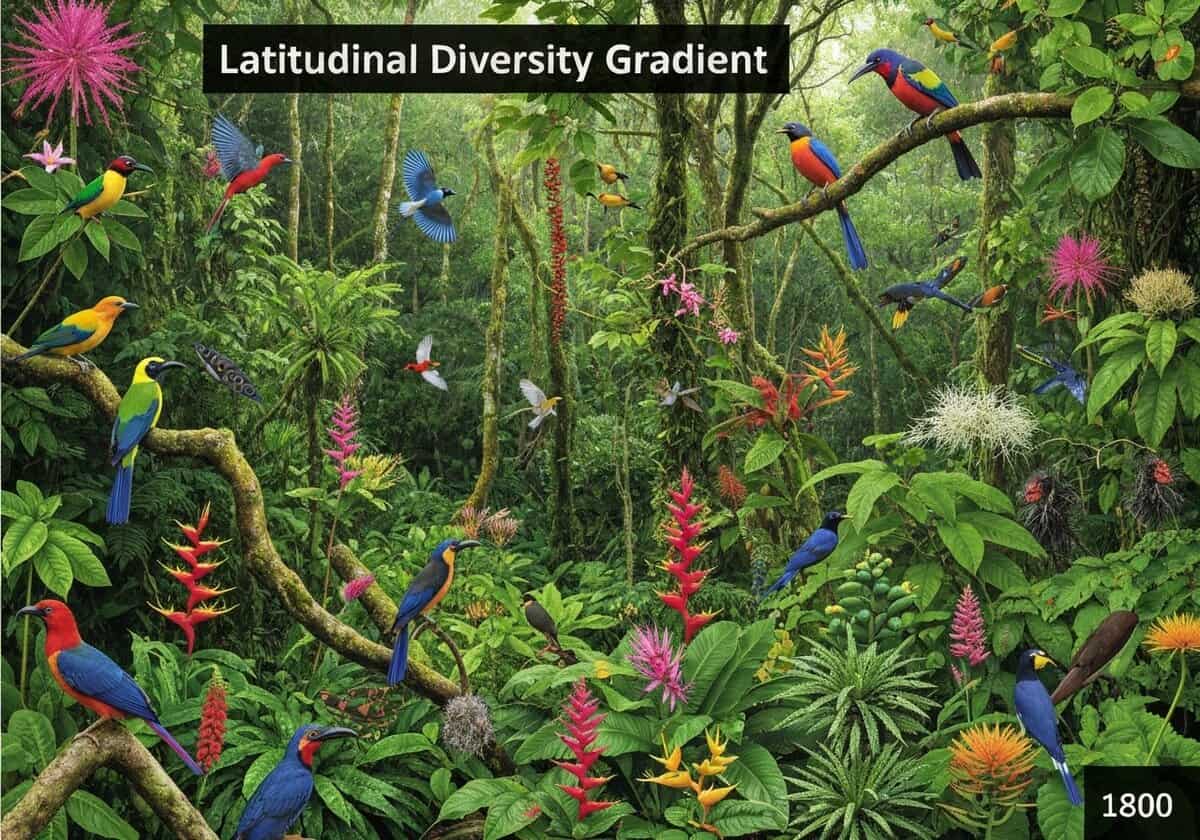
अक्षांशीय विविधता प्रवणता पारिस्थितिकी में सबसे मान्यता प्राप्त वैश्विक प्रवृत्तियों में से एक है। यह उच्च अक्षांश वाले ध्रुवीय क्षेत्रों से निम्न अक्षांश वाले उष्णकटिबंधीय क्षेत्रों तक जैव विविधता में होने वाली सामान्य वृद्धि का वर्णन करती है, जिसे प्रजाति समृद्धि के रूप में मापा जाता है। यह प्रवृत्ती स्थलीय और समुद्री दोनों वातावरणों में स्तनधारियों, पक्षियों, कीटों और पौधों सहित विभिन्न वर्गीकरण समूहों में देखी जाती है।
ध्रुवों की तुलना में उष्णकटिबंधीय क्षेत्रों में जीवन की प्रचुरता का अवलोकन प्राचीन है, लेकिन इसे 18वीं और 19वीं शताब्दी के प्रकृतिवादियों जैसे अलेक्जेंडर वॉन हुम्बोल्ट और अल्फ्रेड रसेल वालेस ने अपने अभियानों के दौरान व्यवस्थित रूप से प्रलेखित किया था। यह पैटर्न, अक्षांशीय विविधता प्रवणता (एलडीजी), तब से लगभग हर प्रमुख जीव समूह के लिए पुष्ट हो चुका है। उदाहरण के लिए, कोलंबिया, एक उष्णकटिबंधीय देश, में लगभग 1,900 पक्षी प्रजातियाँ हैं, जबकि पूरे आर्कटिक क्षेत्र में 100 से भी कम हैं। यह प्रवणता एक मूलभूत वृहद पारिस्थितिक पैटर्न है जिसके लिए स्पष्टीकरण की आवश्यकता है, और दर्जनों परिकल्पनाएँ प्रस्तावित की गई हैं, हालाँकि कोई भी सर्वमान्य नहीं है।
These hypotheses can be broadly grouped into several categories. Historical hypotheses suggest the tropics are older and have been more climatically stable over geological time, allowing more time for speciation to occur and less extinction to interrupt it (the ‘tropics as cradle and museum’ idea). Ecological hypotheses focus on current environmental conditions. For instance, the tropics receive more सौर energy, which increases productivity at the base of the food web, potentially supporting more species. The ‘climatic harshness’ hypothesis suggests that the stable, favorable conditions of the tropics allow for finer niche specialization, enabling more species to coexist. Evolutionary hypotheses propose that speciation rates are intrinsically higher in the tropics, perhaps due to faster metabolic rates driven by higher temperatures, leading to shorter generation times and more rapid genetic divergence.
Understanding the mechanisms behind the LDG is a central goal of ecology and biogeography. It is not merely an academic puzzle; it has profound implications for conservation. The gradient means that a disproportionate amount of Earth’s जैव विविधता is concentrated in tropical countries, many of which are developing nations facing significant economic and social pressures that can lead to habitat destruction. Furthermore, जलवायु परिवर्तन यह अनुमान लगाया गया है कि यह इस पैटर्न को बाधित करेगा, जिससे प्रजातियों की सीमाएँ ध्रुवों की ओर बढ़ सकती हैं और वैश्विक जैव विविधता की संरचना में ही बदलाव आ सकता है।
Related to: latitudinal gradient, biodiversity, species richness, tropics, macroecology, biogeography,
पारिस्थितिकी, alexander von humboldt, climate, speciation.