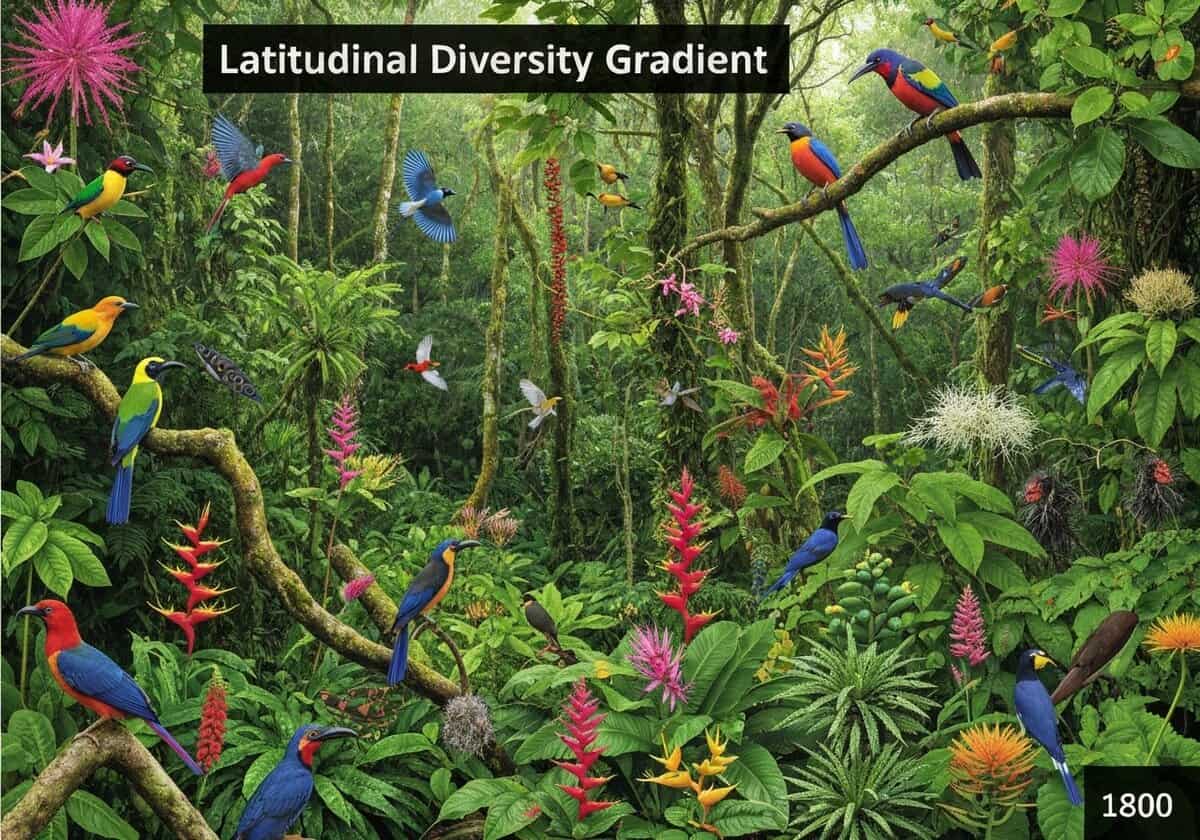
O gradiente latitudinal de diversidade é um dos padrões globais mais reconhecidos em ecologia. Ele descreve o aumento geral da biodiversidade, medida pela riqueza de espécies, das regiões polares de alta latitude até os trópicos de baixa latitude. Esse padrão é observado em uma ampla gama de grupos taxonômicos, incluindo mamíferos, aves, insetos e plantas, tanto em ambientes terrestres quanto marinhos.
A observação de que os trópicos são mais ricos em vida do que os polos é antiga, mas foi sistematicamente documentada por naturalistas dos séculos XVIII e XIX, como Alexander von Humboldt e Alfred Russel Wallace, durante suas expedições. Esse padrão, o Gradiente de Diversidade Latitudinal (GDL), foi posteriormente confirmado para quase todos os principais grupos de organismos. Por exemplo, a Colômbia, um país tropical, possui cerca de 1.900 espécies de aves, enquanto toda a região ártica tem menos de 100. O gradiente é um padrão macroecológico fundamental que exige uma explicação, e dezenas de hipóteses foram propostas, embora nenhuma seja universalmente aceita.
These hypotheses can be broadly grouped into several categories. Historical hypotheses suggest the tropics are older and have been more climatically stable over geological time, allowing more time for speciation to occur and less extinction to interrupt it (the ‘tropics as cradle and museum’ idea). Ecological hypotheses focus on current environmental conditions. For instance, the tropics receive more solar energy, which increases productivity at the base of the food web, potentially supporting more species. The ‘climatic harshness’ hypothesis suggests that the stable, favorable conditions of the tropics allow for finer niche specialization, enabling more species to coexist. Evolutionary hypotheses propose that speciation rates are intrinsically higher in the tropics, perhaps due to faster metabolic rates driven by higher temperatures, leading to shorter generation times and more rapid genetic divergence.
Understanding the mechanisms behind the LDG is a central goal of ecology and biogeography. It is not merely an academic puzzle; it has profound implications for conservation. The gradient means that a disproportionate amount of Earth’s biodiversidade is concentrated in tropical countries, many of which are developing nations facing significant economic and social pressures that can lead to habitat destruction. Furthermore, mudanças climáticas Prevê-se que isso perturbe esse padrão, podendo empurrar a distribuição das espécies em direção aos polos e alterar a própria estrutura da biodiversidade global.
Related to: latitudinal gradient, biodiversity, species richness, tropics, macroecology, biogeography,
ecologia, alexander von humboldt, climate, speciation.