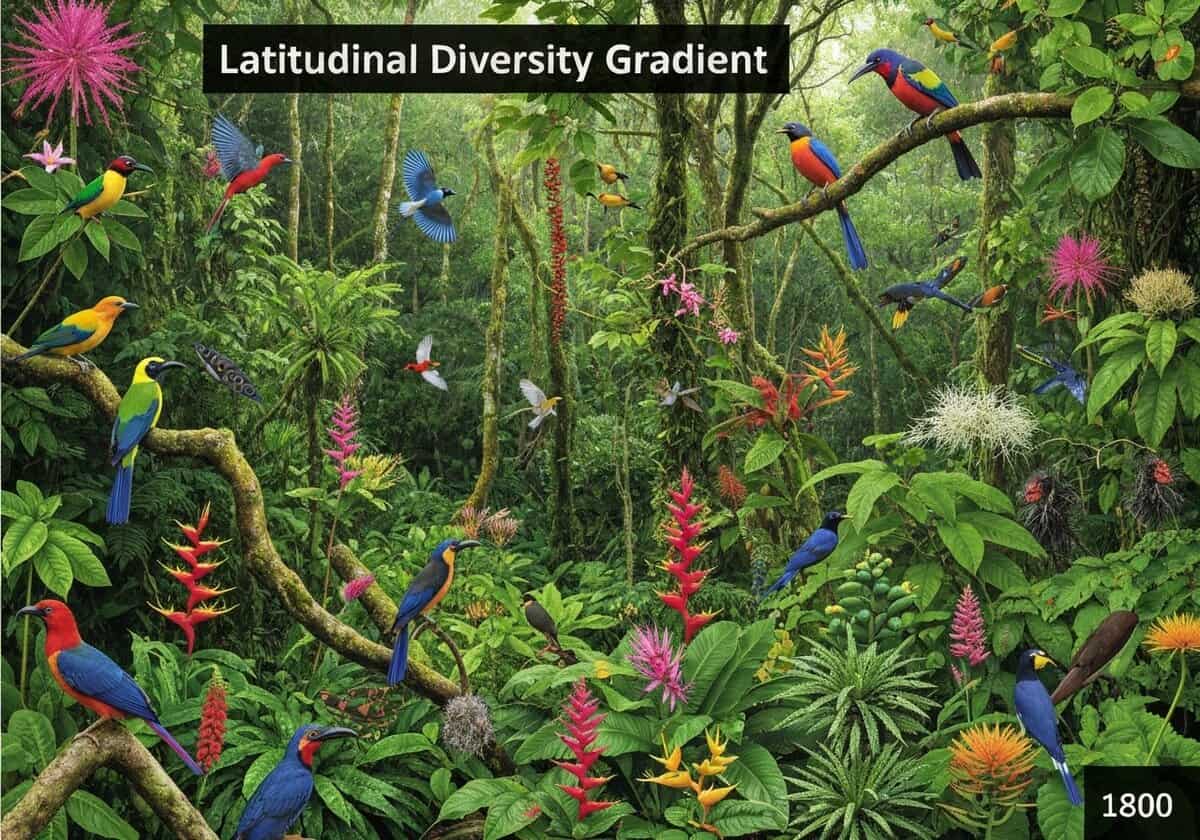
These hypotheses can be broadly grouped into several categories. Historical hypotheses suggest the tropics are older and have been more climatically stable over geological time, allowing more time for speciation to occur and less extinction to interrupt it (the ‘tropics as cradle and museum’ idea). Ecological hypotheses focus on current environmental conditions. For instance, the tropics receive more ソーラー energy, which increases productivity at the base of the food web, potentially supporting more species. The ‘climatic harshness’ hypothesis suggests that the stable, favorable conditions of the tropics allow for finer niche specialization, enabling more species to coexist. Evolutionary hypotheses propose that speciation rates are intrinsically higher in the tropics, perhaps due to faster metabolic rates driven by higher temperatures, leading to shorter generation times and more rapid genetic divergence.
Understanding the mechanisms behind the LDG is a central goal of ecology and biogeography. It is not merely an academic puzzle; it has profound implications for conservation. The gradient means that a disproportionate amount of Earth’s 生物多様性 is concentrated in tropical countries, many of which are developing nations facing significant economic and social pressures that can lead to habitat destruction. Furthermore, 気候変動 このパターンを崩し、種の生息域を極方向へ押しやり、地球規模の生物多様性の構造そのものを変える可能性があると予測されている。
using the ldg pattern to forecast ‘biodiversity velocity’ under climate change
creating ldg-informed models for predicting the spread of invasive species or diseases
developing bio-inspired materials and medicines by focusing bioprospecting on hyperdiverse tropical regions
designing global agricultural policies that leverage tropical agrobiodiversity for food security
establishing a ‘longitudinal diversity gradient’ research program to study east-west patterns
using paleoclimatic data to model how the ldg has changed through geological time
integrating the ldg into global economic models to better value ecosystem services from the tropics
developing educational virtual reality experiences that allow users to travel from the poles to the equator and see the ldg firsthand
applying ldg principles to the design of large-scale バイオリアクター or artificial ecosystems
studying exceptions to the ldg (e.g., penguins, ichneumonid wasps) to gain deeper insights into its drivers
Related to: latitudinal gradient, biodiversity, species richness, tropics, macroecology, biogeography, 生態学, alexander von humboldt, climate, speciation.