Product value analysis (VA) plays in enhancing operational efficiency across various industries, not only including physical product development but also software development, and service sectors. As companies face increasing pressure to deliver high-quality products at competitive prices, understanding the principles and methodologies of product value analysis becomes essential for engineers to optimize their processes and outcomes.
This article aims to provide a comprehensive overview of product value analysis, detailing its core principles and importance in manufacturing and design. Additionally, we will detail two of the VA methodologies, the Function Analysis System Technique (FAST) and the APTE methodology, and clarify the distinctions between value analysis and value engineering.
Key Takeaways

- Value analysis enhances product function relative to cost.
- The value equation balances function and cost effectively.
- FAST methodology improves product development efficiency.
- Value analysis differs from value engineering in application scope.
- Cost reduction strategies integrate into design and procurement first.
Definition and Core Principles
Value Analysis
Value analysis is a systematic approach aimed at improving the value of a product by analyzing its functions and associated costs. This methodology seeks to enhance the product’s functionality while minimizing costs without sacrificing quality.
Background: the origins of value analysis can be traced back to World War II, when Lawrence Miles, a General Electric engineer, developed the concept to address material shortages. His work led to a formal methodology aimed at cost reduction and efficiency improvement in manufacturing.
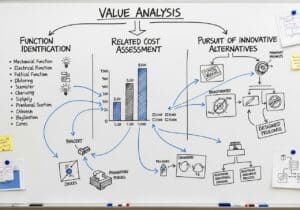
Key principles of value analysis include
- function identification
- related cost assessment
- and the pursuit of innovative alternatives.
The methodology operates under the premise that every product or service must fulfill a specific function. By breaking down these functions and examining associated costs, organizations can identify opportunities for cost savings and improvement. This structured approach encourages creative problem-solving and collaboration among cross-functional teams.

Several methodologies support value analysis, including function analysis, brainstorming sessions, and cost-benefit evaluations. These methods enable teams to gather insights, identify critical functions, and explore alternatives that enhance value.
Product value analysis extended beyond manufacturing into various industries:
- in software development, it aids in prioritizing features relative to their costs, ensuring that resources are allocated efficiently.
- in service industries, value analysis can streamline processes, improve customer satisfaction, and reduce operational costs
Tip: to maximize the benefits of value analysis, involve a diverse team from different departments. This collaboration fosters innovative thinking and leads to more effective solutions.
Functions

Defining function involves identifying the primary purpose of a product or service. Functions can be tangible, such as a car’s ability to transport, or intangible, like providing comfort.
Important note: depending on exact methodology and countries, some products parameters or specifications may not be considered as function. Typical debated examples are:
- compliance with standards
- “be safe”, “be cheap” …
Although critical and/or mandatory specifications, these are not the main usage or purpose of the product. In terms of value, it has not direct value to the user (this is why it is frequently debate with non-VA practitioners). None would buy a car because it complies to standards if the car can not drive …
Some methodologies distinguish:
- primary function -can have more than one- (transport 5 persons from A to B on roads up to 70mph during 200 miles)
- secondary functions (be able to enter the car by 4 sides, a space to put the luggage, ability to pull a caravan ….)
- constraints (meets standards, be safe, accommodate 2m height people…). Although NOT functions, these constraints can have a non-negotiable rating.
The rest of this article is reserved for members
To limit scraping bots (currently 40,000 hits per day!),
we had to restrict access to full articles and tools to registered members only.
to access all the rest.