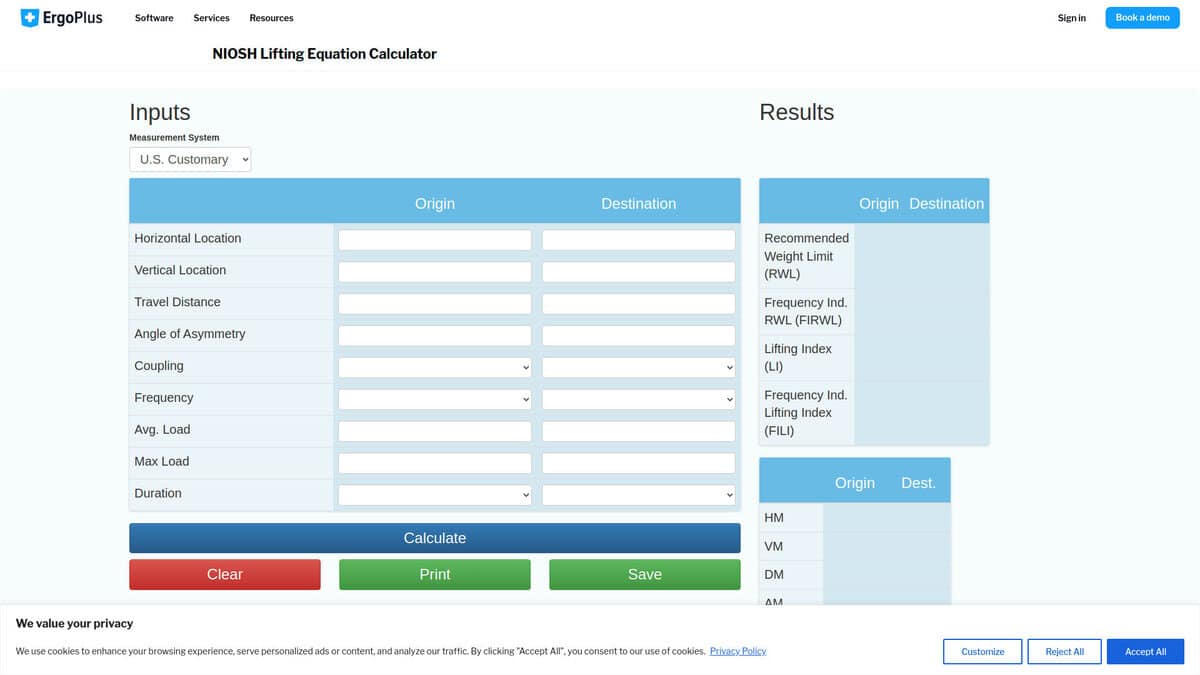
NIOSH Lifting Equation Calculator compared with the Liberty Mutual MMH tables and 3DSSPP| NIOSH Lifting Equation Calculator | Liberty Mutual MMH tables | 3DSSPP |
|---|
| Main technical fields: Ergonomics, occupational health and safety, logistics, manufacturing, warehousing and physiotherapy, where ergonomists and manufacturing engineers assess and redesign manual lifting tasks and product developers set a maximum weight for a part, a tool or a package. | Main technical fields: Industrial safety and loss prevention, since the tables were built to control the cost of manual handling injuries, and job design for lifting, lowering, pushing, pulling and carrying. | Main technical fields: Workstation and task design at an early design stage, and biomechanical analysis of product handling, as in a published case on pulling the starter cord of lawn mowers. |
| Typical expertise required: Intermediate, as no software training is needed but the user must measure the task correctly, in particular the load distance, the twist angle and the grip quality (coupling), because these drive the result. | Typical expertise required: Liberty Mutual states that basic training in ergonomics and manual handling is needed to use the tables effectively. | Typical expertise required: Advanced, as the user must reproduce the worker posture and the force direction on a 3D mannequin and interpret strength and spinal load results, and training is offered with the software. |
| Input data to collect: The load weight plus the horizontal and vertical location of the load, the lift distance, the asymmetry angle, the frequency, the duration and the coupling quality. | Input data to collect: The type of task, its frequency and its dimensions such as heights and distances, looked up in the table that matches the task and the male or female population. | Input data to collect: The body posture, the hand force parameters and the male or female body dimensions, with an automatic posture generation feature to help build the initial pose. |
| Scientific basis and validity limits: It starts from a 23 kg load constant and applies one multiplier per task variable, and it is valid for two-handed lifting only, so the result is as good as the measures entered. | Scientific basis and validity limits: The values are psychophysical, meaning loads that test subjects judged acceptable in about 11 experiments over 25 years, so they reflect perceived acceptability and not measured tissue load. | Scientific basis and validity limits: It is a biomechanical model of static postures that assumes slow movements where acceleration and momentum are ignored, so it is not valid for fast or dynamic tasks. |
| Output and decision criterion: It returns a recommended weight limit and a lifting index, which is the actual load divided by that limit, so a task can be rated at a glance and a value above 1 signals an increased risk. | Output and decision criterion: It gives the weight or force that a chosen percentage of male and female workers find acceptable, so the criterion is a population percentage and not a single index. | Output and decision criterion: It gives the percentage of men and women with the strength to do the job and the spinal compression forces, with a comparison to NIOSH guidelines. |
| Cost and tooling: It is free, runs in the browser without download or registration, and is hosted by ErgoPlus, so an assessment needs only the task measurements. | Cost and tooling: The tables are published guidance that is free to consult, and the values are looked up manually. | Cost and tooling: It is a Windows desktop program licensed commercially through VelocityEHS Humantech since 2020, so it needs a purchase and an installation. |
| When to choose it: For a quick screening of a repetitive lifting task, but it does not cover pushing, pulling or carrying. | When to choose it: For jobs that include pushing, pulling or carrying, or a design goal expressed as the share of workers accommodated. | When to choose it: For a detailed review of one posture or a workstation redesign where joint loads matter. |