Deceptive Patterns compared with Nielsen Norman Group and Interaction Design Foundation| Deceptive Patterns (deceptive.design) | Nielsen Norman Group | Interaction Design Foundation |
|---|
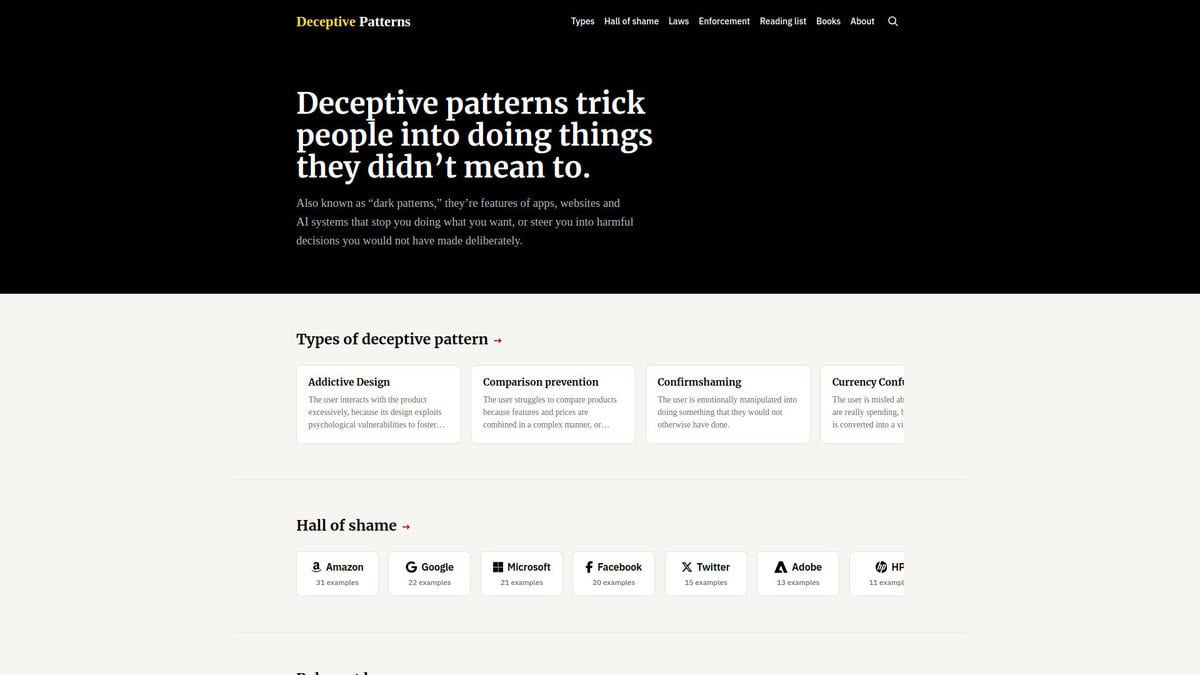
| Nature of the resource: A catalogue site, formerly called Dark Patterns, with the tagline spreading awareness since 2010. It is run by Testimonium Ltd, a company registered in England and Wales. | Nature of the resource: A UX research and training organisation. Its article Deceptive Patterns in UX: How to Recognize and Avoid Them was written by Maria Rosala and published in December 2023. | Nature of the resource: A design education institution founded in 2002, offering online courses, master classes and a library. Deceptive design is one topic among many. |
| Coverage of pattern types: Lists 18 named types, among them confirmshaming, fake scarcity, fake urgency, hidden costs, hard to cancel, preselection, sneaking and visual interference. Each type comes with real examples. | Coverage of pattern types: The article covers common groups: obstruction, visual and wording tricks, nagging, emotional manipulation such as confirmshaming, and sneaking or preselection. It also discusses sludge as added friction. | |
| Examples and legal material: Groups examples by company in a hall of shame, with the most entries for Amazon, Google, Microsoft and Facebook. It tracks laws and enforcement actions, most often the GDPR, and states that its analysis is not legal advice. | Examples and legal material: The article cites studies on prevalence, including deceptive patterns on over 10 percent of 11,000 popular ecommerce sites. | |
| Audit method: Gives evaluators precise names for each pattern, which makes written audits easier to justify. | Audit method: Recommends testing with users, running an amended cognitive walkthrough, and using a vulnerable-user persona to check designs. This is an evaluation method, not a catalogue. | |
| Access and reuse: Free to read. The site is copyrighted and asks for appropriate attribution, with instructions on how to cite it. No open licence is stated. | Access and reuse: Free article on the NN/g site. Some of the organisation training courses are paid. | Access and reuse: Membership model for courses, with a library described as a free resource. |