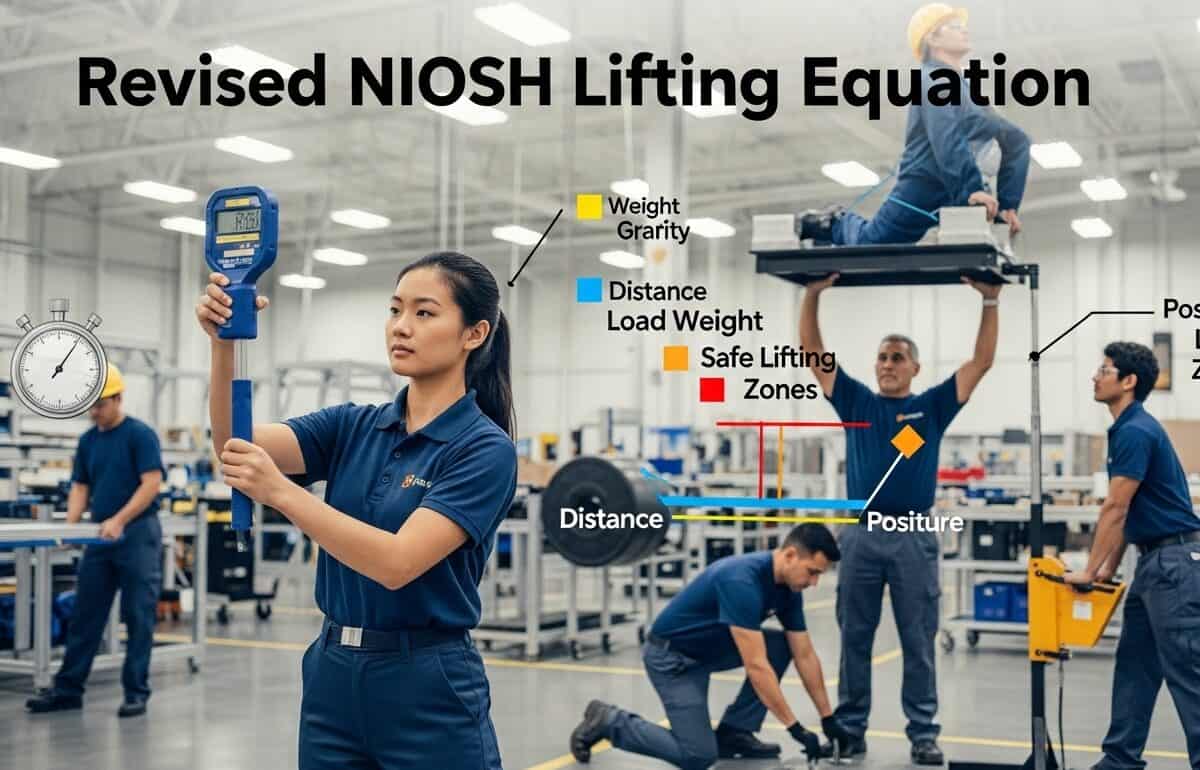
Overexertion injuries account for approximately 33% of all worker injuries, highlighting the need for effective lifting assessment tools such as the Revised NIOSH Lifting Equation. This comprehensive article will detail into the purpose and background of this equation, breaking down its individual components to provide a clearer understanding of how it enhances safety across varied industries such as manufacturing, healthcare, and construction. Readers will gain insights into data collection and measurement techniques for accurate assessments, how to calculate the Recommended Weight Limit (RWL), and the importance of the Lifting Index (LI) in risk assessment. We also will discuss implementing ergonomic controls and redesigning tasks to elevate workplace safety, while also addressing the limitations and scope of this equation in practical applications.
Key Takeaways

- Revised NIOSH equation improves assessment of two-handed lifting tasks.
- Key components include weight, distance, and posture.
- Accurate data collection enhances lifting evaluations.
- RWL calculation ensures safe lifting limits per task.
- Lifting Index indicates risk levels for workers.
- Task redesign and flows redesign is a must to mitigate ergonomic risks effectively.
About the NIOSH Institute
The National Institute for Occupational Safety and Health (NIOSH) is a federal agency in the United States that focuses on researching and providing recommendations to avert work-related injuries, illnesses, and fatalities. Established under the Occupational Safety and Health Act of 1970, NIOSH operates as part of the Centers for Disease Control and Prevention (CDC) and is dedicated to ensuring safe and healthy working environments for all employees. The agency generates new insights in occupational safety and health and applies this knowledge to enhance worker protection. NIOSH employs a diverse team of over 1,300 professionals, including specialists in areas such as epidemiology, medicine, industrial hygiene, and safety.
Background of the NIOSH Equation
The Revised NIOSH Lifting Equation was developed to provide a scientifically grounded method for evaluating and predicting the risk of injury associated with manual lifting tasks in various work environments. This evolution reflects advancements in ergonomic research, emphasizing not only the weight lifted but also factors such as lifting height, distance, frequency, and duration.
Prior to the revision, the original NIOSH Lifting Equation was often criticized for its oversimplification of lifting tasks. The updated equation addresses this by including an array of variables that affect lifting conditions, thus enhancing the predictive accuracy of potential risk.
Utilizing this comprehensive approach has been shown to reduce workplace injuries by as much as 25% in industries that implement ergonomic assessments based on this equation.
Tip: conducting a thorough ergonomic assessment using the Revised NIOSH Lifting Equation before implementing lifting tasks can significantly mitigate injury risks and enhance worker efficiency.
The Revised NIOSH (National Institute for Occupational Safety and Health) Lifting Equation is a tool used to assess the risk of low back injuries associated with two-handed manual lifting tasks.
The equation calculates the Recommended Weight Limit (RWL), which is the maximum weight that most healthy workers can lift over an 8-hour shift without increasing their risk of musculoskeletal disorders of the lower back.
The rest of this article is reserved for members
To limit scraping bots (currently 40,000 hits per day!),
we had to restrict access to full articles and tools to registered members only.
to access all the rest.