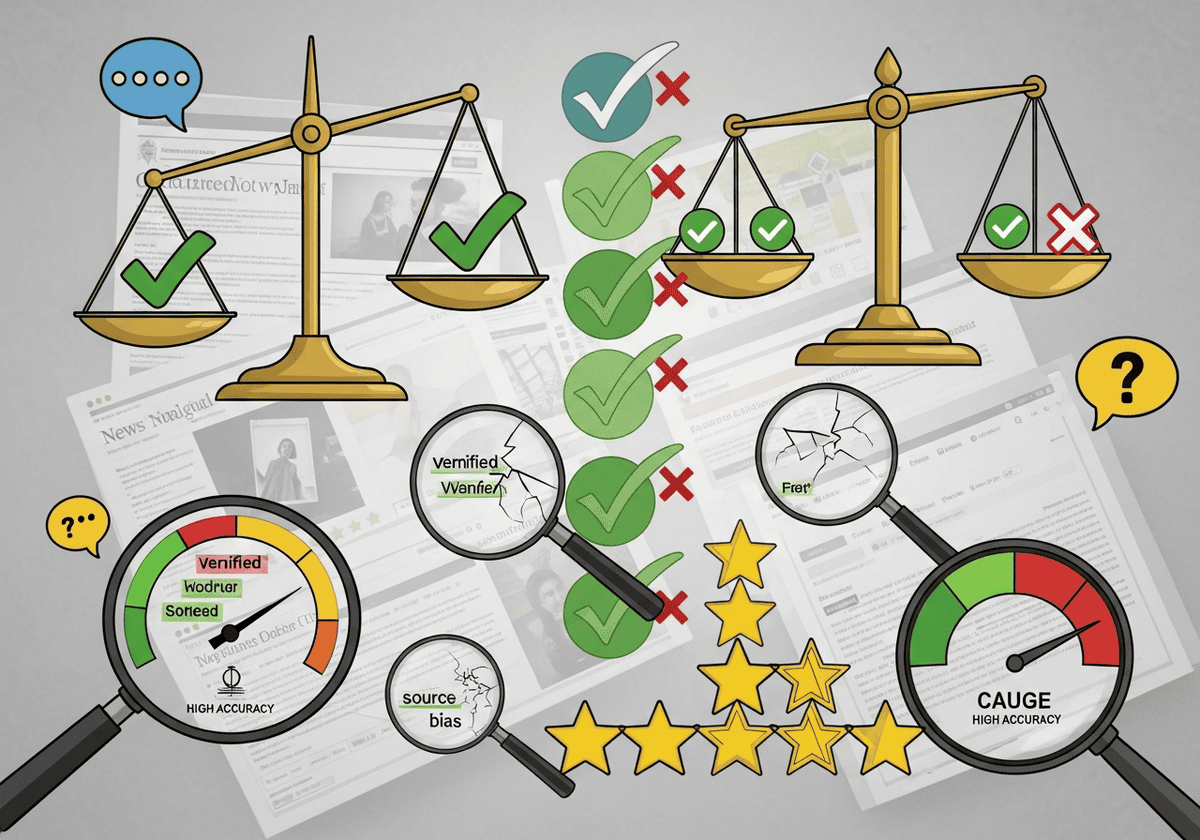

There is no single, universally accepted “master index” that rates the information quality and the accuracy of every website on the internet — nothing equivalent to a credit score for information. What exists instead is a patchwork of services built by journalists, librarians, academics, and search engines, each measuring a different slice of “trustworthiness”: some score entire publications, some score individual claims, some score the author rather than the outlet, and some are invisible algorithms you can only infer the existence of. Used together, they form a reasonably solid triangulation system. Used alone, any one of them can mislead you.
A disclaimer and a warning before you rely on any of these:
Every tool below reflects the judgment, methodology, and — in some cases — the funding sources of the organization that built it. Bias-and-accuracy raters like MBFC and Ad Fontes are themselves regularly accused of bias by people across the political spectrum. Crowdsourced systems can be gamed or brigaded. Bibliometric scores (like Impact Factor or h-index) measure citation activity, not correctness — a frequently cited paper can still be wrong, and a correct paper in a niche journal may have a low score. Even Google’s E-E-A-T is not a transparent, auditable formula; it is inferred from patent filings, leaked documents, and Google’s own vague guidance.
Treat every score below as one data point, not a verdict. Cross-reference at least two independent tools — ideally from different categories — before deciding a source is reliable or unreliable, and never let an automated score substitute entirely for your own reading of the primary material.
For full clarity, even our selection below can be argued, so as our pros, cons and comments on each one! You are welcome to comment, suggest changes, so as other tools we forgot or were not aware of > here <.
In short, despite our “Cons” or comments, if we listed a tool/site here, we thought it worths checking if it fits your purpose.
Key Takeaways
- No single authority decides what’s true online: always cross-check at least two independent sources before trusting a claim.
- Outlet-level raters and claim-level fact-checkers do different jobs: a “credible” source can still publish one false claim, and vice versa.
- Citation metrics measure prestige, not accuracy: a highly cited paper can still be wrong or later retracted.
- Paper mills and fraud have surged in academic publishing: always check a paper against retraction databases before relying on it.
- Virality is not a truth signal: content spreads based on emotional impact, not factual accuracy.
- Every rating tool reflects its creator’s methodology and biases: treat scores as one data point, not a verdict.
- Transparency is the strongest trust signal: favor sources that disclose funding, authorship, and correction policies.
- Context determines reliability: the same source can be trustworthy for one claim and unreliable for another.
- Manual judgment still matters: frameworks like CRAAP remain essential when no database covers a source.
- Slowing down beats any tool: pausing before sharing prevents more misinformation than any single fact-checker.
- Bonus basic rule of thumb: do no trust blindly what a site is claiming about itself (“we are the #1 …”).
Tip: you may find directly some of these tools in our > Online Tools Database <, either in the “Network” section or in the “OSINT” section.
Outlet-Level Credibility Raters
These tools evaluate an entire website or publication — its track record, ownership, and editorial practices — rather than any single article:
NewsGuardA commercial rating service that employs trained journalists (not algorithms) to evaluate the more than 35,000 news sources responsible for approximately 95% of all the news and information consumed and shared online across the U.S., U.K., Canada, Germany, France, Italy, Austria, Australia, and New Zealand. Each site is scored 0–100 based on nine apolitical criteria, weighted differently, that together determine the score, covering things like whether the outlet repeatedly publishes false or egregiously misleading content, corrects errors, and discloses ownership. The result is displayed as a “Nutrition Label” — a green, red, satire, or platform rating shown via a shield icon next to links on search engines and social media when the browser extension is installed. Before publishing a negative rating, NewsGuard’s analysts contact the publisher, seek comment, and give them a chance to resolve the issue or respond, and that response is published alongside the rating. Particularities: It explicitly separates satire from “fake news” — a humor or satire site is given a separate designation rather than scored on the nine criteria.
Best for: a quick, browser-level trust signal while reading news day-to-day, and for understanding who owns and funds a site. | Media Bias/Fact Check (MBFC)An independent, free, searchable database now covering over 10,000 media sources, journalists, politicians, and countries. Rates each outlet on two separate axes — political bias (left to right) and factual accuracy (very high to low) — and maintains classification categories including Fake News, Satire, Extreme Bias, Conspiracy Theory, Rumor Mill, State News, Junk Science, Hate News, Clickbait, Proceed with Caution, Political, and Credible. Particularities: It’s run by a small team rather than a large newsroom, and its write-ups for each outlet typically cite specific failed fact-checks as evidence.
Best for: a fast gut-check on whether an unfamiliar outlet has a track record of distorting facts to fit a political agenda. |
Ad Fontes Media (Media Bias Chart)A visual chart, not in the search results above but well known publicly, that plots outlets on two axes — reliability (vertical) and political lean (horizontal) — using panels of analysts from different political perspectives reviewing the same articles.
Best for: visually comparing many outlets at once rather than deep-diving on one. |
Claim-Level Fact-Checkers
These don’t rate a website — they rate a specific statement, video, or viral post.
PolitiFactA fact-checking website that rates the accuracy of claims by elected officials and others, run by editors and reporters from the Tampa Bay Times. Each claim is placed on the “Truth-O-Meter,” a scale running from True to False, with the most ridiculous falsehoods earning the lowest rating, “Pants on Fire”. Particularities: it focuses specifically on political speech — debates, ads, interviews, social posts by public figures — rather than general internet claims.
Best for: checking a specific quote or political claim you’ve seen circulating. | SnopesThe oldest and largest general fact-checking site on the internet, founded in 1994, originally focused on urban legends and now covering viral claims of all kinds. Claims are rated on a granular scale: ratings indicate whether the primary elements of a claim are demonstrably true, true but with a misleading ancillary detail, a genuine mix of true and false, false but rooted in some truth, or simply demonstrably false.
Best for: checking whether a viral photo, video, or “did you hear about…” story is real. |
FactCheck.org, AFP Fact Check, Reuters Fact Check, Lead StoriesA cluster of similar claim-checking operations, several run by major wire services. Lead Stories in particular uses its “Trendolizer” technology to identify trending content, which is then fact-checked by a team of journalists. Reuters Fact Check is a signatory to the International Fact-Checking Network’s code of principles, as is AFP’s fact-checking arm.
Best for: breaking-news-adjacent claims, especially ones spreading internationally. | https://www.afp.com/en/our-offer/afp-fact-check |
To be Noted: fact-checking organizations have faced a serious funding squeeze in the last 3 years, with the International Fact-Checking Network reporting that 45.3% of accredited fact-checkers saw revenue declines in 2025. Several major funding sources dried up around the same time: Meta ended its U.S. fact-checking partnership, USAID was shut down after a government grant freeze, and the National Endowment for Democracy suspended related grants. This left many organizations cutting staff and relying more heavily on a smaller pool of grants, even as public interest in their fact-checks kept growing.
The rest of this article is reserved for members
To limit scraping bots (currently 40,000 hits per day!),
we had to restrict access to full articles and tools to registered members only.
to access all the rest.
FAQ
What’s the single fastest way to check if a news story is true?
Search the claim’s key facts plus the word “fact check” and see if PolitiFact, Snopes, or Reuters Fact Check has already covered it. If no fact-checker has touched it yet, trace the story back to its original source rather than trusting whoever shared it.
Why can’t I just trust a website because it looks professional?
Polished design is cheap to fake and tells you nothing about editorial standards. Check who owns the site, whether authors have real credentials, and whether claims are sourced — not how the site looks.
Is a high citation count proof that a scientific paper is correct?
No. Citation counts measure influence and visibility, not accuracy, and fraudulent or later-retracted papers can rack up citations for years before anyone catches the problem. Always check whether a paper has been retracted before relying on it.
What’s the difference between misinformation and disinformation?
Misinformation is false information shared without knowing it’s false, often by accident. Disinformation is false information created and spread deliberately to deceive, usually for political or financial gain.
Can I trust an article just because it cites scientific studies?
Not automatically — check whether the cited study actually says what the article claims, since headlines often overstate or distort findings. Also check if the study was peer-reviewed, replicated, or later retracted.
How do I know if an image or video is real?
Reverse image search the photo or a key frame of the video to see where and when it first appeared online. Manipulated and out-of-context media is one of the most common ways false claims spread, so treat dramatic visuals with extra skepticism.
Are Wikipedia articles reliable?
Wikipedia itself is generally a good starting point for context, but its true value for fact-checking is the sources cited in the footnotes. Check those underlying sources directly rather than treating the Wikipedia text itself as the final word.
Why do different fact-checkers sometimes disagree?
Fact-checking involves human judgment, especially on nuanced or politically charged claims, so reasonable disagreement happens. When sources conflict, check more than one fact-checker and look at the original evidence yourself rather than picking whichever verdict you prefer.
What does it mean if a source is “peer-reviewed”?
It means other experts in the field reviewed the work before publication and judged the methodology sound enough to publish. It is not a guarantee of correctness — peer-reviewed papers are still retracted regularly, especially as paper-mill fraud has grown in recent years.
Shold I trust a claim just because it has lots of likes or shares?
No — virality measures how emotionally engaging or shareable content is, not how true it is. False claims often spread faster than corrections precisely because they’re designed to provoke a strong reaction.
How can I tell if a website has a political agenda?
Check an independent bias rating from a tool like Media Bias/Fact Check or Ad Fontes Media, and look at who funds the site and who owns it. A site can still report facts accurately while consistently choosing which facts to emphasize, so bias and inaccuracy are not the same problem.
What’s one habit that improves my judgment of online information the most?
Slow down before sharing — pause and ask who benefits if you believe this, and check the original source before reacting. Most misinformation succeeds because people share on impulse rather than because the claim is convincing once you actually check it.